
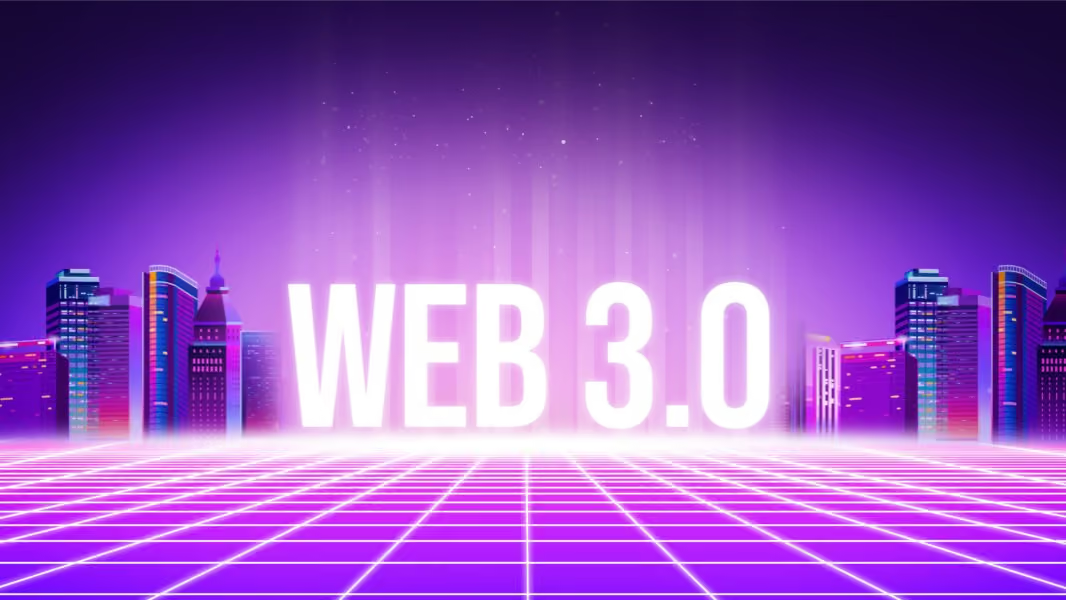
The evolution of Web 2.0 towards decentralization is very promising for users, fostering new interactions without intermediaries and giving rise to what is known as Web 3.0, a more open, permissionless, and trustless type of web, driven by blockchain technology, which is gaining increasing momentum as it breaks with everything established until now.
To understand what Web 3.0 is, what we can expect, and how blockchain technology plays a crucial role in this evolution, we must first put it into context.
With the advent of the internet and its expansion into more commercial use, Web 1.0 soon emerged, a web centered around links where most users were content consumers. This type of web was characterized by its decentralization, open protocols, and community-led governance.
Communication between participants took place on static web pages with an interface very different from what we are used to, and they were read-only, meaning they were unidirectional websites where no direct interaction existed between content creators and consumers.
In 2004, Tim O’Reilly popularized the term Web 2.0, also known as the Social Web, where users could now generate content much more simply and dynamically, as well as interact with other users to strengthen their networks and expand their impact on these new websites.
The design focuses on the user, making them much more participatory and interactive, moving participants beyond just the role of creators to become both creators and consumers of information simultaneously.
Large companies like Google, Meta, or Amazon soon realized the potential of these new websites, where the widespread adoption and participation of users, incentivized by feeling part of a community in a digital environment, gave rise to a new business model that these companies could exploit and monetize. We are referring to the data business.
Data, which until then had not played such a significant role in our society, began to be mass-collected and used to create predictive models and studies based on human and consumer trends and behaviors. These were later commercialized to other companies, allowing them to adapt their production chains, logistics, or services to societal consumption trends.
In other words, we can define Web 2.0 as the "internet" we use today, an internet dominated by large corporations that offer services in exchange for personal data, which is stored and managed centrally, and over which the user has no control.
If we reflect briefly, these large companies have prospered thanks to their community—that is, thanks to the participants who are part of these platforms and whose continuous interactions and information flows have created an ecosystem full of value.
Users are the ones who create and make these businesses possible; however, they remain in the background, in an unfavorable and unfair situation where, despite their continuous contributions, they receive nothing in return. The value they generate does not return to them, instead dissipating into the hands of a few.
This story sounds familiar!

Web 3.0 once again radically shifts what we've been doing until now, repositioning the user at the center as the creator and owner of their data and digital life, offering them power, freedom, and ownership.
To talk about Web 3.0, we have to credit blockchain technology, which, although not the only driver of this new change, is indeed the primary one. Other technologies like big data or IoT can be seen more as somewhat totalitarian technologies focused on large powerful entities rather than the everyday user.
Blockchain technology emerged with the arrival of Bitcoin, proposing to offer society a form of digital money that was uncensored, decentralized, and free from intermediaries whose monetary policies could jeopardize the asset's health. However, it wasn't until the advent of Ethereum with its smart contracts (which in turn enabled the creation of DApps and DAOs) that this collaborative technology, supported by a strong community, promoted its evolution towards more complex new systems. These systems leveraged Bitcoin's technical foundations to extrapolate its philosophy and potential to other sectors, with the goal of empowering users and disassociating from companies that previously held total control.
One of the main propositions this technology brings is offering users the freedom to conduct P2P (peer-to-peer) transactions, where information is managed and distributed across multiple points under network control, not on private company servers.
This means that information flows are now decentralized, and users can exchange value and leverage it for their own benefit and that of the rest of the community, either through traditional models replicated on this new internet or by creating new and innovative business models that were previously impossible to conceive.

In this context, we could say that Web 3.0 takes the best of Web 1.0 and Web 2.0, creating an environment open to interactions between people and machines, without centralized control points, with richer and more transparent information flows, where users are the ones who create and monetize.
To illustrate this with a clearer example, we can think of influencers who contribute their time and effort on social media, generating content to engage their followers and attract new ones. While these influencers are indeed compensated, the total value they generate remains in the hands of the platform administrators where they operate. We must consider that if these companies at some point decide to change the rules of the game and offer less compensation to their users or directly shut down their websites, it's not hard to imagine that all the work and community generated would be lost.
If Web 1.0 was based on links and Web 2.0 is based on likes, Web 3.0 is based on tokens, units of value recorded on the blockchain capable of capturing the value generated by a community and returning it for the benefit of its members.
As we already know from other articles, tokens allow any asset to be represented digitally and traded with other users without restrictions or borders. This is precisely what this new web is based on: small economies centered around users, supported and empowered by tokens, allowing participants to generate, measure, and exchange value through them.
The potential of Web 3.0 is immense, as is its application to the real estate sector, a topic we will save for another post.
Finally, I would like to remind you that Web 3.0 is currently limited and conditioned by its adoption. While we are already seeing significant inroads in some industries with lower counterparty risk, such as finance, there is still a long way to go. This path will shorten as the technology begins to consolidate in society through education, as well as with the development of much more intuitive and user-friendly platforms.
In conclusion, Web 3.0 represents a significant advancement in the evolution of the web. This new era focuses on decentralization, transparency, and user privacy, allowing for greater online security and autonomy. Blockchain technology and smart contracts are some of the pillars of Web 3.0, enabling new forms of online interaction and collaboration. As technology advances and more users adopt this new way of interacting online, we can expect Web 3.0 to have a significant impact on society and on how we interact with the digital world.


.png)

41 Av. del Oeste
Funded
-
-
Target
€763,249.36


.png)
.png)
.png)
.png)


.avif)
.avif)


