
.avif)
A prominent urban phenomenon in the last 10 years refers to gentrification, a term somewhat complex to pronounce, but one that requires analysis. This process basically occurs when a popular neighborhood with many deficiencies is gradually displaced by people with greater purchasing power, expelling its former inhabitants.
In this instance, we will analyze in detail what gentrificationis, how it originates, and what its effects are on housing prices. We will also explore its types, the causes that generate it, look at some examples, and discuss responses to combat or at least prevent it.

As we mentioned, gentrification is a process where we see the renovation of a neighborhood or urban area where housing prices rapidly increase. In this case, middle-class people begin to move into this area, and low- profitable passive income are practically forced to leave.
The term gentrification derives from the English word "gentry," which was loosely translated as "bourgeois," but this implies much more than a simple embourgeoisement of society. It implicitly involves the expulsion of the most vulnerable people and a radical change in the life of the sector or neighborhood.
This urban phenomenon presents itself as a kind of improvement in urban quality of life which, although ultimately real, benefits few. The main beneficiaries are the new residents of the neighborhood and people with high purchasing power who begin to frequent the area until they move there.
The former residents, for the most part, are displaced due to changing conditions and the increase in housing and services. In an updated context, and with the arrival of investor platforms peer to peer speculative housing opportunities are being created for tourist accommodation.
This speculation occurs partly due to the availability of Spanish real estate, which ultimately affects the smallest and cheapest housing segment and the investment in apartments. This generates a new form of exploitation that ultimately contributes, in part, to the rise in housing prices, especially rental prices.
As a result, people are popularizing two new terms: tourism-phobia and touristification, which, as processes, are directly linked to gentrification. However, the process of touristification has proven more toxic in its effects because it is replacing a population with a non-population.
This process affects much more rapidly, causing policymakers to speak of a “gentrification 4.0” with clear threats of creating dehumanized urban spaces. They also add that these areas would lack basic services for stable residents, such as commerce and affordable housing prices, among others.
It even discusses the minimum conditions for people's rest, and the situation is much more serious in tourist areas. In other words, it transforms those spaces where professionals of any kind will struggle to find accommodation near their workplace.
According to several authors, the world is facing the fourth wave of gentrification, where the classic reference point — neighborhood rehabilitation for mass appeal — is being abandoned. This allows for the expansion into new geographies, encompassing water sources, urban and rural areas and peripheries; implementing rehabilitation, destruction, and new construction.
However, the constant eviction of low-income residents remains, dispossessing them of their neighborhoods to be used for consumption, not just for housing. In this sense, there are several types of gentrification, which, based on their primary purpose, could be classified as follows:
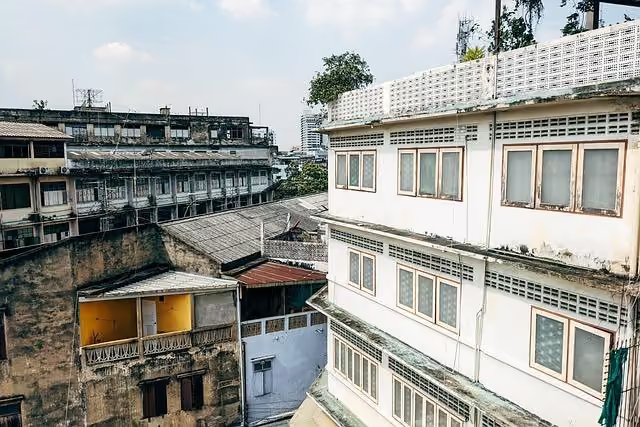
Refers to the influx of a number of middle-class students from neighborhoods and towns near a university, for example. There are known cases of studentification that eventually transform a small town into true urban centers where students are the protagonists of social change.
Small cities that have served as models or monitoring centers for establishing universities or higher education institutions are transformed into student cities. These would be some points in favor of gentrification which, as we have already seen, also generates consequences that are not entirely positive, especially for the original inhabitants.
Seen as the influx of small luxury retail businesses that arrive to replace the residential function for workers and low-income individuals. This is how the well-known minimarkets, cafes, makeshift clothing stores, and popular eateries operating out of family homes emerge.
Boutiquification eventually formalizes a type of commerce that initially began informally, because authorities "assimilate" them and demand tax payments. This generates revenue for local councils but also turns them into consumers of services that sometimes don't exist.
Defined as the transformation of neighborhoods into enclaves exclusively for tourists, often with corporate entertainment offerings. Affordable housing is replaced by accommodations, restaurants, and other services for tourist consumption, and a variant occurs with the gentrification of coastal cities.
Here, fishing villages, for example, are transformed into summer resorts and leisure centers for the local and international middle class.
A process that occurs in a cascade, from a large city, like London, for example, towards smaller cities. Towns are gradually being taken over by new residents and their new constructions, which end up transforming them into "commuter towns."
It's an influx of middle classes seeking permanent housing near the countryside, displacing farmers and rural residents. A dire consequence of this gentrification is the disappearance of agricultural and animal husbandry areas used for production and trade.
It is a process of “rehabilitation” of neighborhoods, inhabited coastlines, or residential centers in the Third World, intended for the middle classes of the First World. This neoliberal urbanism, which affects cities worldwide, is a form of neocolonization by the middle classes and the white race.
It refers to a more intense form of the phenomenon of gentrification that develops in some select neighborhoods of large cities, such as New York. This phenomenon involves more private funding, more aggressive social changes resulting in increased evictions and exclusion, and a globally connected elite.
The gentrification is a truly complex and multifaceted phenomenon that arises from a combination of economic, social, and political factors. Here are some of its main causes:
Central urban areas, offering transportation, services, and job opportunities, are highly attractive to new investors and residents.
The real estate interests of developers and investment funds, along with municipal support in many cases, contribute to fostering this phenomenon.
Young professionals, artists, and other upper-middle-class individuals migrate to accessible neighborhoods, bringing energy and attracting others.
The search for genuine and authentic neighborhoods, allowing people to move away from suburban areas.
Government plans and projects aimed at revitalizing deteriorated urban areas certainly boost the gentrification, attracting investment and infrastructure improvements.
The rising cost of living and inflation in other areas of the city can transform previously less attractive neighborhoods. Access to mortgage loans and financing for acquisition and renovation facilitates the purchase and improvement of properties in these neighborhoods, and also makes it easier to invest in real estate with little money
The popularity of digital platforms for short-term rentals increases housing demand in some areas, driving up prices and promoting touristification.
The lack of affordable housing in certain parts of the city puts pressure on residents to seek options in more affordable neighborhoods. Investors buy properties because they know they can quickly increase their property value , and this displaces lower-income individuals.
The main consequence generated by gentrification is the process of displacing people from a specific neighborhood to more affordable areas. It is quite common to see this "mass exodus" from central areas to the periphery; it can even be observed how peripheral neighborhoods themselves become "gentrified."
We are also seeing how the process of gentrification affects the uses of the affected area, with it becoming increasingly "normal" for some neighborhoods to have a reduced stable population. The result is a radical change in the type of commerce, where basic services and living conditions, such as peaceful nights, disappear.
Another consequence of gentrification is the increase in commuting between the periphery and central areas. This is because a large number of people must travel from their homes to their workplaces, which offer a greater variety of cultural and recreational services.
This drastically affects long-term rentals, which end up decreasing in availability and becoming considerably more expensive, and the stable population begins to be replaced by a transient population. Then, basic services increase, and businesses designed to meet some visitor needs disappear, which reduces the offerings for regular residents.
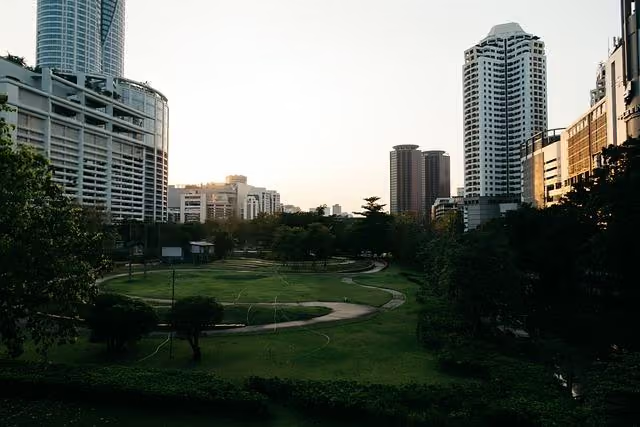
There is a case that is already considered a "classic" example of gentrification, such as Puerta del Ángel, Carabanchel, or Usera, in Madrid. Here, one can observe how the income from rent per capita of its inhabitants increases, as does the rental price.
Another example can be seen in the Malasaña neighborhood, which went from being abandoned during the 80s and 90s to becoming attractive to young creatives. The cases of Lavapiés, La Latina, Huertas, and Chueca neighborhoods, also in Madrid, are also well-known, representing a type of "spontaneous" and natural gentrification.
Regarding "Airbnb gentrification," a consequence of more radical changes, an example would be Barcelona, where tourism displaced many citizens. This altered the configuration, uses, and services in areas like Malasaña or Chueca, which transitioned from spontaneous gentrification to tourist gentrification.
There are many examples of gentrification in Spain, as the boundaries of real estate investment are increasingly disappearing due to attraction policies, the tokenization of properties, real estate crowdfunding, and investment. Ultimately, to try and view gentrification as something positive, it would be a matter of weighing the pros and cons and analyzing them.
It's an open secret that low-income citizens are forced to leave their rental homes to find more affordable ones. It remains to be seen if decision-making authorities are capable of legislating in favor of those most in need – a prospect some call hope.
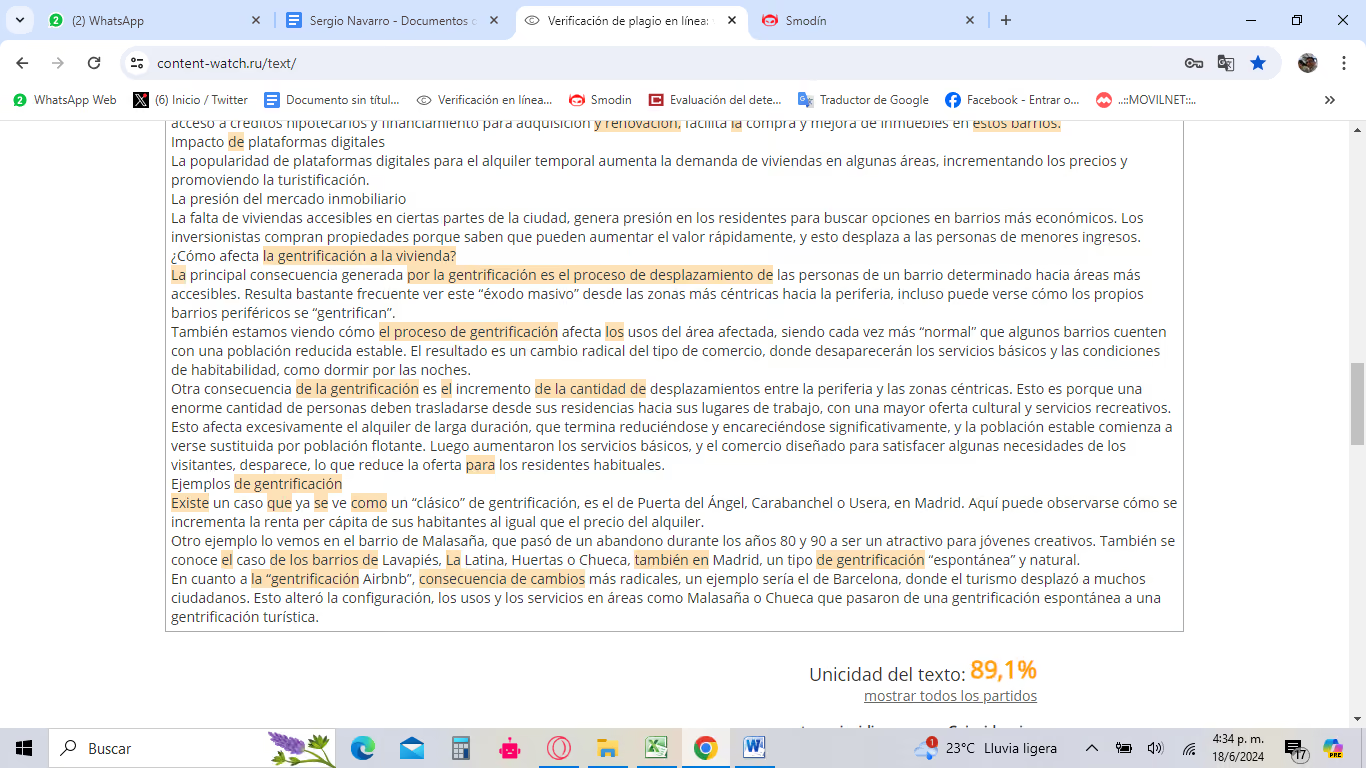
Plagiarism check:
AI check:



.png)

41 Av. del Oeste
Funded
100%
763.249,36 €
Target
€763,249.36


.png)
.png)
.png)
.png)




.avif)
.avif)
.avif)


