
The IRAV, or Residential Rent Reference Index, is something you should know about as a tenant. Today we’ll explain EVERYTHING you need to know about this index, which is used to calculate your rent.

If you only have a minute, here are the key points about the IRAV. What it is: an index compiled monthly by the INE that sets the maximum amount by which rent can increase during the annual adjustment. Therefore, when asked what the IRAV is in the context of rent, the short answer is that it’s the legal cap on that adjustment—not a tax. Who it applies to: residential lease agreements signed after May 26, 2023, that include an adjustment clause. Previous contracts: These have been adjusted using the CPI or another agreed-upon index, although as of October 8, 2026, Royal Decree-Law 29/2026 also sets the IRAV as the limit for them (see below). How the increase is calculated: The most recent IRAV published at the time the adjustment is notified is applied to the rent. What is the current IRAV? The latest figure, from September 2026, is 2.54%, published by the INE on October 14, 2026.

The Residential Rental Reference Index (IRAV) is a new index created by the INE (National Institute of Statistics). Its primary purpose is to adjust rent in residential lease agreements.
In 2025, the IRAV replaced the well-known CPI as the benchmark for calculating any increase in apartment rent. It took effect for contracts signed after May 26, 2023.
This table or index is calculated monthly, and its value serves as the maximum limit for rent adjustments. However, for all contracts signed before May 26, 2023, rent adjustments are governed by the CPI.
You may be interested in: how to draw up a lease agreement.
The IRAV originated from the need to comply with Law 12/2023, which addresses the right to housing. The intention was to replace the CPI (Consumer Price Index) used to regulate rental contracts.
However, the primary objective is to cap rent increases, especially in an environment of high inflation. This provides greater stability to the real estate market.
IRAV, VAT, and ISLR differ significantly and should NOT be confused when applying them. In the following box, we will provide a comparative analysis, highlighting their differences to clarify these concepts.
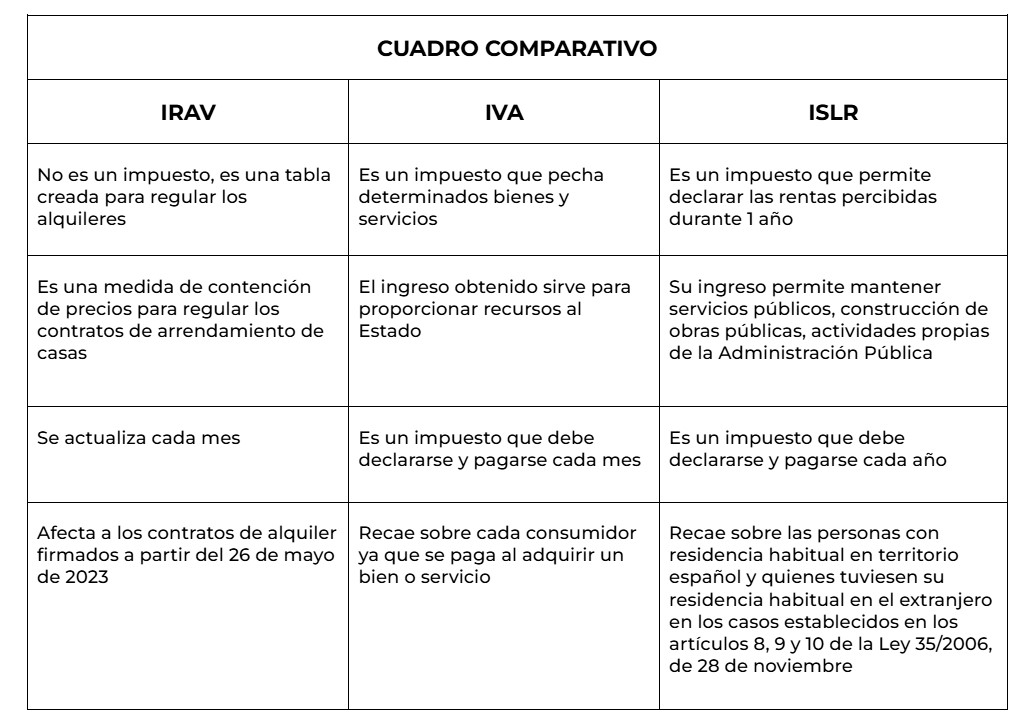
The Residential Rental Price Reference Index is NOT a tax that is paid, but rather an index that regulates rental prices. It applies to certain areas of the residential market experiencing high demand.
In this regard, there is no legal obligation to pay the IRAV, but certain landlords are required to apply its limits when setting or adjusting rental rates for a dwelling.
The IRAV, or Residential Rental Price Reference Index, does not apply to all rental agreements. There are some exceptions, such as agreements signed before May 25, 2023.
But let’s take a closer look at other exceptions:
You may be interested in: large property owners in Spain.
The exact formula is quite technical and must be published in the BOE (Official State Gazette). The goal is to ensure there are no doubts about the reality of the residential rental sector.
At the end of the day, the goal is simply to strike a balance between tenant protection and property rights. The best way to explain how the IRAV is calculated is through a practical example.
Let’s suppose a lease agreement was signed for a house in Buñol in June 2024, with a monthly rent of 900 euros. When the first year ends in June 2025, the landlord will likely want to increase the rent.
In that case, the landlord or property owner must follow these steps:
NR = 900 € + (900 € * 2.15 / 100) = 900 € + 19.35 € = 919.35 €
However, this new calculation has some implications and considerations that should not be overlooked:

For the tenant, the answer to whether the CPI or the IRAV is better lies in the formula itself. The IRAV takes the lower of the general CPI, the core CPI, and an adjusted average of the two, so it never exceeds inflation. In September 2026, the difference was clear: the CPI stood at 4.9% and the IRAV at 2.54%. For the landlord, it’s not a choice, because the applicable index is set by law. If you’re wondering how to calculate the IRAV for 2026, there’s no need to calculate the index: simply consult the latest data published by the INE and apply it to the rent, as in the previous example. Now, by how much can you raise the rent this year? For rent adjustments taking effect between October 8, 2026, and December 31, 2027, Royal Decree-Law 29/2026 imposes an extraordinary cap. If the rent already exceeds the maximum set by the state system of reference indices for rent prices, it cannot be raised. If it does not exceed that maximum and there is no new agreement between the parties, the maximum increase is 2%. With an agreement, the cap remains the IRAV. This sets the maximum increase for a €900 monthly rent, such as the one in the example, in 2026: €918 per month without a new agreement, or up to €922.86 with an agreement and the September IRAV. This decree is pending approval by Congress, so it’s advisable to check its status before notifying tenants of any increase.

We recommend checking the IRAV on the INE (National Institute of Statistics) website. It is supposed to be published monthly, usually around the middle of the month, and should reflect the data from the previous month.
You can also check the IRAV using the official calculator provided by the Ministry of Housing. This ministry has set up a webpage that provides transparency regarding updates to the maximum rent, in accordance with current legislation.
As mentioned above, the IRAV is NOT a tax that must be reported or paid directly. It is an index created to regulate rental prices in high-demand areas.
In effect, it adjusts any income you may receive from rent. This income MUST subsequently be reported on your IRPF (Personal Income Tax) return.
You may also be interested in: 2025 reference value.
To ensure compliance with the IRAV, here are some specific and practical recommendations:
If you’re a landlord and wondering how to apply the IRAV, the process for adjusting rent in Spain is always the same. First, check that the lease includes an adjustment clause, because without it, the rent cannot be increased. Next, wait until the lease anniversary, use the most recent published index, and calculate the new rent. How should I notify my tenant? In writing and at least one month in advance, as in the case study, specifying the index used, the percentage applied, and the new amount. It’s best to use a method that leaves a paper trail, such as a certified fax (burofax) or an email with a read receipt. What if I think the increase is illegal? If you’re a tenant, check the signing date, the clause, and the index applied, and compare them with the official sources we’ve mentioned (INE and the Ministry of Housing). If the numbers don’t add up, notify the landlord in writing while continuing to pay the rent that is not in dispute. If you cannot reach an agreement, contact the housing office in your autonomous community, a consumer association, or a lawyer.

As of May 2025, it is 1.99%, according to the INE.
You must update it annually, based on the figure published by the INE in May.
In writing, with at least one month’s notice prior to the lease renewal date, applying the IRAV (1.99%) for leases entered into after May 26, 2023.
No, not in high-demand areas, except in certain cases—such as improvements that justify an additional 10%. However, small landlords may maintain the previous rent, which must have been adjusted by 3% by 2024.
Landlords may be subject to fines ranging from €90,001 to €900,000 if the rent exceeds the IRAV limit by more than 30% in high-demand areas.
Yes, the IRAV must be used when adjusting contracts signed on or after May 26, 2023. However, for earlier contracts, the increase is capped at 3% in 2024.
Domoblock is transforming your access to the real estate market—today, you don’t have to set aside a large sum of money to be part of a profitable project. Just €200 is enough for an initial investment in carefully selected properties.
Your potential returns will exceed 10% within 8 to 12 months, thanks in large part to Domoblock’s simple and transparent design. This allows you to manage your investment digitally, securely, and 100% online.
Its model, based on real estate tokenization and real estate crowdfunding, allows you to diversify your portfolio without any complications. If you have a specific financial goal, Domoblock can help you choose the option that best suits your risk tolerance.
Have you thought about a specific financial goal? Domoblock is the real estate investment platform that helps you identify the opportunities best suited to your risk tolerance. Professional advice combined with efficient management ensures a secure and profitable experience.
Check out our real estate investment projects in Madrid, Alicante, Zaragoza, and Valencia.
Invest today starting at just €200 and grow your wealth safely, efficiently, and with Domoblock. With Domoblock, all of this is possible—and hassle-free. It’s time to sign up and transform your financial future!
If you’re considering renting a home, remember to apply the IRAV, and if you need advice, just contact us—consult with the experts at Domoblock!
The best investment of your money will always be the one you’ve carefully considered and discussed with those who know the selected sector—be one of our lucky investors.



Pedro María Ric, 5
Funded
Target
€550,012.94