

What is dividend investing? It involves buying shares in companies that distribute a portion of their profits to shareholders. In Spain, these dividends are taxed at the savings tax rate for personal income tax, ranging from 19% to 30% in 2026, with a 19% withholding tax upon receipt. A dividend is not guaranteed: the company may reduce or eliminate it.
At Domoblock, we don’t invest in stocks, but in real estate; however, we speak daily with investors seeking passive income who are comparing their options. That’s why we’re focusing here on what’s most often overlooked: taxes, dates, and risks.
Dividend investing is a popular strategy among investors seeking to generate long-term passive income. Here at Domoblock, we’ll explain what dividends are, how they work, and the key factors for choosing dividend-paying stocks in 2026. If you’re looking for a way to grow your wealth and receive regular payments, dividend investing is an option worth considering—though it does come with risks.

Dividend investing involves buying shares in companies that regularly distribute a portion of their profits to shareholders in the form of dividends. Dividends are cash payments or additional shares that you receive as a shareholder. These payments are typically made quarterly, semi-annually, or annually, depending on the company’s dividend policy.

When you invest in dividends, the main goal is to generate a passive income stream through regular dividend payments. To get started, you should select stocks from companies that have a solid track record of paying dividends and stable growth potential. Once you own the shares, you’ll receive regular dividend payments, which you can reinvest to buy more shares (and take advantage of compound interest) or use as additional income.
There are different types of dividends that companies can offer their shareholders. Here are some examples:
Type 1 dividends are the most common and are paid in cash. Companies distribute a fixed amount of money per share to shareholders. This type of dividend is ideal if you’re looking for regular cash income.
Type 2 dividends are stock dividends. Instead of receiving cash, shareholders receive additional shares of the company as payment. This type of dividend can be beneficial if you’re looking to increase your stake in the company without spending additional money.
Type 3 dividends are special dividends. This type of dividend is paid in exceptional situations, such as when the company earns extraordinary profits or sells significant assets. Special dividends are typically one-time payments and do not recur on a regular basis.
Here are some companies known for their dividend history. These are examples to help you understand what to look for—not investment recommendations: each case depends on your profile, and past performance does not guarantee future dividends.
Johnson & Johnson is one of the leaders in its sector and has a solid track record of paying dividends. According to the company itself, it has increased its dividend for more than 60 consecutive years.
GlaxoSmithKline, now GSK, is a good example of why a track record isn’t enough: in 2022, it reduced its dividend after spinning off its consumer business, which began trading as Haleon. Investors who had bought the stock solely for the dividend saw their income decline.
IBM, whose origins date back to 1911, is one of the oldest companies on the U.S. stock market. According to the company itself, it has increased its dividend for more than 25 consecutive years, though that doesn’t guarantee it will continue to do so.
That’s why we’re skeptical of “best stocks” lists. In real estate, as Sergio says, the hardest part is “finding the opportunity,” and the same is true in the stock market: what was true two years ago may no longer be the case.
When choosing the best stocks for dividend investing, it’s important to consider several key factors:
Research the company’s dividend payment history. Look for companies that have paid dividends consistently and have increased their dividends over time.
Assess the company’s growth potential. Look for companies with a strong market position and a track record of steady growth. These companies are more likely to generate sustainable long-term earnings.
Analyze the company’s financial health. Verify that the company has sound financial management and low debt. This makes it more likely that the company will be able to continue paying dividends in the future.
Dividend investing offers several advantages to investors:
Passive income: Dividend investing allows you to generate a steady stream of income without having to sell your shares.
Capital growth potential: In addition to receiving regular dividend payments, you also have the opportunity to benefit from the long-term growth in the net asset value of the shares.
Protection against inflation: Dividends tend to increase over time, which can help you maintain your purchasing power even during periods of inflation—though they don’t always do so: with inflation at 4.9% in October 2026, according to the INE’s leading CPI indicator, a dividend that does not increase loses purchasing power.
However, there are also some disadvantages associated with dividend investing:
Market risk: The value of company stocks can fluctuate due to economic and market factors, which can affect the stock price and, ultimately, dividend yields.
Dividend taxes: If you reside in Spain, dividends are always subject to personal income tax (IRPF), and dividends from foreign companies may also be subject to withholding tax in the country of origin, which can reduce your earnings.
Dependence on the company: The amount and frequency of dividend payments depend on the company’s dividend policy. If the company decides to reduce or eliminate its dividend payments, this may affect your passive income.
This is the main factor that separates the advertised returns from what actually reaches your account. These are the rules in effect in 2026:
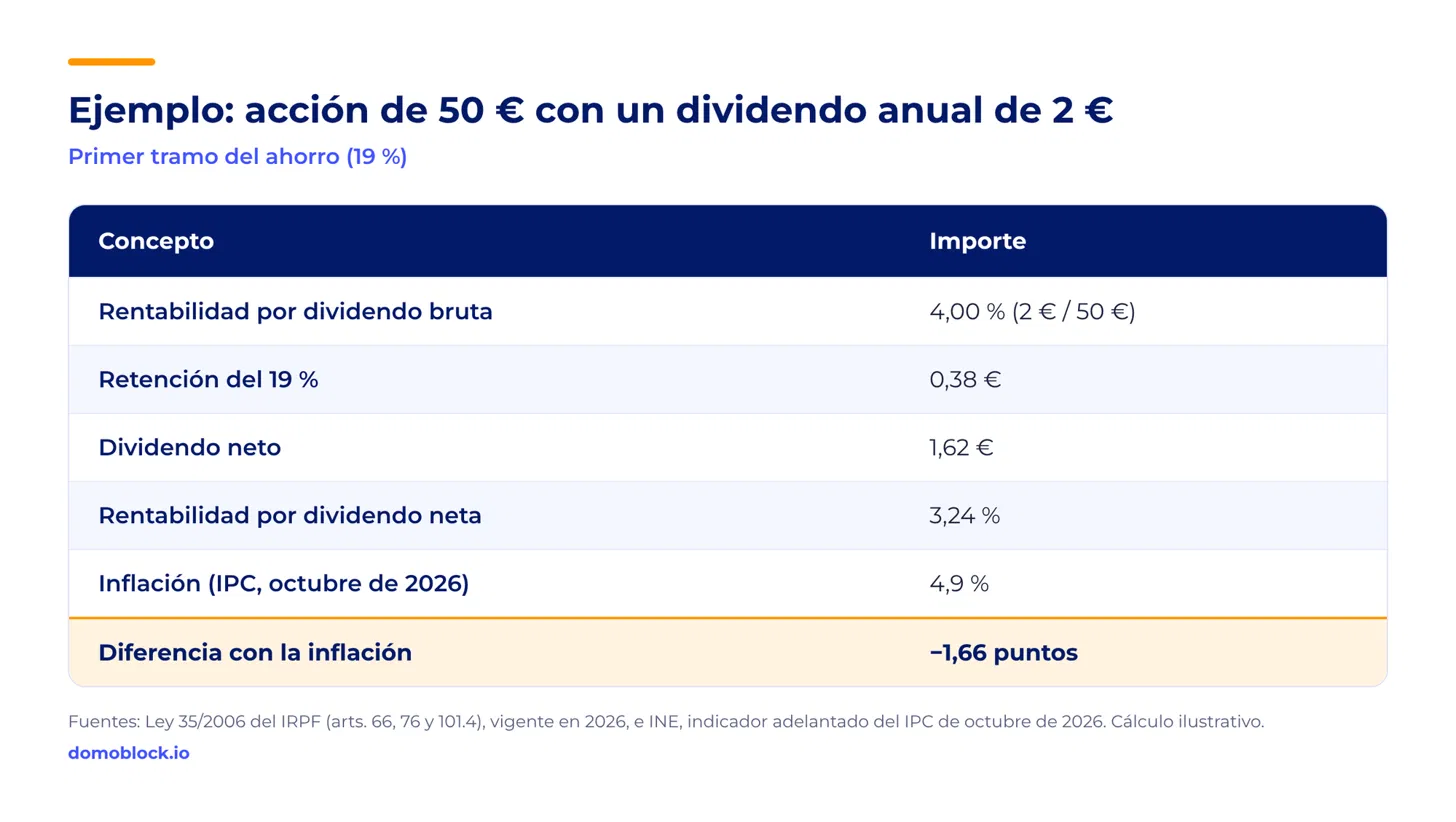
And here’s a nuance that’s often overlooked: on the ex-dividend date, the stock price typically adjusts by approximately the amount of the dividend, because that money leaves the company. The dividend isn’t extra money. It’s the same as what we see in real estate: what counts is what’s left after costs and taxes.
Investing in stocks involves risks, including the potential loss of principal, and dividends may be reduced or discontinued.

Finding stocks that offer attractive dividends may require a bit of research and analysis. Here are some steps you can take to find these stocks:
Investing platforms often offer stock screener tools that allow you to filter stocks based on specific criteria, such as dividend yield. You can set a filter to show only stocks that have a minimum desired dividend yield.
Look for companies that have a stable track record of paying dividends over several years. You can review companies’ financial reports to see how much their dividends have increased over time.
Don’t just focus on the dividend yield; also consider the company’s ability to maintain that dividend in the future. Evaluate key financial indicators such as the dividend payout ratio and dividend coverage ratio to determine whether the company has the financial flexibility to continue paying dividends.
Some sectors tend to offer higher dividend yields than others. For example, utilities and real estate companies typically have higher dividend yields due to the nature of their businesses. However, it’s also important to consider the sector’s stability and growth potential. If you’re interested in publicly traded real estate, we’ll explain what REITs are.
There are several lists available online that highlight stocks that have increased their dividends for several consecutive years. These stocks are often viewed as financially sound companies committed to their shareholders.
Financial analysts and investment experts often offer recommendations on stocks they believe offer attractive dividends. You can read research reports and market analysis to get ideas on stocks with dividend potential.
Instead of betting on a single stock, consider diversifying your portfolio by investing in several stocks that offer attractive dividends. This can help reduce risk and increase the stability of your dividend income.
As you conduct your research and analysis, always remember to consider your own risk profile, time horizon, and investment goals before making investment decisions.
To receive stock dividends, it’s essential to know the key dates and requirements that determine eligibility. Here are the details you need to know:
If a company declares a dividend with an ex-dividend date of July 10, you must purchase the shares before the market closes on July 9 to be eligible to receive the dividend. If you purchase the shares on July 10 or later, you will not receive the dividend.
In the U.S., stock trades settle one business day (T+1) after the trade date, effective May 28, 2024, following the reform of SEC Rule 15c6-1. Since then, the ex-dividend date has coincided with the record date: to receive the dividend, you must purchase the shares no later than the preceding business day.
In the European Union, Regulation (EU) 2025/2075 moves settlement to T+1 effective October 11, 2027, so dividend dates for European stocks will also need to be adjusted. If you invest in stocks on both sides of the Atlantic, always check the ex-dividend date published by your broker.
To receive a stock dividend, you must:
Once the ex-dividend date has passed, you can sell the shares and still be eligible to receive the dividend, since the company will verify the list of shareholders as of the record date.
In summary, to receive dividends on your shares, you must ensure you own them before the ex-dividend date and hold them until that date. This ensures that your name is on the record date and, therefore, that you are eligible to receive the payment on the payment date.
Investing in individual dividend-paying stocks and dividend-focused mutual funds are two different approaches to generating dividend income. Here are some key differences between the two:
When you invest in individual dividend-paying stocks, you’re exposed solely to the performance of those specific companies. Diversification is limited to the stocks you choose to buy.
Dividend-focused mutual funds typically have a diversified portfolio that includes multiple stocks of dividend-paying companies. This provides greater diversification and can help reduce the risk associated with investing in individual stocks. Additionally, if the fund is a tax-deferred fund, it does not distribute dividends to you, and you do not pay taxes until you redeem your investment; you can also switch funds without paying taxes thanks to the tax-free transfer rule (Article 94 of the Personal Income Tax Law).
Managing your portfolio of individual stocks is entirely up to you. You must conduct the necessary research and analysis to select the right stocks and decide when to buy or sell.
Investment funds can be managed actively or passively.
Actively managed funds are run by fund managers who make investment decisions with the goal of outperforming a benchmark index.
Passively managed funds, such as exchange-traded funds (ETFs), simply track a benchmark index and do not require ongoing active management.
You can buy and sell individual stocks through a brokerage platform, which may involve transaction fees and other costs.
Mutual funds may have management fees and other associated expenses. These costs can vary depending on the type of fund and the management approach.
Access to professional management:
As an individual investor, you are responsible for making all investment decisions related to your stock portfolio.
Dividend-focused mutual funds: When you invest in a fund, you have access to professional management by fund managers. These professionals may have the experience and expertise to help optimize your dividend portfolio.
In summary, the choice between investing in individual dividend-paying stocks, a dividend fund, and dividend-focused mutual funds depends on your personal preferences, comfort level with active investment management, and specific investment goals. Both approaches have their own advantages and disadvantages, so it’s important to carefully evaluate your options before making an investment decision.

If you’re looking for passive income, you should know that at Domoblock we don’t invest in stocks or pay dividends. We’re a real estate investment platform based on real estate tokenization: we buy homes below market value, renovate them with energy efficiency in mind, and sell them (house flipping), and we also engage in building flipping (conversion to residential use) and new construction.
Your investment, starting at €200, is structured as a participatory loan. Your return depends on the outcome of each project—typically lasting 6 to 12 months—rather than on periodic profit distributions. For tax purposes, it is treated similarly to a dividend: it is taxed as investment income under the savings tax bracket, with a 19% withholding tax.
There are no direct costs to the investor: you pay nothing directly, and Domoblock charges a 5% management fee, which is included in the project costs. The historical IRR of our projects is +15% annually; this is historical data and does not guarantee future returns. If you’d like to compare models, we’ll also explain what real estate crowdfunding is.
Before investing, please consider the risks: the return on each project is an estimate; there is no secondary market, so your capital remains tied up until the project closes; there may be delays in construction or sales, and you could lose some or all of your capital, which is not covered by the Deposit Guarantee Fund. Domoblock does not offer financial instruments regulated by the CNMV.
In 2026, dividends are taxed as savings income for personal income tax purposes: 19% on amounts up to €6,000, 21% on amounts up to €50,000, 23% on amounts up to €200,000, 27% on amounts up to €300,000, and 30% on amounts above that. When you receive them, 19% is withheld at source, which you can then claim as a credit on your tax return.
It’s the annual dividend divided by the share price. If a share costs €50 and pays out €2 per year, its dividend yield is 4%. Note: A very high yield may be due to the share price having fallen significantly, not because the company is more generous.
In theory, yes. On the ex-dividend date, the stock price usually adjusts by approximately the amount of the dividend, because that money leaves the company. That’s why buying right before the ex-dividend date to collect the dividend usually doesn’t pay off: you receive the dividend, but the stock is worth less, and you also have to pay taxes.
They may be subject to withholding tax in the country of origin and also taxed in Spain. This double taxation is offset by a deduction on your personal income tax return (Article 80 of the Personal Income Tax Law). For U.S. stocks, filing Form W-8BEN reduces the withholding tax at source from 30% to 15%.
It depends on your time horizon and your net worth. A fund spreads the risk across many companies, and if it’s a reinvestment fund, you don’t pay taxes until you redeem your shares, and you can transfer them without paying taxes. With individual stocks, you make your own choices, but you assume more risk and pay taxes every time you receive a dividend.
Dividend investing can be a useful strategy for generating profitable passive income over the long term. By investing in stocks of companies that pay dividends, you can benefit from regular dividend payments, the potential for capital growth, and some protection against inflation. However, it’s also important to consider the risks and drawbacks associated with this strategy. If you’re interested in dividend investing, be sure to do thorough research and consider the investment options that best suit your financial needs and goals.
Sources
This article is for informational purposes only and does not constitute tax, legal, or financial advice, nor is it an investment recommendation. Past performance is no guarantee of future results. All investments involve risks, including the partial or total loss of principal: consult a professional regarding your specific situation.



Pedro María Ric, 5
Funded
100%
€550,012.94
Target
€550,012.94