


Where to invest in 2024 is a recurring question, especially among small investors. After two years of a global pandemic, the outbreak of war between Russia and Ukraine, and rising inflation have destabilized markets.
In addition, two factors stemming from poor investments have contributed to this. On the one hand, many small investors panicked and, poorly advised, began selling their assets during the COVID-19 crisis, worsening the situation. On the other hand, a large number of speculators who had invested almost all their assets in cryptocurrencies saw them lose up to 70% of their value throughout 2022.
Therefore, with a new year that still looks challenging, marked by 9% inflation in Europe, political instability, and the fuel crisis, deciding wisely where to invest in 2024 takes on particular importance.
One must be aware that where everyone sees a crisis, there can be a good opportunity.
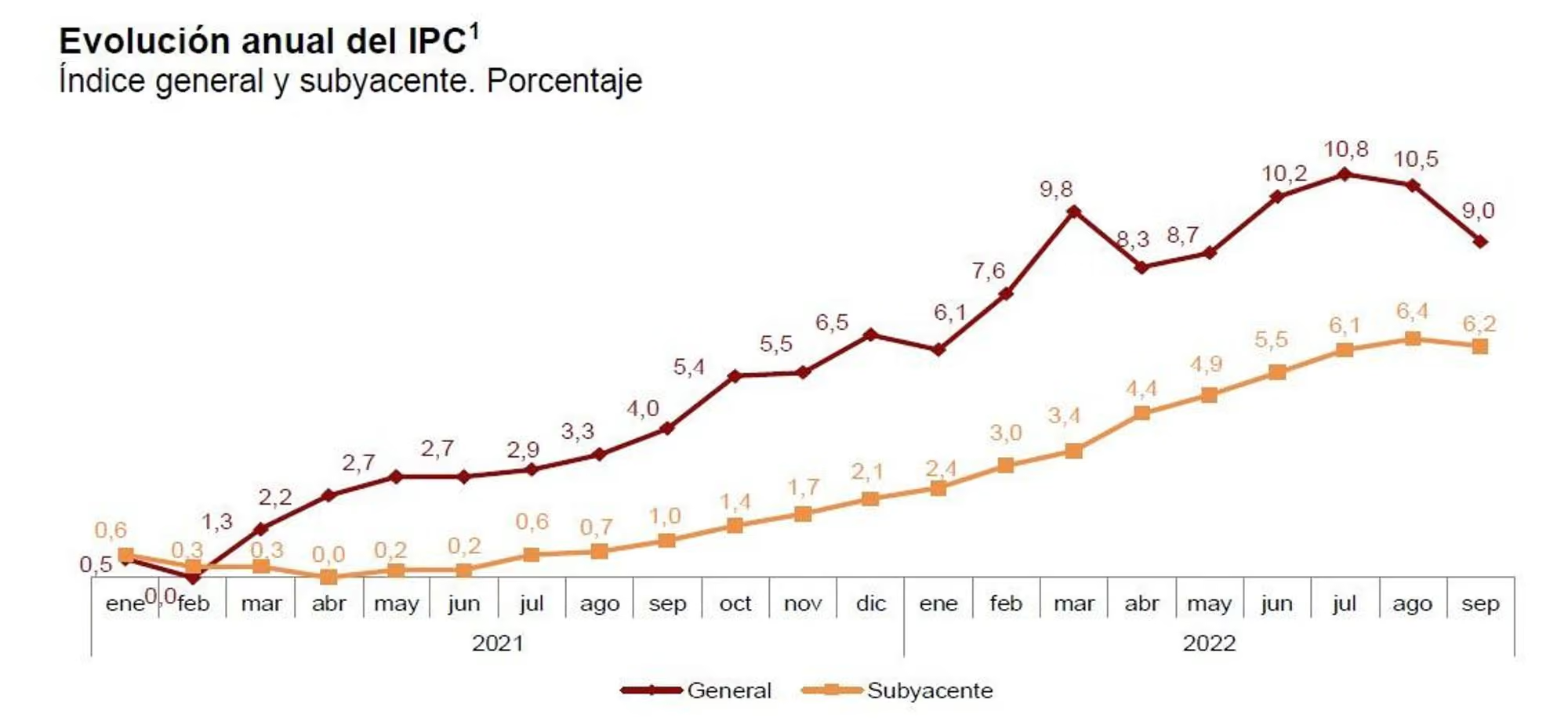
Inflation is here to stay. Some experts already consider it a structural problem, although its causes can be found, globally, in a demand crisis: high consumer demand, especially concerning the energy sector, and distribution difficulties have combined to lead to price increases across the board.
To control this rise, the FED and the European Central Bank are raising interest rates, hoping to curb consumption.
But that is a solution that cannot be sustained for long, as it makes debt more expensive and, therefore, can lead companies and states into a rather complicated economic situation.
Therefore, although some experts claim that inflation will decrease, it is likely that they are mistaken, as they were in 2021.
It is most likely that inflation will continue to be a problem next year and, in Europe, it will be exacerbated by the structural weakness already noticeable in the economies of some countries, such as Germany, and by the energy crisis associated with the conflict in Ukraine.
So, what does inflation mean for savers? Basically, that the money one has, whether in cash or in the bank, is worth less every day. And, although sometimes rising interest rates benefit savings account holders, it is not likely that this will happen in the coming months.
The COVID crisis imposed forced lockdowns and business closures in many countries, leading to a decrease in household spending. As a result, banks have a lot of cash and do not need to attract new savings accounts.
Since inflation devalues money, keeping money without using it, that is, simply saving, is not a good option these days.
The ideal is to invest wisely, which means asking yourself: where should I invest so that my money continues to yield returns? And the answer is simple: you must invest based on inflation, meaning focus on investments whose returns are higher than the current inflation rate and are on the rise.
In other words, you should invest in what you know will increase in value as inflation rises.
If you're considering where to invest, it's clear you're one of those who believe that where others see a crisis, there can also be a good opportunity. But before you start investing, it's wise to pause and take a number of considerations into account.
First and foremost, your assets must be properly structured, and your investments should be diversified, in addition to having an entry, maintenance, and exit strategy.
But you also shouldn't forget about COVID-19. Although some authorities have declared the pandemic over thanks to high vaccination rates and the fact that new waves have lower mortality, the virus is still active. Therefore, we must be alert to the possibility that a more aggressive variant could emerge in the coming months, leading to a new lockdown.
In that case, we would require sufficient liquidity to operate independently for weeks, or perhaps months. And that means that, although it's good to increase the percentage of our assets allocated to investment during times of inflation, prudence is always necessary.
In this context marked by inflation and economic instability, it's clear that asking where to invest means asking which assets are safest and which will prove most profitable despite the complexity of the situation.
The first thing to do is, without a doubt, to steer clear of assets associated with Russia. The invasion of Ukraine has led major stock indices to withdraw Russian stocks and other securities, and international companies are severing their ties with Russia.
Furthermore, it's important to note that the dollar is expected to maintain its strength, a trend also anticipated for the Japanese Yen and Swiss Franc. The Euro and British Pound, conversely, will be significantly affected by instability on the European continent.
Therefore, it's clear that emerging markets in Asia-Pacific and U.S. assets are a great option.
And finally, in the current climate, gold is once again a rising asset.
Below are our suggestions on where to invest, but remember they are just that—suggestions that cannot replace sound professional advice.

Investing in the real estate sector can be done in several ways. On one hand, it's possible to invest in real estate through the most traditional method, which is by purchasing a home, commercial property, or land.
However, if you cannot afford the cost of buying a property, or lack the necessary knowledge or time, you can also choose to invest through Domoblock, a collaborative investment platform that allows you to invest from €200 in real estate projects managed by professionals, passively and 100% digitally.
One of the main advantages of the real estate sector, which makes it a good investment option, is that property prices tend to rise in parallel with inflation.
Soaring inflation often also drives up real estate asset prices, though there are exceptions, of course, such as in Canada, where properties have lost 10% of their value in the last year.
But in Spain, where it seems we learned the lesson of the 2008 crisis well, 57% more was invested in this sector in the first nine months of the year compared to the same period in 2021, and the year is projected to close above 15 billion, more than in 2019, according to data from BNP Paribas Real Estate.
That's why real estate is one of the best sectors to invest in.
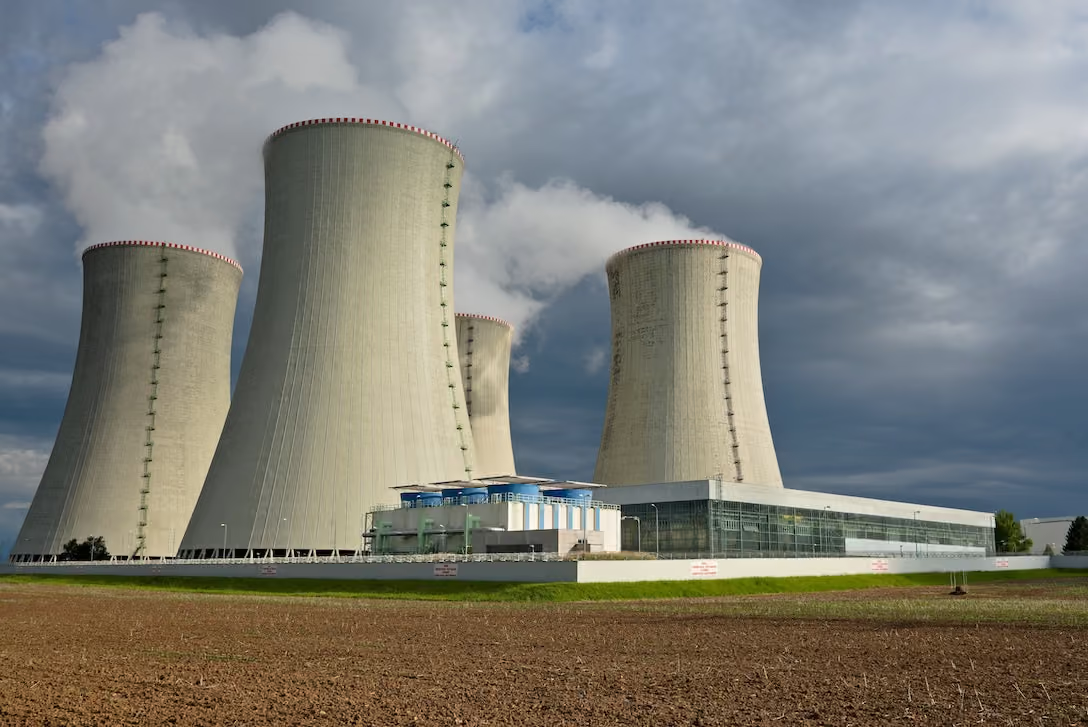
The classification of nuclear energy as "green energy" and the prospects opened by advancements in nuclear fusion suggest that nuclear energy will be a rising asset in the coming years.
Furthermore, the scarcity of gas and oil due to the war in Eastern Europe is expected to persist for the coming months.
The International Energy Agency (IEA) has warned that natural gas shortages could affect storage capacity, predicting that nuclear energy will remain the primary source of electricity in Europe.
As if this weren't enough, two of the biggest investors of recent times have firmly backed this energy industry, anticipating potential medium and long-term problems related to fossil fuels.
We are specifically talking about Bill Gates and Warren Buffett, who are betting on nuclear energy through the innovative company TerraPower.
In a world where actions towards decarbonization are quite clear, and where solar and wind energy do not guarantee a supply to meet all of the population's needs, nuclear energy is positioned as a future bet.

In the case of farmland, two of the safest assets during inflation are combined: the land itself, and the raw materials that can be produced on it. The advantage of investing in agriculture is that these are products no one can do without, and therefore, they are barely affected by inflation.
When prices soar, one might forgo buying shoes or stop using cologne, but one cannot stop eating. And if you invest in the most basic products, you can be sure that profitability will always remain above inflation.
And once again, Bill Gates, Microsoft's founder, is taking action in this type of investment, having acquired over 269,000 hectares of farmland in the last ten years, making him the largest landowner in the US.
Investment in defense companies has not been well-regarded in recent years. In fact, until the beginning of this year, most ESG portfolios (Environmental, Social, and Governance Criteria) did not consider the stocks of companies in this sector.
An investor concerned with ensuring their investments are "good" for the planet and its inhabitants, and by the environmental impact of the industry, was reluctant to invest in weapons, tanks, or combat vehicles.
However, after the outbreak of the war in Ukraine and the resulting polarization, several banks have started to include these securities in their portfolios. They argue that these are companies that defend freedom and democracy. They are also highly profitable companies, generating significant profits, with their stock prices rising.
A clear example of this can be seen in the company Lockheed Martin (LMT), which has appreciated by approximately 45% in the last year.
Most bonds are presented as fixed-income investments, meaning that although their market value may change, their interest remains constant.
This makes them not the most suitable product in inflationary situations. In fact, anyone considering where to invest would likely be deterred by knowing that bonds have experienced losses and declines of up to 16% over the last twelve months.
But if you're wondering where to invest without incurring risks, there's a type of bond perfect for the occasion: Inflation-Protected Bonds (TIPS), whose interest is indexed to inflation.
They don't offer high returns, but they are safer.
Although market instability and inflation have severely impacted most countries, it still presents an opportunity for investors who choose wisely where to put their money.
The real estate sector, nuclear energy, and generally all investments that, by their nature, are resilient to price increases, are a good option for those wondering where to invest to get a return on their money without taking unnecessary risks.


.png)

León XIII, 27
Funded
-
-
Target
507.697,35 €


.png)
.png)
.png)
.png)




.avif)
.avif)


