

In Spain, house rentals are governed by a Royal Decree, but the room rental agreement is regulated by the Civil Code. This means there are legal regulations we must observe before and during this rental relationship for a single room to avoid setbacks and penalties.
Since it falls under different legal regulations, this leads to different situations, such as agreeing to a verbal contract instead of a written one. In such a case, the rental, for example, will have a duration equal to its payment frequency: if paid monthly, it will be monthly, and if paid annually, it will be annual.

In Spain, it's possible to rent an apartment by rooms, but a room rental is a different agreement from a house rental. We are talking about an arrangement where an occupant or tenant rents and pays for a room in a shared flat or property.
Room rentals in Spain are governed by the Civil Code, specifically Article 1554 and subsequent articles. This is because this type of tenancy is not included in the scope regulated by the LAU (Urban Leases Act).
Nevertheless, room rentals could eventually fall under the LAU, even though this law does not explicitly specify this type of tenancy. In a room rental, for example, the tenant is not obliged to provide a security deposit, but the owner can demand one.
When drafting a room rental agreement specific legal content is not required, nor is it even mandatory to do so in writing. However, it is always advisable to do so to avoid future inconveniences between the owner and the tenant, and it is suggested that it include these characteristics:
It is suggested to precisely describe the space the tenant will occupy, in order to avoid any doubt or confusion about the rented room.
It will always be advisable to record in writing the duration of the contract, with specific start and end dates.
The agreement should state the agreed-upon rent and how it is to be paid for the duration of the rental of the leased space.
It is recommended that every service included in the rental agreement be listed, such as the right to use the kitchen, authorization to connect to the internet, etc.
It is advisable to specify how additional expenses should be divided, especially in cases where other costs apply.
One crucial detail is whether the occupant will have the right to sublet the room, due to a simple legal presumption. If nothing is agreed upon regarding this, and in accordance with the Civil Code, the tenant would be entirely free to do so.
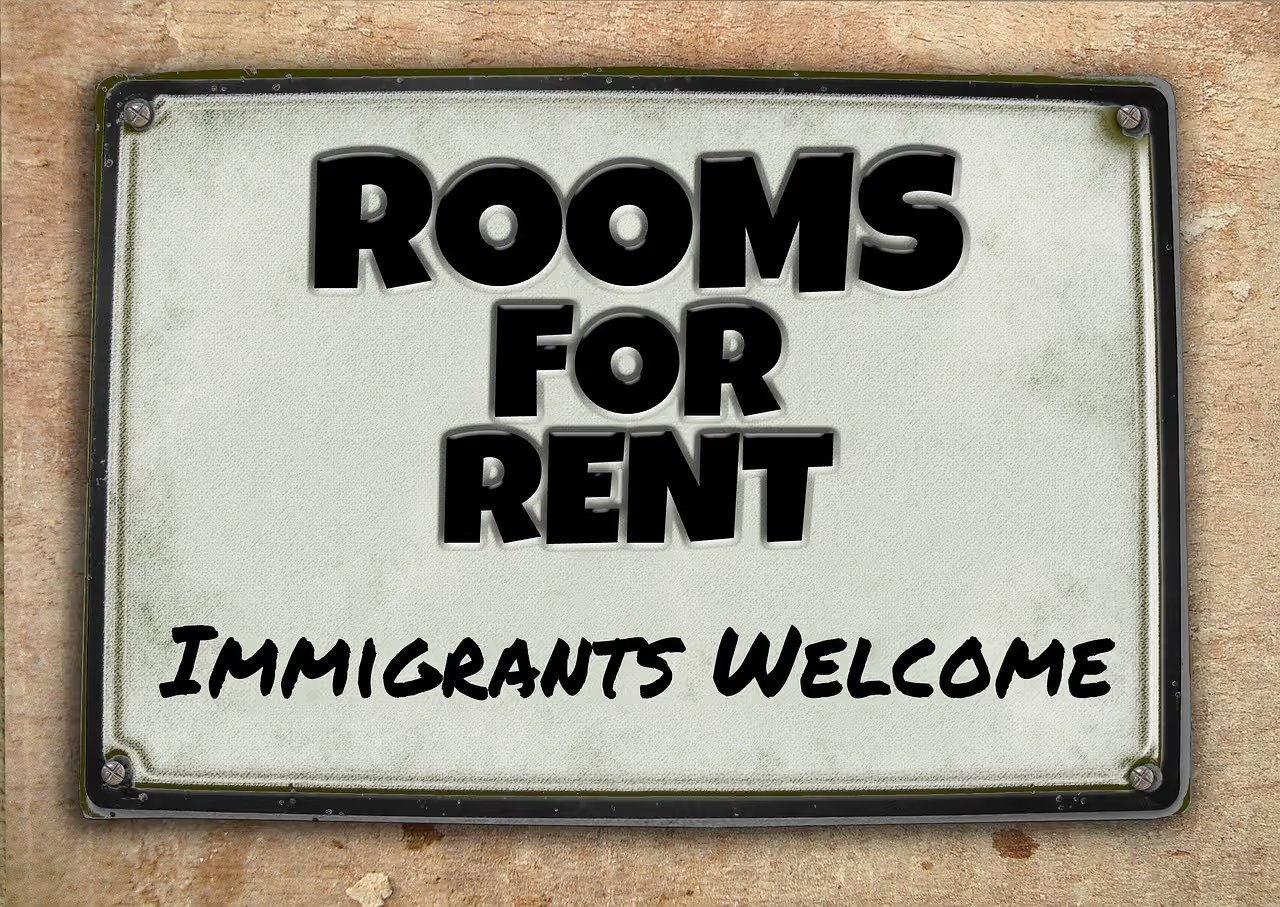
Knowing your rights when signing this type of contract often prevents uncomfortable situations and misunderstandings between the signatories. For this reason, it will always be very useful to have a signed contract specifying your rights as a room occupant, which could include:
The owner or other occupants of the house may never enter the rented room without the occupant's permission.
The Civil Code broadly authorizes a room occupant to sublet or rent it out, unless otherwise agreed upon in the written agreement.
Unlike a conventional lease, someone renting a room does not have the right to automatically extend their stay. The rental period is as agreed upon in the contract, and if the duration has not been specified, a special rule applies:
If the rent is paid annually, it will be year-to-year; if monthly, it will be month-to-month; and if daily, it will be day-to-day.
The tenant has the right to use the common areas of the dwelling, as specified in the respective agreement. These include the kitchen, the bathroom (if shared), the multi-purpose room or main living area, hallways, and any other shared area.
Similarly, this particular tenancy comes with the following obligations:
The tenant must ensure that the room and common areas remain tidy and clean, using them respectfully and appropriately.
It is a legal obligation of the tenant to pay the rent agreed upon in the contract, in the manner and within the timeframes stipulated.
The tenant must inform the landlord of any damaging issues that require repair as soon as possible, indicating the type of repair needed and its urgency.
Upon termination of the tenancy, the occupant must return the room in similar condition to how it was received, normal wear and tear excepted.
It is always important to remember that maintaining open and constant communication with the landlord and other tenants is paramount, establishing rules of coexistence. Mutual respect greatly contributes to a pleasant environment and avoids potential conflicts, by respecting rights and fulfilling obligations to prevent an eviction for breach of contract
The term of this contract is agreed upon by the contracting parties, but it is generally for months, quarters, or semesters. It is also possible to agree on a term of years or academic courses, especially when dealing with students pursuing specific studies.
It is important to know that the duration of this contract is NOT renewable, and as soon as it ends, the parties involved can agree on something new. In this situation, it is possible to reach a new agreement to sign another contract and maintain the tenancy.
According to the most recent study on shared housing, conducted in Spain in 2023, the price can vary depending on several factors. However, the average cost for a rented room is 465 euros per month.
To update the cost of this contract, the signatories should:

Room rental must be declared on the income tax return, including the amount of this income in the respective boxes. These are located under "Income from real estate capital derived from urban properties."
Furthermore, these taxes are subject to the same tax regulations as renting a house, and the rental income must be included in the IRPF (Personal Income Tax), allowing for the deduction of rental expenses. If the rental is not declared, the Tax Agency could impose a fine equivalent to 50% and up to 150% of the undeclared amount.
Renting a room without a written agreement could lead to legal and financial consequences for owners who do not declare that income. They could face tax penalties or fines, while tenants might lose their right to protection against eviction. Learn what to do in situations of renting without a contract.
Several consequences can arise, but the most serious is that if a tenant sublets a room without the owner's permission, they would be breaching the lease agreement. In such a situation, the owner has the right to terminate the contract by right and demand the vacating of the property and compensation.
Discover Domoblock, the innovation that combines the best of blockchain and tokenization real estate to offer a secure way to invest. With Domoblock, you gain access to exclusive real estate projects, diligently selected by a team of experts who maximize the profitability and effectiveness of your investment.
Start investing with as little as €200 and explore a wide variety of real estate opportunities that generate returns exceeding 10%. Domoblock is transforming how investors participate in the high-yield real estate market with a diversified and accessible investment model.
This platform provides you with the necessary tools to efficiently grow your capital, regardless of prior knowledge. Secure your financial future with Domoblock, where they offer confidence, transparency, and peace of mind every step of the way.
Don't miss the opportunity to be part of this revolution in real estate investments!Invest in Domoblock today and take your financial strategy to new heights!
If you own an apartment and want to rent out rooms, you know you can do so, but you are subject to certain legal regulations. It will always be advisable to sign a room rental agreement to avoid future inconveniences.
Remember, if you want to have a team of experts guide you through the decision to invest, consult with Domoblock!


.png)

León XIII, 27
Funded
-
-
Target
507.697,35 €


.png)
.png)
.png)
.png)




.avif)
.avif)


