
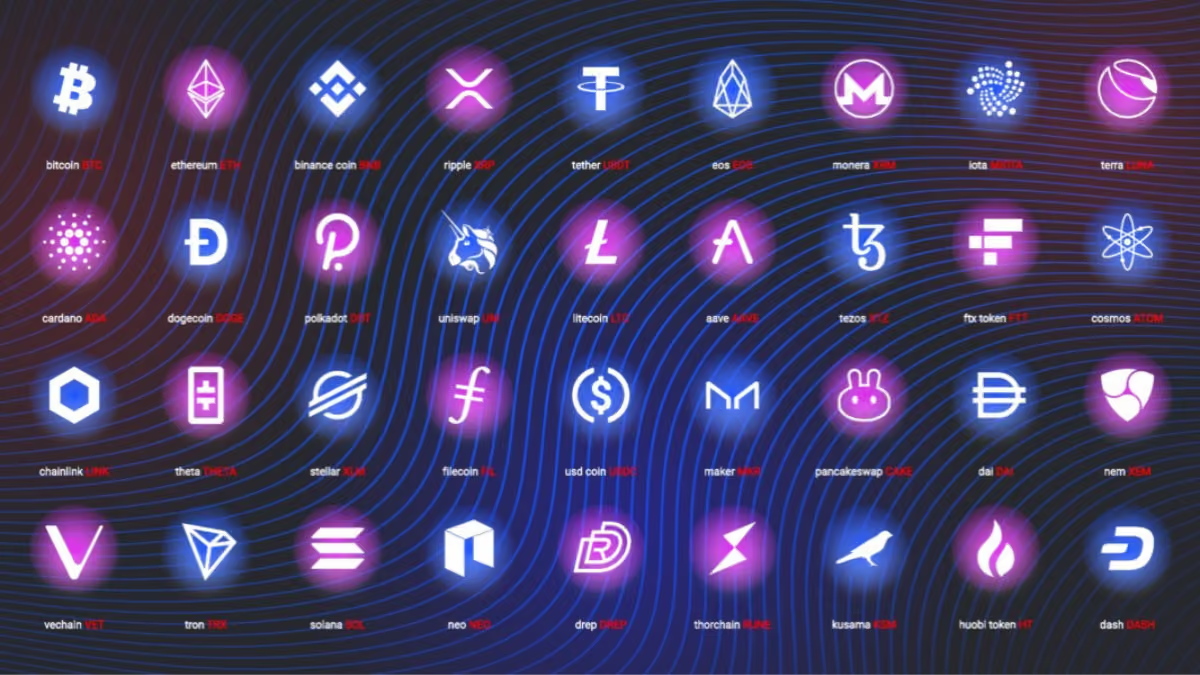
It's a fact that cryptocurrencies and tokens are here to stay, and their adoption and use are becoming increasingly noticeable. So much so that, along with other trendy terms within the blockchain ecosystem like Metaverse or NFT, they are among the most searched topics on the internet.
Some say that tokens, or rather tokenization, have the power to change the world as we currently understand it, and the way people and entities interact. To be honest, I share this idea. But first, let's understand what tokens are and which types of tokens are most relevant today.
The word 'token' is likely not unfamiliar to us, as tokens actually existed long before the advent of blockchain technology. In fact, the word 'token' comes from the Anglo-Saxon word 'tacen,' which means sign or symbol. In Spanish, we could liken it to the term 'ficha' (chip/counter).
As I was saying, before Ethereum appeared in 2015 or Bitcoin in 2008, we were already using tokens. For example, when our trusted store or supermarket gave us loyalty points for recurring purchases, which we could later redeem for product discounts.
Another example would be the chips used in a casino to play or participate in the games offered there. These chips represent a currency, such as the euro or the dollar. Therefore, we can understand that tokens are privately issued units of value intended to represent some type of asset, utility, right, or obligation.
With the advent of blockchain technology, tokens adopted unique characteristics that propelled them into an advantageous position, transforming the assets they represent into more traceable, transparent, immutable, and interchangeable units.
Tokens are digital units based on cryptography that reside within the blockchain infrastructure. Their great advantage is that they can represent almost anything we can imagine, from exclusive rights like access or utility for a specific product or service, to financial instruments such as bonds, stocks, debt issuances, etc.
Depending on their purpose and what they represent, these tokens are divided into two main groups;
- Utility tokens
- Security tokens.
The value of a token can vary significantly depending on several factors. Here are the aspects that influence its valuation:
To find the current value of a specific token, it is advisable to consult cryptocurrency price tracking platforms like CoinMarketCap, CoinGecko, or directly on the cryptocurrency exchanges where the token is traded.
The value of a 1-token coin varies widely depending on the specific token. Here are some steps and considerations for determining the value of a particular token:
Let's say you want to find out the value of a specific token like Ethereum (ETH):
The value of tokens varies widely. For example:
To get a specific answer, I would need to know which token you are referring to, as each one has a different market value.

Tokens offer a range of benefits within the cryptocurrency and blockchain technology space. Here are some of them:

There are 2 types of tokens that differ in that some are interchangeable and have the same value as each other, while non-fungible tokens are unique and indivisible. Below are more details on each:
These are tokens that are interchangeable with each other and are identical in terms of their value and functionality. Each fungible token is considered equal to another and can be replaced by another token of the same type without any difference. A popular example of a fungible token is Ethereum (ETH), which can be exchanged one-for-one without any distinction.
Unlike fungible tokens, non-fungible tokens are unique and indivisible. Each non-fungible token has unique characteristics that distinguish it from other tokens. These tokens are commonly used to represent unique digital assets, such as digital art, game collections, and virtual collectibles. A famous example of a non-fungible token is CryptoKitties, where each virtual cat is unique and has distinct characteristics that make them valuable and different from each other.
The main difference is that cryptographic tokens are digital representations of assets or utilities on a blockchain, cryptocurrencies are digital currencies used as mediums of exchange, and altcoins are all cryptocurrencies other than Bitcoin. Each has its own specific characteristics and use cases in the world of cryptocurrencies. However, here are more details:
Cryptographic tokens are digital representations of assets or utilities that run on a blockchain. These tokens can be both fungible and non-fungible and are used within a specific platform or ecosystem. For example, Ethereum-based ERC-20 tokens are a widely used type of cryptographic token for creating smart contracts and building decentralized applications (dApps).
Cryptocurrencies are a specific form of cryptographic tokens used as digital mediums of exchange. These virtual currencies function as digital money and can be transferred and used as a means of payment. Popular examples of cryptocurrencies include Bitcoin (BTC) and Litecoin (LTC). Cryptocurrencies typically have their own independent blockchain and are used for peer-to-peer transactions without the need for intermediaries.
When we talk about cryptocurrencies, we are still essentially talking about tokens, whose primary function is to serve as a decentralized form of payment within the virtual blockchain environment, thus adopting the role of a native token. In some cases, their use has evolved to be seen as a store of value and a form of savings. To draw an analogy, we can consider cryptocurrencies as "legal tender" accepted by users as a medium of exchange and payment within the decentralized environment they belong to.
Cryptocurrencies, for their part, are a key component for ensuring the proper functioning and security of the network, fulfilling two basic and essential purposes of any DLT (Distributed Ledger Technology).
Firstly, they serve as an incentive for good network usage, rewarding miners/validators for their work and good practices. The second is related to payment for network usage, where the cost discourages dishonest users from issuing empty or low-value transactions that could compromise its state. Similarly, it serves as a way to disincentivize validators from performing malicious actions, as such acts could result in the total or partial loss of their cryptocurrencies. Both actions foster the creation of a trustworthy environment within an ecosystem of distrust among participants.
Cryptocurrencies are characterized by sharing a series of common features, such as being fungible, divisible, having a limited supply, and being easily transferable and quantifiable.
ETH, BTC, AVAX, ADA, SOL, FTM would be some examples of cryptocurrencies.
The term "altcoin" is used to refer to all cryptocurrencies that are not Bitcoin. That is, any digital currency other than the original cryptocurrency is considered an altcoin. These alternative currencies often aim to offer different features and functionalities than Bitcoin. Some popular altcoins include Ethereum (ETH), Ripple (XRP), and Litecoin (LTC). It's worth noting that many altcoins are based on blockchain technology and have specific uses beyond simple value exchange.
The utility tokens , as their name suggests, refer to tokens that represent a utility, granting their owner the right to access products or services. Their price is determined by the law of supply and demand; that is, they are not backed by any underlying value and are not intended to be used as an investment vehicle, although, as we can imagine, this is a fairly common practice.
Some of the utilities of these tokens could include access to services like decentralized cloud storage (SC), currency for acquiring virtual items or land (MANA), the right to be part of a decentralized community whose decisions are based on voting and governance systems (REP), etc.
On the other hand, security tokens are linked to financial securities, which is why the intention behind their acquisition is primarily for profit; that is, an expected benefit or return over time. Unlike utility tokens, their intrinsic value will be determined by the underlying asset they represent.
Some examples of security tokens would be tokenized company shares, fractional ownership, or rental property income rights.
Often, due to the great flexibility and adaptability that blockchain offers when assigning functions and uses to tokens, the line between them becomes somewhat blurred, making their differentiation difficult in practical or even regulatory terms. But don't worry, we will dedicate a full article to discussing security tokens and how to differentiate them.
By now, you're probably tired of hearing the term NFT, which stands for Non-Fungible Token. But what exactly are these tokens everyone is talking about?
Essentially, a Non-Fungible Token (NFT) is a unique and indivisible digital crypto asset, recorded on the blockchain, ensuring its ownership, immutability, and originality. Like any other token, they are smart contracts programmed based on a standard (ERC-721, in the case of Ethereum) that gives them unique characteristics and interoperability, facilitating their trade among themselves by adhering to a community-agreed standard.
NFTs are characterized by their scarcity and can represent both utility and serve as an investment vehicle. A property considered unique would therefore be an NFT, but so would an in-game item like a unique weapon or vehicle, whose purpose is to be used within the game.
NFTs are having a significant impact on DeFi, where many desperately turn to them as an investment vehicle or as a means to multiply their value in monetary form through the digital replication of a real asset or good, such as artworks or property.
Currently, NFTs are largely focused on the creation and mass production of digital assets (most of them without inherent value), meaning the creation of digital content, driven by a trend that began in 2021.
However, the true disruption lies in the power to tokenize unique valuable items, and I'm not just referring to luxury goods, but also to information such as statistical data, medical records, financial risk studies, intellectual property, or patents, mortgages, and loans. The act of tokenizing and registering these on the blockchain makes them more accessible, secure, exchangeable, and traceable assets, ensuring digital ownership and originality like never before. This is where their true value proposition lies.
On the other side of the coin, we find Fungible Tokens (FT), which, unlike NFTs, do not represent a unique asset. Instead, other tokens of the same value can represent them without any difference.
For example, the euro is a fungible asset because all euros have the same value and can be directly exchanged for one another. The same applies to Bitcoins. In practical terms, owning one Bitcoin would have the same effect as owning another, provided, of course, that both are genuine.
That said, some examples of fungible tokens include cryptocurrencies like ETH, a bumper car token digitally represented through a token, or governance tokens of a protocol like SUSHI from Sushiswap.
Finally, I'd like to briefly mention the term Semi-Fungible Tokens or SFTs, which are a hybrid between NFTs and FTs.
Let me explain: imagine we tokenize tickets for a play. Each token represents access to a specific seat in a venue at a particular time and date. We might say it's an FT because all tokens grant access to the same play, at the same venue, date, and time. However, each ticket grants access to a specific seat, meaning not all tickets are truly identical. Therefore, we would be talking about a Semi-Fungible Token.
Tokenization opens the door to a new economic framework, allowing individuals, communities, or businesses to create their own token-based microeconomies—self-sufficient economies independent of governments and central banks, which, until very recently, were the only entities capable of controlling assets.
As we mentioned at the beginning, tokens have existed for some time, but the token economy is only possible thanks to the deployment of these tokens on the blockchain. Its intrinsic characteristics ensure ownership and traceability, reduce risks and failures, and facilitate commercialization, making tokens more liquid and helping them unleash their full potential in a decentralized digital environment where governance is in the hands of the community.
Thanks to tokens, we can create incentive systems that reinforce the effort and collaboration of users involved in projects with shared goals, thereby increasing their activity and involvement. As a result, the community becomes more prosperous and stable, completing and re-energizing this cycle.
Perhaps the tokenization of real estate is one of the main value propositions of blockchain technology, and Domoblock is aware of this.


.png)

41 Av. del Oeste
Funded
-
-
Target
€763,249.36


.png)
.png)
.png)
.png)





.avif)


