
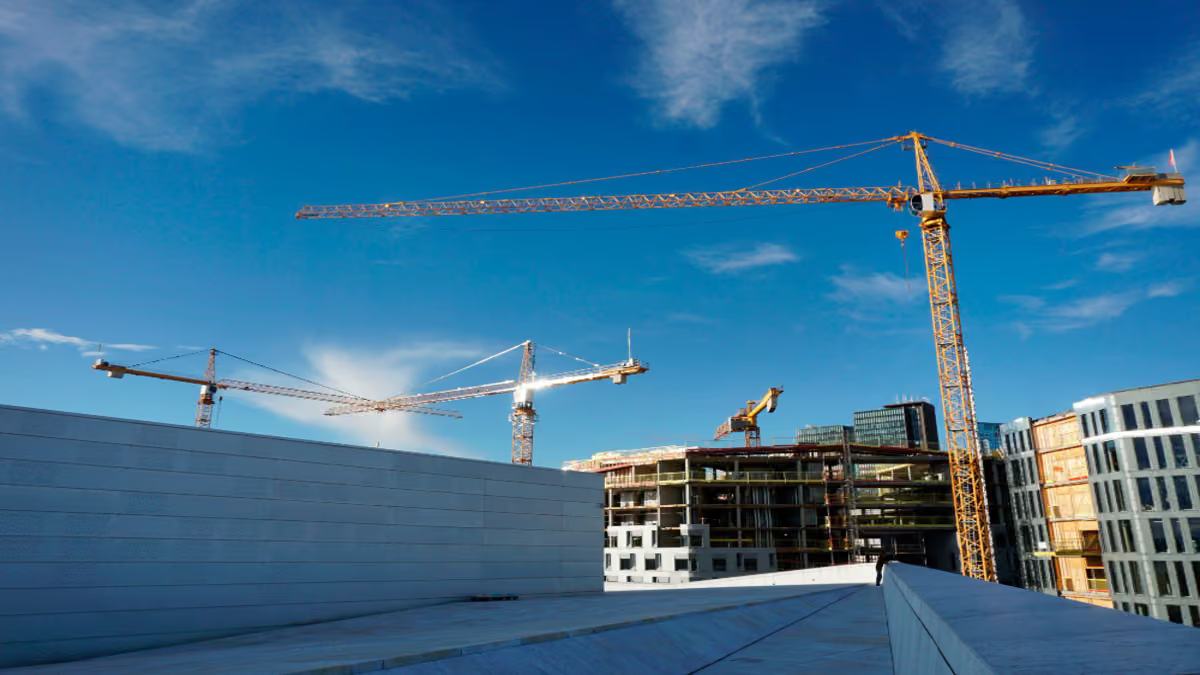
For years, the debate about the real estate market in Spain has focused on prices: whether they will go up, go down, or if it's a good time to buy.
But the reality is that the market's current problem is not about price.
It's in something much more structural: Spain is not building enough homes.
This imbalance between supply and demand is not only not being corrected, but has solidified as a fundamental trend that will continue to shape the market in the coming years.
And when this happens, value is no longer solely in buying well…
and shifts to being in creating supply in a market where it's scarce.
This is where new construction comes in as one of the most significant opportunities in the current cycle.

New construction is not simply buying a newly built apartment.
From an investor's perspective, it involves participating in the entire process of creating a real estate asset:
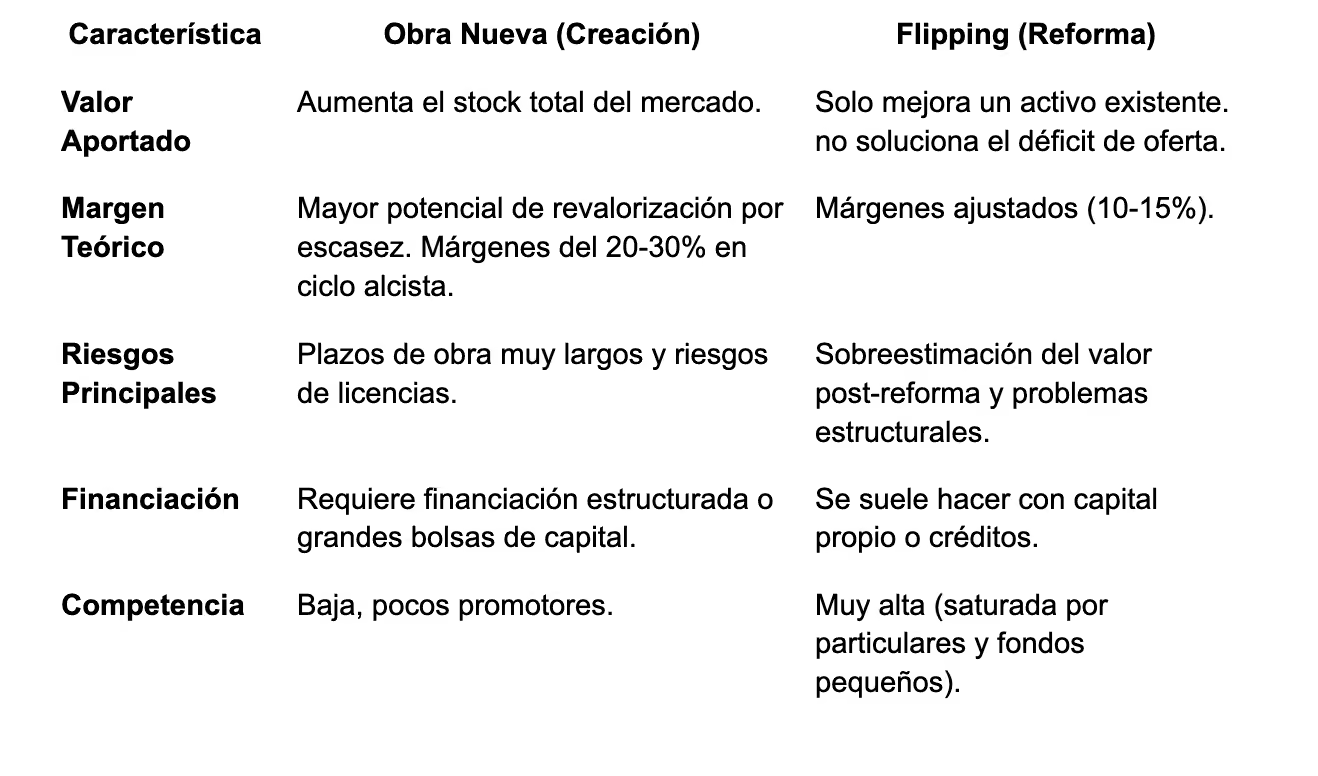
This implies a fundamental difference compared to other strategies: new construction creates value from scratch. It doesn't improve an existing asset; it generates one. And in a market with a housing shortage, this is key.
2025 data shows signs of deceleration: although the first quarter recorded 34,416 housing starts, the second quarter dropped to 29,637, suggesting that developers are struggling to maintain production pace.
The housing deficit in Spain has become a structural problem in recent years. Between 2021 and 2025, the cumulative gap between new household formation and housing construction has exceeded 600,000–700,000 units, reflecting a clear inability of the market to generate sufficient supply. In 2024, for example, only 100,980 homes were completed, a figure clearly insufficient to renew the housing stock and meet existing demand.
Available supply is at a historic low in many capital cities. Although new construction permits have recovered from the 2013-2014 low, the current pace remains insufficient to absorb demand.
Looking ahead, forecasts indicate that even if the number of permits grows gradually, it will not be enough to close the accumulated gap, meaning the housing deficit will remain significant in 2026 and 2027.
Demand remains strong thanks to job creation, foreign investment, and new household formation.
The process is often prolonged, causing supply to react slowly to demand peaks, leading to upward price pressure.
It's not enough to have empty plots. What's needed is "developed land," which is scarce and expensive.
Although material costs have decreased from their 2022 peaks, labor costs have risen by 15-20%. Additionally, high interest rates increase the cost of capital for developers.
Obtaining a building permit can take between 12 and 24 months, which is one of the main causes of the shortage.
Spain lacks skilled labor, and there's a generational gap in the sector.
Direct (you buy an off-plan apartment), Indirect (you invest in a development's capital through crowdlending or a cooperative).
Look for cities with job creation and urban growth limits.
Ask for their track record. The "developer partner" is more important than the location.
For new construction, you typically pay a 10-20% reservation deposit, 10-20% upon licensing, and the remainder upon signing the deeds.
Make sure the contract includes a Bank Guarantee (or insurance) that refunds your money if the project isn't completed.
Value in new construction doesn't just appear at the end; it's built throughout the process. The earlier you get in, the more value you capture:
When there's a housing deficit, new assets sell themselves. Investing in developments allows you to set initial prices with assured high demand.
The best price is obtained during the "land acquisition" or "initial project" phase. Entering at the initial stage allows for multiplying the investment, as the asset's value grows with each milestone. Investing in the land acquisition phase is riskier but can multiply capital by 3 or 4. Investing in the "turnkey" phase is safer, but the appreciation is already priced in.
Amenities typically yield better returns per square meter in new developments.
A property with an A or B energy rating will have much higher demand than one with a C or D.
Failure in real estate investment often results from poor management by the partner. It is vital to establish a management agreement that specifies the developer's fees, reporting timelines, and mechanisms for replacing the manager.
A project is viable when the Internal Rate of Return (IRR) exceeds the opportunity cost of your money (currently >12%).
The individual investor needs to professionalize and execute a plan: land acquisition, permitting, construction execution, and marketing and sales.
The small investor should partner with platforms or family offices that filter risk. Syndication allows access to larger-scale projects and better locations.

A realistic project takes at least 24 months from land acquisition to completion.
The main risk is that the PGOU (General Urban Plan) changes or that archaeological/industrial remains are found on the ground, halting construction.
Delays in key handover are the most common risk. If you have a future sale or mortgage commitment, delays can lead to extremely high financial costs.
Look for areas with an "approved partial plan" and close to public transport hubs.
Avoid "opportunistic" developers. Demand a track record of at least 3 completed developments.
Only invest with a "final license."
Are you investing as a participant in an APE (Urban Interest Group) or through a participating loan? The tax and liability implications are different.
From day one, decide whether you will sell the property or rent it out. Your exit strategy determines the type of product you should look for (city center vs. periphery).
It means there are more buyers than available homes. In this situation, the seller holds the negotiating power.
Yes, the average profitability of a well-managed development in Spain ranges from 15% to 25% annually on the capital invested (IRR), significantly higher than traditional rental income.
Between 18 and 30 months from the initial investment until the recovery of capital plus capital gains.
Experts point to a need for 150,000 to 200,000 annually over the next decade.
Through real estate crowdlending platforms, investment companies (SICAVs), or investment cooperatives like Domoblock.
When interest rates are high, when the second-hand market supply is overvalued, and when the housing stock is very old.
The 2026 market presents a unique scenario: interest rates on a plateau, stabilized construction costs, and a soaring supply gap. Opportunities lie in participating in developments in second-tier cities (Seville, Zaragoza, Alicante, Malaga capital) where land is cheaper and demand is unmet.
Get ready for upcoming new construction project launches at Domoblock.
Investing in new construction in Spain in 2026 is a bet on economic logic. The investor who understands the timelines, partners with solvent developers, and enters early development phases will likely achieve the best risk-adjusted return in the national landscape.


.png)

41 Av. del Oeste
Funded
100%
763.249,36 €
Target
€763,249.36


.png)
.png)
.png)
.png)



.avif)
.avif)


