

In a country like Spain, where urban development and construction are subject to strict regulations, thoroughly understanding the process of obtaining a building permit is essential for owners, architects, and contractors.

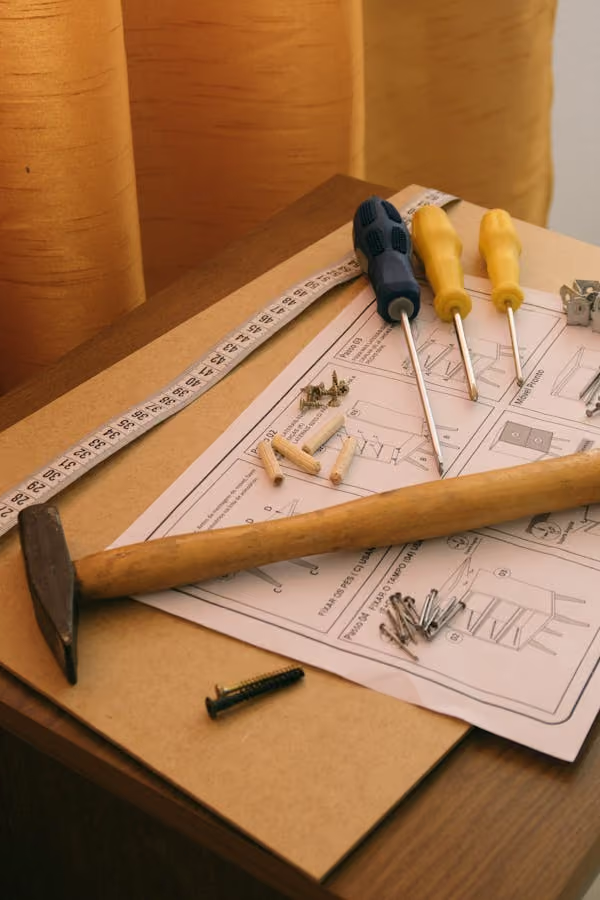
A building permit, also known as an urban planning permit or construction permit, is a procedure that authorizes construction work, renovations, or demolition on a property. This permit is processed at the local administration level, specifically in the urban planning department of the City Council concerned and aims to ensure that the work is carried out in accordance with urban planning, environmental, and safety regulations.
In Spain, requiring a building permit is mandatory, as it guarantees compliance with current legislation and the proper payment of established fees; failure to do so is illegal and incurs penalties.
You might be interested in: cost of a full renovation for a 60-square-meter apartment.
If you plan to carry out large-scale works, such as the construction of new floors, extensions, partial or total demolitions, or changing the use of the property, you must apply for this type of permit. A major work requires a technical project prepared by an architect, which includes plans, a descriptive report, detailed measurements, among others. The processing of this permit depends on the relevant city council. Look for information in the urban planning department or on the city council's website to find out the procedure to follow.
Minor work refers to small renovations, repairs, aesthetic changes, or improvements that do not affect the building's structure. Furthermore, it does not require a technical project, and its budget is affordable. Processing this permit is a much simpler and faster procedure compared to a major building permit.
It's important to know that in Spain, any work intended to be carried out on a property requires a building permit. Depending on the scope of the work, the type of license to be requested will be determined. This permit certifies compliance with current regulations, protects the integrity of the building where the renovation will take place, and ensures the safety of the people involved. Some examples include:
You might be interested in: permits to convert a garage into a dwelling.
Although the documentation will vary depending on the type of license and the City Council, these are some of the documents frequently requested for a major building permit:
Getting a building permit might seem like a complicated process, but if you follow these steps, you can do it more efficiently:
The initial recommendation, before starting any procedure, is to go to the City Council for a preliminary consultation. There you can clarify any doubts about the project's viability and the necessary requirements.
For this step, you will need to hire an architect or competent technician to prepare the technical project required for the work; ensure it complies with all regulations and requirements set by the City Council.
It's time to prepare all the necessary documentation: the formal application, the technical project, property documentation, and proof of fee payment.
Submit the application to the City Council along with all the required documentation. Make sure it is complete to avoid delays in the process.
The City Council will review the application and issue a resolution. This process will take time depending on the officials' workload and the project's complexity.
Once the application is approved, you will receive the permit. You should keep this document handy while the work is being carried out. Once the permit is obtained, you can begin the work.
We invite you to read: flipping house.
The urban planning license application must be submitted at the relevant City Council for the location where the property is situated. Most City Councils accept these applications in person at their offices. However, many also offer the option to complete the process online through their websites. Check the official City Council website to find out about the specific procedures and opening hours.
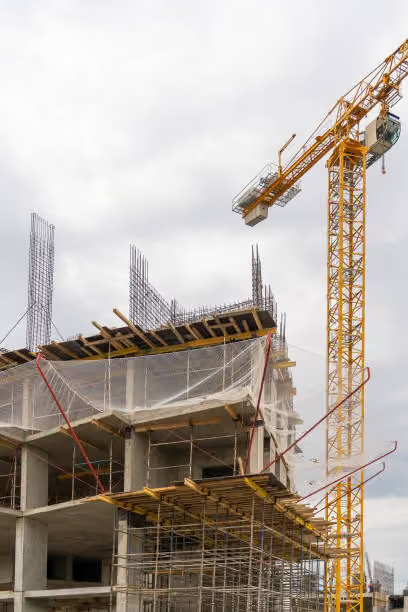
The cost of a building permit varies considerably depending on the type of work, location, and City Council. In some cases, it's a single fee for minor permits. The calculation of the building permit price will depend on the type of work and its estimated cost. Generally, fees range between 4% and 6% of the Material Execution Budget for the project (PEM). Once the permit is approved, you will need to pay the Tax on Constructions, Installations, and Works (ICIO), which amounts to between 2% – 4% of the project budget. In addition to this, VAT would still need to be paid. You also need to consider the technical project cost; this is essential for the permit and must be prepared by an architect or a qualified professional.
Theoretically, city councils should grant or deny a major building permit within a period not exceeding three months, but, in reality, in most situations, it takes a year from the application. Everything will depend on the workload of the city council's Urban Planning department. It is important to note that in some municipalities, the major building permit has been replaced by a responsible declaration, which fortunately shortens the time for permit approval.
Indeed, the building permit has a period of validity. Generally, it expires if the work is not started within six months of its granting. Furthermore, once the work has begun, it must be completed within an established timeframe, which is usually one to three years, depending on the type of work and the City Council. Likewise, having the work stopped for more than 6 months can lead to the cancellation of the permit.
If the work is not completed within the established timeframe, it will be necessary to request an extension or a new permit, which would entail a new evaluation and additional costs.
In most cases, a building permit is not required for minor interior work in a home, such as painting, furniture changes, or simple repairs. However, if the work involves structural modifications, changes in space distribution, or alterations that could affect the building's safety, a building permit will be required. An initial consultation (before starting any work) with a qualified professional or the City Council will clarify any doubts you may have.
Obtaining a building permit is not only a legal requirement but also offers significant advantages:
Permits ensure that the work complies with all safety and quality regulations, protecting the well-being of both construction workers and future occupants of the property.
Non-compliance with regulations leads to fines and penalties, resulting in problems and financial loss. Having the permit in hand ensures peace of mind.
Having the urban planning permit opens the door to more favorable financing options, as banks and financial institutions positively value compliance with regulations. Furthermore, possessing a permit can enable access to specific government grants and aid for regulated sectors, facilitating monetary impetus for the company's growth or modernization.
This document is also a way toinform the community of property owners about the project's characteristics, duration, and potential disturbances. Informing neighbors contributes to maintaining good neighborly relations.
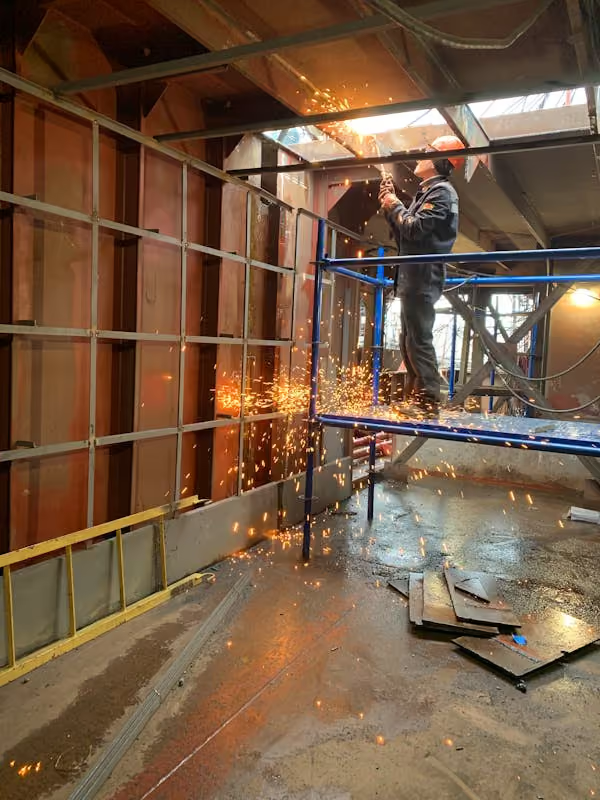
Carrying out construction work outside the law, without the corresponding permit, entails serious and varied consequences that can affect the owner both financially and legally. Firstly, City Councils have the authority to impose financial penalties ranging from a few hundred euros to tens of thousands, depending on the severity of the violation. In addition, a stop-work order may be issued for cessation of work, causing significant project delays and incurring additional costs.
In the worst-case scenario, the demolition of the construction carried out illegally could be demanded, which would represent an additional cost and a considerable loss of time and resources. Likewise, carrying out work without a license would cause conflicts with neighbors and authorities, potentially leading to complex legal proceedings
Finally, it is important to note that if unauthorized work is discovered, this will not only make selling the property difficult, but also reduce its market value, which represents a significant disadvantage for the owner.
Investing in real estate has never been so accessible and efficient. Our real estate investment model eliminates unnecessary intermediaries and gives you direct access to exclusive opportunities for profitable investment in global real estate markets, with complete transparency and security in every transaction.
At Domoblock, we carefully select properties in strategic areas with high medium- and long-term potential. These locations are supported by detailed market analyses and growth projections, ensuring that every investment is profitable and reliable. Furthermore, our team of experts optimizes each project to maximize investor returns.
Our platform is designed to democratize access to the sector, offering returns exceeding 10% in short periods of 8 to 12 months, an ideal option for those seeking quick and effective results.
Domoblock offers various projects in real estate investment in Madrid, real estate investment in Alicante, real estate investment in Zaragoza and real estate investment in Valencia. Check it out!
Don't miss the opportunity to build a solid and diversified portfolio with Domoblock! Discover how to transform your finances with global real estate investments designed to maximize your returns. Take the first step today and leverage the power of technology and innovation on your path to financial success.
A building permit is an essential component in the construction and renovation process in Spain. Although it may seem like a tedious process, obtaining the correct permit provides security, avoids penalties, and ensures that works are carried out in accordance with current regulations.


.png)

41 Av. del Oeste
Funded
-
-
Target
€763,249.36


.png)
.png)
.png)
.png)




.avif)
.avif)


