

A mortgage is a financial instrument that allows many people to acquire real estate; however, it's important to note that once the debt has been paid off, we must proceed with the cancellation of the mortgage in the registry, as it does not disappear automatically. This process not only has legal and financial implications but is also essential to guarantee full ownership of the property.


The cancellation of a mortgage in the registry is the legal process by which the entry reflecting the existence of a mortgage on a property is removed from the Property Registry. Therefore, anyone who finishes paying off their mortgage loan must proceed with the official cancellation of the mortgage. This way, it will be recorded in the Property Registry that the property is free of encumbrances. This procedure is essential to ensure that the property owner can exercise all their rights over the property, without limitations.
Cancelling the mortgage in the registry is not mandatory, but it is advisable. By doing so, the full ownership of the property is restored to the debtor, who no longer has any financial burden. Let's look at the reasons for its importance.
Once the mortgage is cancelled, the owner can sell, rent, or re-mortgage the property without restrictions. After all, the value of a property free of encumbrances, in terms of an owner's financial solvency, is greater than that of a mortgaged property, which facilitates any type of financial operation they might wish to undertake. Furthermore, when selling the property, the buyer will demand that it be free of the mortgage and other encumbrances that could harm or diminish its value or their rights.
With the property free of that encumbrance, you have the option to take out a new mortgage, should you need one.
The cancellation ensures that the property is free of encumbrances, which is fundamental for legal certainty in any subsequent real estate transaction you wish to carry out.
As an owner, you will have greater peace of mind knowing that the property is completely free of encumbrances.
There are three cases in which mortgage cancellation is carried out, by going to the registry so that the mortgage no longer appears as an encumbrance on the property:
This is the most common case: once you have completed the agreed-upon terms for paying all installments of your mortgage loan, you must process the final mortgage cancellation.
This occurs when the borrower makes an early payment and settles the entire debt with the bank. It's important to note that, depending on the signed contract, you might have to pay an early repayment fee, a cost that will be added to the total mortgage cancellation expense.
A special case, for example, is when you are not satisfied with the mortgage terms and cannot transfer it. You might consider canceling and proceeding to open a new mortgage with another institution. Keep in mind that, in a case like this, transferring the mortgage to another bank is more cost-effective than canceling it, as cancellation involves higher costs.
The process of canceling a mortgage in the Spanish property registry involves several steps, which we will outline below:
The first thing you need to do is go to the bank to request the “zero-debt certificate”. This is a free procedure, as stated by the Bank of Spain.
Once you have obtained the certificate, it will be time to go to the notary to formalize the mortgage cancellation deed. Present the aforementioned "zero-debt certificate," your ID (DNI), and the property's purchase deed there. The notary's fees will be paid at this point.
It is important to note that this procedure requires representatives from the bank to be present for the signing of the cancellation, and just like the previous step, you should not pay anything to the bank. Signing before a notary is the fulfillment of an obligation and not a service provided by the bank, as the institution must extinguish the guarantees when the mortgage is canceled.
Now you will need to go to the Tax Agency to request and complete the Documented Legal Acts Tax form (Form 600). Although the mortgage cancellation process is exempt from paying this tax, this is a mandatory step. You will not pay anything, but you will receive the form presented and stamped by the Tax Collection Office.
With the zero debt certificate, the notarized mortgage cancellation deed, and a copy of the Documented Legal Acts Tax form in hand, it's time to go to the Property Registry to remove the charge and finalize the entire mortgage cancellation process.
Upon completing this process, it is recommended to request a property registry extract from the Property Registry, to verify that the mortgage has been correctly cancelled and that the property is free of encumbrances.
After paying off your mortgage, you will need these documents to proceed with the mortgage's registry cancellation:
It is important to ensure that all documentation is complete and correct to avoid delays in the cancellation process.
These are the expenses you will incur when carrying out the process:
These fees are calculated as a percentage of the originally granted capital, meaning they depend on the amount of each loan. An estimated cost of 115 euros is expected for notary and registry fees.
As these are not fees regulated by law, they will depend on the rates applied by each particular agency.
Should this occur, the costs of mortgage cancellation would also include an early repayment fee. This fee will depend on when the loan was signed.
Mortgage cancellation costs should be anticipated from the moment the client is about to take out the mortgage. In total, they can range from around 600 euros if you handle them independently, or about 1,000 euros with the services of a professional agent.
Generally, the cost of officially canceling a mortgage in the registry must be borne by the property owner, meaning the person who has settled the debt with the financial institution.
Since 2002, it has been possible to cancel a mortgage due to lapse, once 20 years have passed since the end of the payment term stipulated in the deed, as dictated by Article 82 of the Mortgage Law.
To proceed with the official cancellation of a mortgage due to lapse, 21 years must have passed since the last payment was made. This additional year is mandatory for the Property Registry to ensure three things: if there was any default, if the loan was not renewed, or if the prescriptive period was not interrupted in any way.
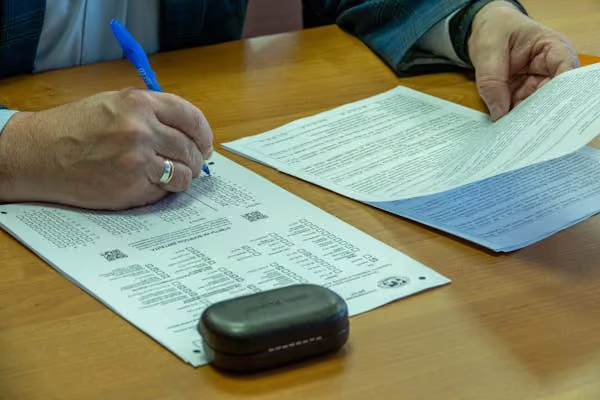
If you have finished paying the installments and do not wish to go through the process of canceling the mortgage in the Registry, you can wait for the mortgage to be canceled by lapse or statute of limitations. This occurs after 20 years from the end of the mortgage term (as stated in the deed); at that point, the mortgage lien expires. You can then submit a request to the Property Registry to remove this lien on your home. You will incur the registrar's fees, but you will save on notary and agent fees, and the operation will be completed quickly.
Obviously, if you wish to sell or rent the property before these 20 years, you will face difficulties because the property will still appear as an encumbered asset. Furthermore, you will not be able to apply for financing using the property as collateral, and if the property is inherited, the heirs may face problems related to the mortgage lien. For all these reasons, our recommendation is that you officially cancel the mortgage in the registry once you have finished paying it.
At Domoblock, we invite you to read our articles on: reverse mortgage, open-ended mortgage, fixed, variable, or mixed-rate mortgage, mortgage review, mortgage subrogation, mortgage tax relief.
Domoblock is much more than a platform for real estate investment, it is the bridge connecting the traditional real estate market with the future of digital finance. Thanks to our innovative approach to real estate tokenization, we are redefining how people access and participate in high-impact real estate projects. This model not only makes investing simpler and more secure but also opens the door to unprecedented democratization, allowing anyone to diversify their portfolio with as little as €200.
Our value proposition focuses on maximizing your results without complications. We offer a unique opportunity to achieve returns exceeding 10%, with projected returns in less than 12 months. This approach not only delivers attractive results but also adapts to the needs of modern investors seeking dynamic and flexible options to grow their wealth.
Additionally, we offer different types of real estate investments; you can check out our real estate investment in Madrid.
With Domoblock, you're not just investing in investment assets, you're investing in a better future, backed by innovation and trust. This is your opportunity to be part of a revolution that is transforming the real estate sector and opening new possibilities for investors worldwide. Start building your portfolio today and be part of the change!
If you find yourself in the situation of having finished paying off your mortgage, do not hesitate to initiate the registration cancellation process as soon as possible. Remember that seeking advice from a specialist can greatly facilitate this procedure and ensure it is carried out correctly and efficiently. Your property is a valuable asset, and ensuring it is free of encumbrances is essential for your peace of mind and financial security.


.png)

León XIII, 27
Funded
-
-
Target
507.697,35 €


.png)
.png)
.png)
.png)



.avif)
.avif)


