
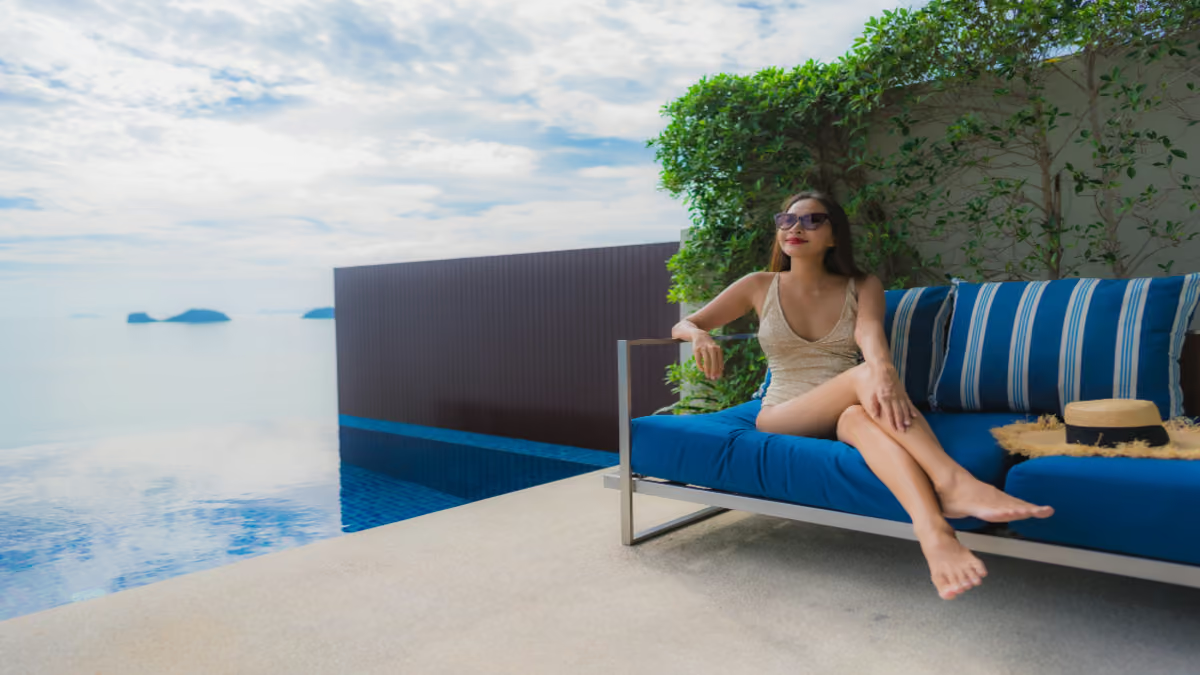
Branded residences combine the comfort of a home with the prestige, security, and impeccable service of a major luxury brand. This is one of Europe's most active markets.


An exclusive residential property, a collaboration between a real estate developer and a renowned brand, whether from the hotel, fashion, automotive, or another luxury sector. They offer owners high-end living and access to a package of services, amenities, and experiences managed by the brand.
They emerged in 1927 in New York with the opening of the Sherry-Netherland Hotel, which offered apartments with hotel services. The concept took off in the 1980s, driven by chains like Marriott International, Four Seasons, and Hyatt. These were primarily residences within hotel complexes.
Currently, they are independent projects with a very defined brand identity and also include fashion, automotive, and design firms, or public figures.
Owners gain access to a wide range of luxury services that simplify and enrich daily life: 24-hour concierge and personal assistance, maintenance, security, package and reservation management, and exclusive amenities.
Association with an internationally recognized luxury brand provides intangible value and a seal of quality. Buyers acquire a privileged status.
They typically sell at a premium of 20% to 40% compared to an unbranded luxury property, and have shown sustained appreciation due to demand and associated prestige.
Many residences offer rental programs managed by the operator. This allows for income generation during periods of absence.
Condo-Hotels are located within a hotel, sharing its facilities and services. Co-located residences are in a building or complex adjacent to a hotel, and standalone projects are independent residential developments managed by the brand.
Hotel-branded residences are led by luxury hotel chains, Fashion/Lifestyle-branded residences are from fashion, design, or lifestyle brands, and Motor-branded residences are from ultra-high-end automotive companies.
For residential use, conceived as primary residences or secondary homes, and for hotel/investment use, designed to be incorporated into a tourist rental program.
You might be interested in: investing in tourist apartments.
Branded residences reflect the brand's aesthetic and values. World-renowned architects and designers are often involved.
A dedicated team is available for any need, such as booking restaurants, managing in-home events, or handling unexpected household matters.
They feature swimming pools, spas with treatments, equipped gyms, private cinema rooms, wine cellars, chef's kitchens, and landscaped gardens.
State-of-the-art security systems, access control, and discreet management ensure peace of mind and confidentiality.
Brands regularly organize social events, tastings, private dinners with chefs, or cultural activities to foster an exclusive social environment.
It combines the work of the real estate developer who develops the project, the brand that licenses its name, contributes to design and service, and usually manages daily operations. In return, it receives an initial fee and/or a percentage of service or rental income; and the investor/owner, who purchases the property and pays, in addition to the purchase, an annual ****service fee.
The owner can sign a rental program agreement, ceding the use of the property to the operator for tourist rental during part of the year, while reserving a number of days for personal use.
In branded residences, the buyer owns a specific property registered in the land registry and pays for services managed by a brand.
In a Condo-Hotel, the buyer acquires ownership of a room or suite within a hotel, which is managed as part of the hotel's inventory, and receives a percentage of the income generated by "their" room, but does not use it as a personal residence.
Miami, Dubai, London, and New York are mature and competitive markets. Destinations like Indonesia, Turkey, Mexico, and the United Arab Emirates have experienced exponential growth.
Growth has reached 39 projects and over 2,000 units by 2025, representing 12.5% of the European market.
Notable areas include the Costa del Sol (Málaga) with 21 projects, mainly in Marbella, Benahavís, Estepona, and Casares, featuring hotel brands (Marriott, Four Seasons), fashion brands (Dolce & Gabbana, Fendi), and automotive brands (Lamborghini); Madrid, with prime locations and luxury hotels like Four Seasons Madrid; and Barcelona, the Balearic Islands, and the Canary Islands with projects for both international and national markets.
The Spanish market is led by the Costa del Sol, Madrid, the archipelagos, and Barcelona. Projects include "Sierra Blanca by the Sea" (by Rafael Nadal and Palladium) in Estepona, "Design Hills Dolce & Gabbana" in Marbella, and "The Gallery by Minotti" in Marbella.
Projected growth exceeds 300% in a few years, driven by international demand with over 60% of buyers being foreign, the massive entry of global hotel chain brands and luxury firms, and strong fundamentals of stability, first-class tourist infrastructure, and still competitive prices compared to other destinations.
Yes, but with selectivity. The market is expanding, with solid demand from a global high-net-worth base, and projects have shown strong appreciation and resilience. However, careful analysis of the real value proposition, the developer's solvency, and the brand's reputation is needed.
Traditional luxury properties have a high purchase price due to their location and quality, are subject to local market cycles, management is the owner's responsibility, good rental income can be generated but requires active management or an agency, they have recurring community and maintenance costs, and their value proposition is based on space and location.
In a branded residence, the price includes a 20%-40% premium for branding and services; they offer more resilient and superior appreciation due to the brand, which also manages them. Rental income comes from integrated programs, the premium service fee is high, and the lifestyle, services, prestige, and comprehensive experience are their value proposition.
Demand is global, driven by the growth in the number of high-net-worth individuals. Supply in Spain is growing at an accelerated pace, but it remains a niche and exclusive segment within the overall residential market.
For international high-net-worth individuals, for investors seeking capital appreciation and profitability, and for people who prioritize lifestyle and time-saving, such as very busy professionals or retirees who want to enjoy an environment of maximum comfort.

The future points to greater diversification and sophistication, an increased influence of fashion, design, and wellness brands, and the rise of experience and community with the creation of curated communities around common interests.
There will also be geographical expansion to other Spanish coasts and exclusive inland destinations. Sustainability will be prioritized as a standard, along with integrated technology.
The difference lies in focus and scope. A serviced apartment typically offers a limited range of services and lacks a brand identity. A branded residence is built around a specific narrative and lifestyle of a global luxury brand, offering superior amenities and management.
In the hotel sector: Four Seasons, Marriott International (through its St. Regis, Ritz-Carlton, EDITION brands), Mandarin Oriental, Accor (with Raffles, Banyan Tree). In fashion and lifestyle: Armani, Dolce & Gabbana, Fendi, Missoni. In automotive: Lamborghini, Porsche Design, Bentley.
They include a core set of services: 24h concierge, security, common area maintenance, basic cleaning. They may also include deep cleaning, laundry and ironing, catering and private chef services, childcare/pet care, travel and event management, and in-home spa and wellness services.
They can be an attractive investment due to their potential for appreciation and income generation. However, in 2026, with a more mature market and greater supply, discerning selection will be crucial. It is not an investment for everyone, due to the high initial outlay and high recurring costs, but it can offer a unique combination of personal enjoyment and financial return.
The world of real estate investment is no longer reserved only for large capital. With Domoblock, you can invest in real properties starting from just €200, removing the entry barriers of the traditional model.
Its blockchain-based technology, real estate tokenization and real estate crowdfunding ensure secure, traceable, and transparent operations at all times. Each project is carefully evaluated to offer opportunities with an estimated return exceeding 10% and capital repayment periods ranging from 8 to 12 months.
Domoblock positions itself as an innovative solution for those looking to diversify their money through digital, accessible, and financially growth-oriented real estate investment.
Branded residences market a lifestyle, an experience, and belonging to an exclusive community. For the buyer-investor, they represent an opportunity to access an asset with interesting financial potential.


.png)

41 Av. del Oeste
Funded
100%
763.249,36 €
Target
€763,249.36


.png)
.png)
.png)
.png)




.avif)
.avif)
.avif)


