

The advent of blockchain technology is changing and will continue to change how society thinks, interacts, relates, and exchanges value. This exchange is largely supported by digital assets (tokens and cryptocurrencies), which are essential for this complex decentralized system to function correctly.
Since their inception, cryptocurrencies and tokens, despite their countless advantages, have been characterized by high volatility, negatively impacting the development of decentralized financial products.
Developing an investment strategy based solely on volatile assets or transferring value between individuals or companies using cryptocurrencies as a payment method presented a significant drawback, often leading to abandonment or rejection.
Given this unstable and inefficient situation, the emergence of a crypto asset with a stable price was imminent—a digital asset whose objective was to provide prices that would not fluctuate sharply and would allow for greater market stability.
As you can imagine, these are called stablecoins.
A stablecoin is essentially a token, used as a digital currency on the blockchain, and whose price is pegged 1:1 to fiat currencies like the dollar, euro, or others.
Stablecoins offer numerous advantages, as they are still crypto assets registered on the blockchain, and therefore retain properties such as immutability, traceability, privacy, agile trading and storage, etc. Additionally, they provide a framework of stability for all participants without the need to move off-chain to protect against high volatility.
The popularity of stablecoins has increased exponentially in recent years with the mass adoption and emergence of new coins that maintain their value pegged to the dollar. However, as we can imagine, some have become more popular than others, mainly due to the mechanisms used to maintain their stable price and whether these mechanisms are centralized or decentralized.

Stablecoins are cryptocurrencies designed to maintain a stable value relative to a fiat currency, such as the US dollar. To achieve this, they use several methods, including:
They are a useful tool for those who wish to use cryptocurrencies without the volatility associated with traditional digital currencies.
The way stablecoins maintain their price is directly related to how they are generated or created. Let's look at this in detail.
There are different ways to create stablecoins, although the most common is by using fiat currencies as collateral.
A centralized company generates new stablecoins while depositing the same number of dollars or euros in a financial institution (it issues one stablecoin for each fiat currency deposited).
This means that each stablecoin is backed by a government currency, and the market understands it this way. Therefore, its price is directly linked to that currency and any potential deviations are corrected through arbitrage.
If we want to trust this type of stablecoin, we should ensure that the fiat money deposits backing them are audited. Otherwise, it's possible that the issuances are only partially backed, with the potential risks that would entail.
Some of the most popular fiat-backed stablecoins are; USDT, USDC, BUSD, and GUSD.
These stablecoins can be purchased on a secondary market through a DEX or a centralized exchange. You could also acquire them directly from the platform that issues them, although in this case, you would have to go through an identification process (KYC/AML).
These stablecoins are created through token-collateralized loans. For example, if I have ETH, I can take out a loan against my ETH in the form of a stablecoin.
Their operation is more complex than that of fiat-backed stablecoins, as in this case, smart contracts are used to manage the issuance and collateral to ensure that new stablecoins are not partially collateralized.
The way to avoid this situation is:
The first cryptocurrency-backed stablecoin to appear was DAI, and it is currently one of the most well-known. DAI, through its decentralized protocol (Maker DAO), allows for the creation of cryptocurrencies in the form of a loan, by depositing ETH or other cryptocurrencies as collateral.
The protocol ensures its stability by locking the collateral, which, if its value falls below a predefined limit (collateralization ratio), will automatically liquidate the position. We will dedicate a full article to discuss this revolutionary protocol.
As you can imagine, this type of stablecoin aligns with the philosophy and principles of blockchain technology by maintaining issuance, storage, and governance in a decentralized manner, without relying on any bank or centrally managed collateral.
Unlike the previous ones, algorithmic stablecoins are not backed by any currency or token; instead, their price is algorithmically established through smart contracts that adjust the coin supply based on demand.
If the price of the stablecoin falls, decoupling from the fiat currency it represents, the system will automatically reduce the total supply of tokens (without us doing anything). Similarly, if the price increases, the system will issue more stablecoins to adjust the price and maintain parity.
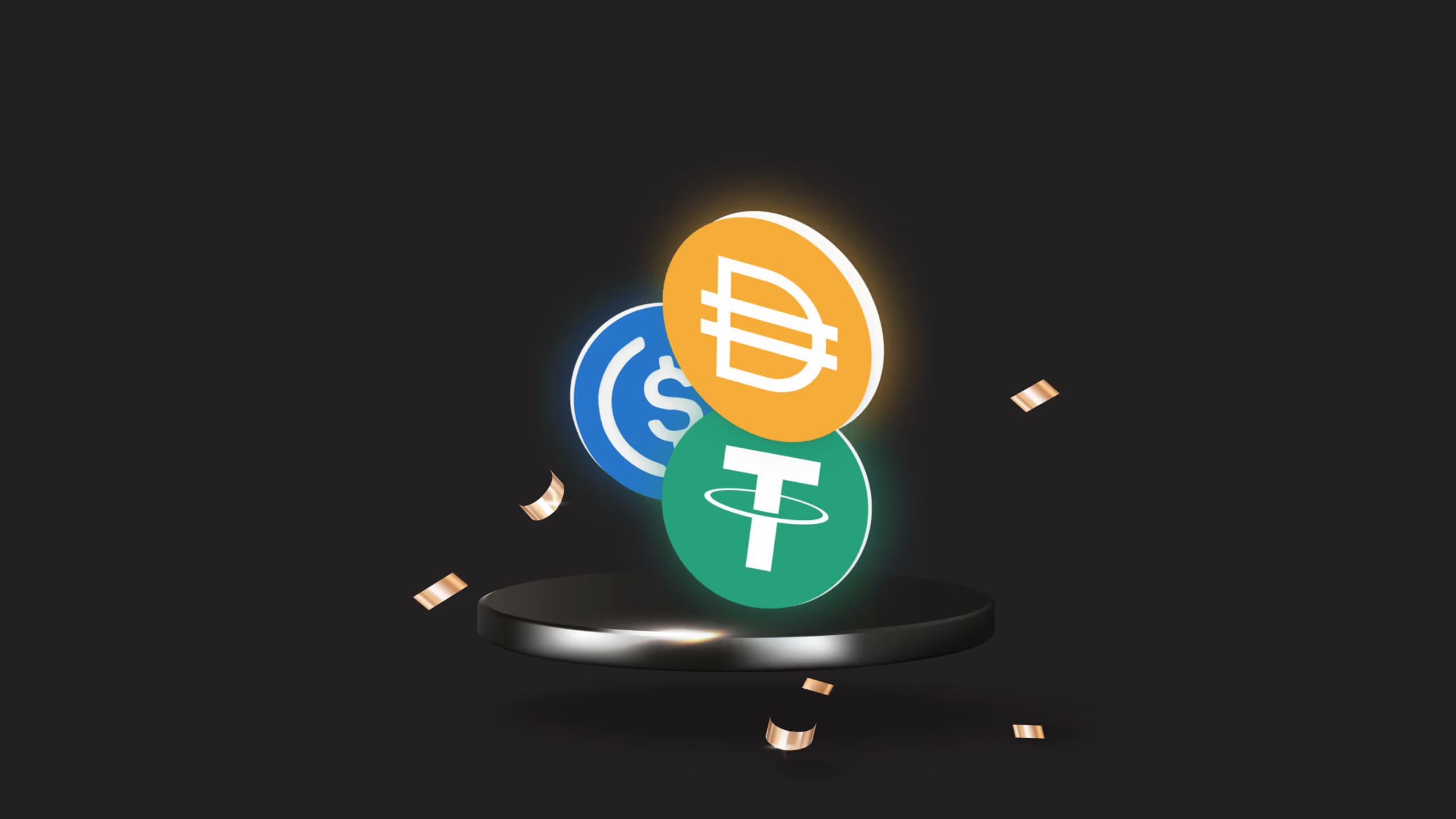
Having a 1:1 parity with the dollar or euro, in a way, means we have tokenized fiat money, and this can be very useful to avoid the risks associated with market volatility.
For example, a user can utilize stablecoins during market downturns to protect their capital, disinvesting without having to convert it to fiat money, which is much more practical and efficient.
They also help boost the liquidity of crypto assets, as almost all tokens and cryptocurrencies are usually traded for a stablecoin, which is safer and easier for investors.
Finally, if we live in countries severely affected by inflation, such as Argentina, using stablecoins could be a useful tool to protect the value of our assets, with greater privacy than if done directly in dollars.
Although it may seem like a trivial use case, as we mentioned, they represent fiat money, it is not yet widely adopted. However, we are already seeing some projects that allow payments in stores using stablecoins. In the near future, we could see greater adoption driven by the advantages of having a fiat currency represented by a token.
Among these advantages, we can find much faster international payments, as well as micropayments, greater accessibility, and use by countries whose population is unbanked.
Perhaps this is the most widespread use and one of the main reasons that helped create this type of token. Stablecoins lay the foundation for decentralized finance and enable the development of financial products that would be difficult to implement without them.
Thanks to stablecoins, decentralized finance protocols are more stable and secure, allowing them to offer more attractive investment alternatives than traditional banking.
We can use stablecoins to make our savings profitable by providing liquidity to a DeFi protocol, or by lending our money in the form of stable currency to other users in a completely decentralized manner in exchange for interest, or directly by yield farming alongside another token or cryptocurrency.
We can say that stablecoins are here to stay and are solving major problems that limited the growth of the crypto world.
They improve user experience and thus their adoption, help protect against high volatility, allow for the design of a more affordable and simpler investment strategy, and of course, generate passive income by utilizing DeFi protocols, such as Compound, a borrow/lend protocol.
But despite all these advantages, we must not overlook the underlying risks, such as the high volatility of the crypto market, increasingly stringent regulations, potential security flaws in smart contracts, or the significant responsibility involved in their storage (losing the private key associated with the wallet would mean losing all funds).


.png)

41 Av. del Oeste
Funded
-
-
Target
€763,249.36


.png)
.png)
.png)
.png)




.avif)
.avif)


