

Full ownership, also known as absolute ownership, is a fundamental concept in civil law that refers to complete title over an asset. In Spain, this term is used to describe the situation in which a person possesses all rights corresponding to the ownership of an asset, whether real estate or movable property.
Property owners and those interested in acquiring assets should be familiar with this information, as it affects transactions, rights, and obligations arising from asset possession. Let's take a closer look.


Full ownership is defined as the legal situation in which a person holds all rights over an asset. This refers to the right to use, enjoy, and dispose of the asset, as well as the right to exclude others from its use. According to Article 348 of the Spanish Civil Code, the owner of an asset in full ownership has the power to exercise all rights granted by law over said asset, within the limits established by regulations.
It's important to note that the concept of full ownership differs from other forms of property rights, such as bare ownership or usufruct: while in full ownership the owner enjoys all rights, in bare ownership the titleholder only retains ownership of the asset without the right to enjoy it, as this right has been granted to another person through a usufruct.
Full ownership is the union of bare ownership and usufruct; meaning that full ownership can only be acquired by combining both rights. It has the following characteristics:
The owner has all rights over the asset: the right to use it, enjoy its fruits, and dispose of it as desired.
This means that, without the owner's consent, no one can use or interfere with the property right.
The owner is responsible for damages their property may cause to third parties and must comply with the tax and legal obligations associated with the property.
The right of full ownership is perpetual, meaning it has no expiration date and can be transferred to heirs.
To better understand full ownership, it is essential to compare it with other property-related concepts:
It refers to the complete possession of an asset, with both the ownership of the asset and its full use resting with the same person. In other words, the owner has the right to use it, enjoy its fruits, and dispose of it.
On the other hand, regarding expenses, when full ownership of a property is acquired, all related expenses will be the responsibility of the owner.
Bare ownership refers to a situation where a person owns a property but does not have the right to enjoy it; their right has been transferred to another person through a usufruct. Therefore, the bare owner cannot use the property until the usufruct expires. Regarding expense payments, the bare owner is obliged to cover expenses arising from the homeowners' association, as well as property taxes and home repairs.
This is the right that allows a person to use and enjoy a property belonging to another person (the bare owner). The usufructuary has the right to enjoy the fruits of the property but cannot sell or alter it in a way that affects the bare owner's property.
Furthermore, the usufructuary must cover expenses arising from the use and enjoyment of the property, such as electricity, gas, and water services.
In summary, full ownership implies complete title, bare ownership refers to property without the right of use, and usufruct is the right to use and enjoy a property that is not one's own.
Full ownership is the most complete form of property, meaning the owner has all rights over the property; however, as is well known, rights also come with obligations. Full owners are required to pay the taxes corresponding to the property, such as Property Tax (IBI). They must also comply with urban planning and environmental regulations that may affect their property.
Considering that full ownership is a real right that implies total possession of a property, it has its pros and cons. Let's look at them:
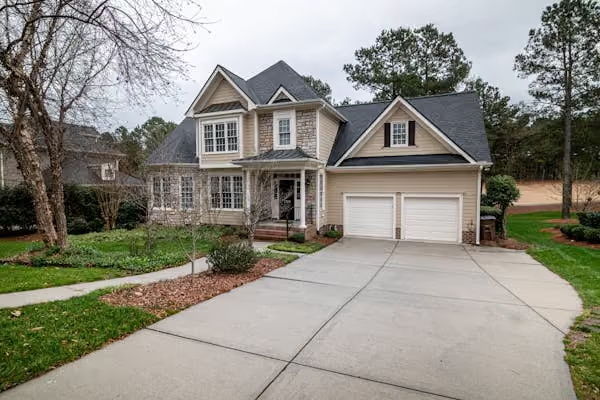
To transition from bare ownership to full ownership, the usufruct that limits the bare owner's rights must terminate. The conditions for this to happen are as follows:
It is important that bare owners are aware of the conditions under which the usufruct was established in order to plan for the recovery of their rights.
Undoubtedly, as a full owner, you have the right to transfer your property to another person whenever you wish. This can be done through various methods. One of them is sale, where you transfer your property to a buyer and grant them full ownership in exchange for an agreed price
You also have the option to donate your property, which allows you to transfer full ownership of your property to another person without receiving financial compensation.
Another way is, in the event of death, full ownership of your assets will be transferred to your heirs according to what is stipulated in your will or, in its absence, according to the provisions of the law.
We recommend that any property transfer be carried out through a formal contract and registered in the Property Registry to ensure the validity of the transfer.
Yes, it is possible to lose full ownership of a property under certain circumstances.
Any owner involved in illicit activities runs the risk of losing the property; the State can confiscate it if it is associated with crimes, which would result in the loss of full ownership
Another situation that can lead to this loss is the seizure, which occurs when creditors, due to unpaid debts, request the seizure of the property, resulting in the loss of the property.
On the other hand, full ownership of the property can be lost if the State decides to expropriate it for reasons of public interest, although in these cases, the owner must be fairly compensated.
Full ownership allows owners to make decisions about their assets, according to their interests and needs. Let's look at some examples:
Domoblock, the revolutionary platform that combines the best of blockchain technology and in real estate tokenization and real estate crowdfunding to offer you a modern and secure way to invest. At Domoblock, you gain access to exclusive real estate projects, hand-picked by industry experts to maximize your profitability and optimize your investment.
Start investing from just €200 and discover a wide range of opportunities in the real estate market with returns exceeding 10% in less than 8 months. Domoblock is transforming how investors access the real estate market, providing easy access to high-yield properties and a diversified, affordable investment model for everyone.
Domoblock focuses on selecting exclusive properties in locations with high performance projections, so get ready for the best investment. This sector has immense growth potential, with a secure and transparent method.
While full ownership provides complete control over assets, it also entails responsibilities and risks that must be considered. The ability to transfer full ownership and understanding how it can be lost are important aspects that every owner should keep in mind.


.png)

41 Av. del Oeste
Funded
-
-
Target
€763,249.36


.png)
.png)
.png)
.png)



.avif)
.avif)
.avif)


