
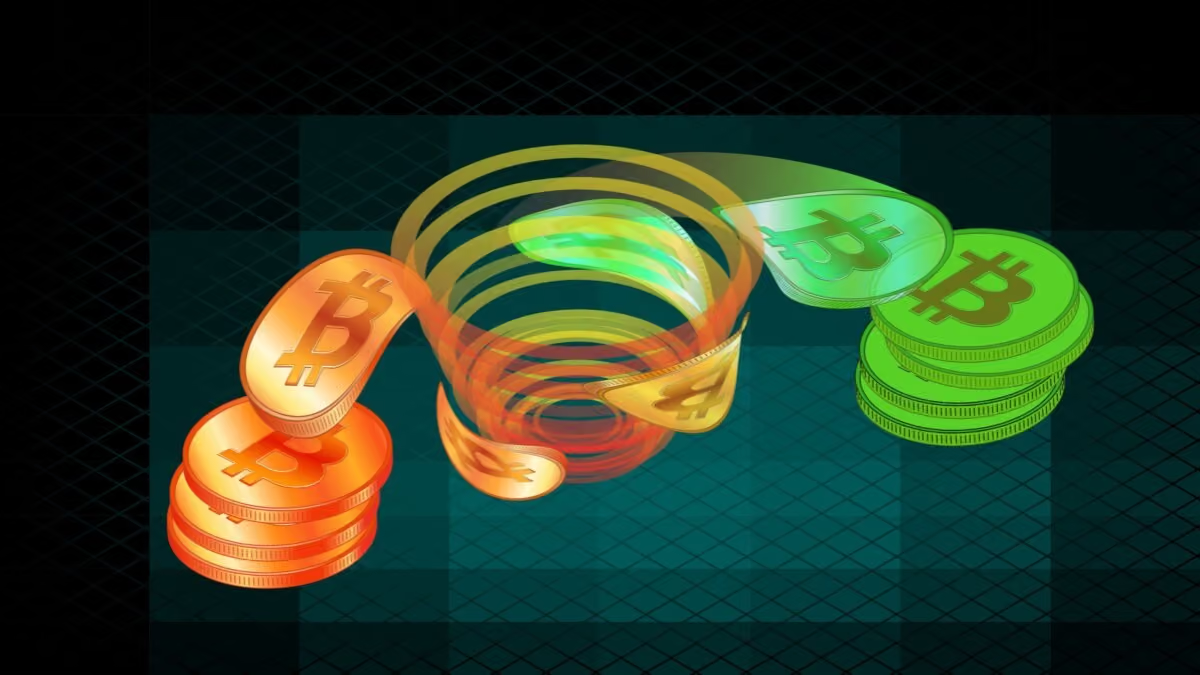
One of the most widespread myths about Bitcoin (and most public blockchain networks, with some exceptions like Monero) is that its transactions are anonymous.
However, the information stored on the Bitcoin network is actually pseudo-anonymous.
This means that the transactions executed are visible to everyone, making the information public. However, it is true that the senders and receivers of these transactions are nothing more than a set of numbers and letters that are NOT intrinsically linked to a real-world identity.
In other words, the information contained in a public blockchain network is visible to everyone, but no one knows, a priori, who is behind each transaction. Everyone can see that X sent 1 bitcoin to Y, but no one knows who X is or who Y is. Hence their pseudonymous nature.
However, reality shows that it is possible to associate a large portion of public addresses with the natural or legal persons who own them. This is because, when we interact with the network, we leave a trace that can be used to link our personal identity with all the activity we carry out on that network.
Basically, because in the process of entering or exiting the blockchain, when introducing or withdrawing real-world fiat money to exchange it for cryptocurrencies, we use mechanisms that require personal identification (for example, when interacting with platforms that use Know Your Customer systems, or when we publicly provide our public address — if you'll pardon the redundancy — to receive donations, payments, etc.).
Furthermore, through the use of advanced techniques, it is possible to associate different wallets and payments with identities thanks to data stored in big data; although it should be noted that in these cases it is usually a probabilistic estimation and it is not possible to prove such a relationship with 100% certainty.
Moreover, this fact implies that everyone will be able to see who you interact with and how, how many cryptocurrencies you own, and associate it with your personal identity. It is in this context that cryptocurrency mixers emerge.

A cryptocurrency mixer is an application or service that allows you to erase or hide the trace of cryptocurrencies, making them anonymous again, by sending them to 'untainted' addresses (not associated with real-world identities).
Initially, cryptocurrency mixers were conceived as centralized services: a company would provide a service for which it charged a commission in exchange for receiving your cryptocurrencies, pooling them with others and mixing them (hence the name), and sending them to their recipient. This way, it was not publicly recorded on the blockchain who you sent the cryptocurrencies to from the 'tainted' address. And thus, the 'clean' address would hold an amount of cryptocurrencies that no one could associate with any real identity.
However, this type of mixer has a fundamental problem: the company acting as an intermediary knows and records your input and output data, meaning it could sell your information or hand it over if compelled.
For this reason, the decentralized mixers. These are programs hosted on the blockchain (smart contracts) that allow numerous users to send their cryptocurrencies to the protocol.
This is designed (broadly speaking, as each protocol has specific and complex functions) to gather the total amount received, divide it into fractions, mix them together, and send small amounts to the set of recipients indicated by the senders (each receiving the corresponding amount, of course).
In this way, and very efficiently, any cryptocurrency sent through these protocols completely loses its trace, making it impossible to associate the final recipients with any real identity.
These mechanisms would be the panacea for privacy if it weren't for the fact that they are targeted by governments.
Over the past 2 years, we have seen several of these decentralized projects targeted; their creators even arrested, as in the case concerning the protocol Tornado Cash, a decentralized protocol that is therefore not controlled by a specific entity. This fact has generated significant debate within the community.
Furthermore, numerous protocols on which a large part of the crypto community relies have blocked or prevented the use of cryptocurrencies that have passed through any of these crypto mixers. As a result, addresses holding mixed cryptocurrencies will not be able to use them.
Governments justify the targeting of these types of protocols because, as some prominent blockchain analytics firms have shown, these mixers are sometimes used to launder cryptocurrencies stolen in hacks or banned for other reasons.
This is not an opinion piece, so I will only comment that I don't get the impression that the money laundering argument is the true reason governments pursue privacy. But it is the official argument.
In short, cryptocurrency mixers are currently at the center of a debate that encompasses much more than just the use of these applications: the right to privacy for any citizen versus the duty to ensure collective security. The age-old debate: freedom versus security.
And that's a debate for another article.


.png)

41 Av. del Oeste
Funded
-
-
Target
€763,249.36


.png)
.png)
.png)
.png)




.avif)
.avif)


