
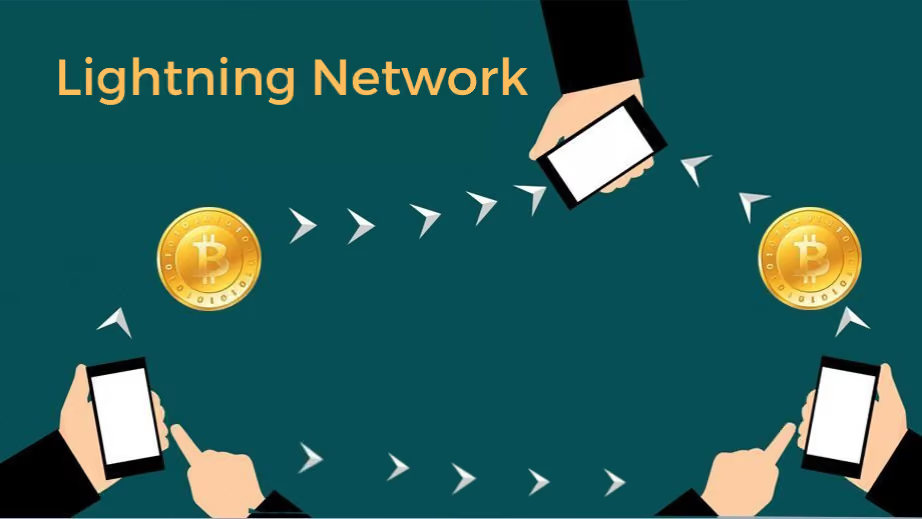
Lightning Network revolutionizes the way Bitcoin is used. It aims to be the definitive solution for transforming Bitcoin into a large-scale payment method, reducing transaction confirmation times and network costs.
B(b)itcoin is a cryptocurrency known to all. Bitcoin (with a capital B) is the decentralized software launched by Satoshi Nakamoto in 2008, while bitcoin (with a lowercase b) is the digital currency that this software generates as an incentive and aspires to be the future of electronic money, exchanged peer-to-peer without the intervention of a financial institution (it aims to eliminate the centralized intermediary through process decentralization, relying on existing technologies like cryptography or algorithms such as proof-of-work).
However, despite meeting many of the necessary requirements to become digital money, it has a series of limitations that currently prevent it from being used on a large scale in this way. In fact, it can be said that today it is used more as an investment product and store of value than as a means of payment.
Among these limitations, for the topic at hand – which is also one of Bitcoin's main current problems – we can highlight its limited scalability.
This problem was identified from the moment Satoshi proposed Bitcoin in 2008, when James A. Donald publicly stated that, as he understood the proposal, he didn't see it capable of scaling to the necessary size. Even Satoshi Nakamoto himself, in 2013, debated with Mike Hearn the need for high-speed trading in Bitcoin to process a large number of transactions per second.
Lightning Network is a tool created with the aim of solving this problem, and its use and specific use cases have been growing steadily since it was introduced in 2015.
But what do we mean when we talk about Bitcoin's scalability problem?
Basically, it refers to the network's inability to generate and store information at the speed its users demand. This problem arises once the number of users, and therefore network utilization, increases significantly. In other words, the more people use it, the worse the user experience will be.
Bitcoin operates by issuing information in the form of transactions on a shared database among network participants, who are responsible for continuously updating it based on the orders or transactions being issued.
Well, this database stores information in the form of blocks, and these blocks are issued at regular intervals. Obviously, each block can only store a specific amount of information.
This is where the problem arises, because if the network can only issue a limited amount of information within a given timeframe, the transactions issued (which occupy a certain space) will not be able to exceed this limit. Therefore, the frequency at which the network will store a transaction once issued will not be high.
If we compare Bitcoin with VISA, Bitcoin's scarcity of processing speed stands out, with a maximum (approximately) of 7 transactions per second (on average, about 4.6 tx/s are processed) compared to VISA's 24,000 tx/s (on average, about 1,700 tx/s).
This means that if a large number of users are issuing transactions, the network will not be able to issue information at the same rate that users make requests. This will result in two visible consequences for them: a delay in the time it takes for their transactions to be confirmed and approved by the network, and an increase in the fee to be paid.
Consequently, if the entire population were to use Bitcoin, the number of transactions required per second would be far greater than what the network can support, and in this scenario, using bitcoin as a payment method would not be optimal for the user.
Many solutions have been proposed throughout Bitcoin's history, such as increasing block storage capacity (increasing block size), decreasing the time between block emissions, creating other cryptocurrencies that sacrifice other aspects like decentralization or security... but without a doubt, the solution that is having the most impact on the ecosystem is Lightning Network.

Lightning Network is a layer-two solution that allows its users to perform instant, low-cost transactions, leveraging the security of the Bitcoin protocol but without individually including each transaction on the blockchain. Although Lightning's scope is not limited to Bitcoin, it also allows operations with other cryptocurrencies like Litecoin.
Lightning Network, through a network of payment channels and operating on a second layer of Bitcoin (it operates off-chain; it consists of a layer two -ledger2- that leverages the security of the main layer but provides it with new functionalities and capabilities), allows its users to exchange bitcoin without needing to record each transaction individually in a block.
As early as 2013, Satoshi Nakamoto himself discussed with Mike Hearn the need for high-speed trading in Bitcoin to process a large number of transactions per second. However, it wasn't until 2015, at a Bitcoin seminar in San Francisco (Bitcoin Devs Seminar: Scaling Bitcoin to Billions of Transactions Per Day), that Joseph Poon and Thaddeus Dryja officially presented Lightning Network as a project.
The whitepaper was published in 2016, although the first transaction using a payment channel took place in 2017.
Since then, its growth has been exponential, and currently, some of the companies working on and investing in the development of this network are Blockstream, Acinq, and Lightning Labs.
The full potential and utilization of a solution like Lightning was not possible until the Segwit update was implemented in 2017, which addressed the malleability problem that Bitcoin suffered from.
Lightning is built upon payment channels. The Lightning Network is essentially the way all these payment channels are connected so they can interact with each other.
But how does a payment channel work?
The answer is, through multi-signature transactions. A multi-signature transaction is one that is signed by more than one private key (which means more than one user) and in which at least one of them sends funds.
This multi-signature transaction generates a payment channel via a script in which these two participants can exchange up to the entirety of the bitcoin sent in the transaction, which, in turn, has been locked from the main network and therefore cannot be used on it until the payment channel is closed.
In this way, both participants can exchange bitcoin as many times as they require, and due to Lightning's nature, all these transactions are issued off the main network, resulting in an immediate update of both signers' balances within the payment channel; this means these transactions are conducted without paying fees and can be confirmed on Lightning instantly. However, both the initial transaction to open the payment channel and the transaction that updates the signers' new balance on the main network must pay a fee like any other transaction on the main network, so it is advisable to open channels only when multiple transactions are planned.
It is important to mention at this point that to open payment channels, it is necessary to own a node on the network, or to interact with an existing node enabled for such use.
A node is a computer that has the necessary software installed to run and interact with the network of the software it has installed, in this case, Lightning Network. Finally, it's worth noting that each user can create as many payment channels as they wish to establish an exchange relationship in units of bitcoin with anyone they choose.
Well, the above explains a payment channel. However, when many users establish channels among themselves, a network of payment channels is created that can interact with each other and, thanks to its design, allows participants to connect and send funds without being directly connected. That is, if Alice is connected to Bob via a payment channel and Bob, in turn, connects with Fred, Alice will be able to transact with Fred through Bob.
To connect to the network of nodes, it is therefore necessary to open at least one channel with another network participant.
It's worth noting that these intermediary nodes can earn a small commission from such transactions for their intermediation service. This is the case in El Salvador, a country where Bitcoin is legal tender and which offers an intermediary payment channel for its citizens to use Bitcoin as a regular means of payment.

Users have several ways to use Lightning. The way Lightning is conceived involves owning a Lightning node, thus interacting with and directly participating in the network. However, running a node correctly can be complicated for an inexperienced user who simply wants to take advantage of Lightning Network's benefits.
But you can interact with this network through the use of an existing node, just as transactions are made on the main Bitcoin network via an external node instead of installing a node and interacting directly with the network (which is how Bitcoin's operation is designed).
If you don't own a node, to access and transact on this network, you need a wallet that can connect you to one.
There are custodial and non-custodial wallets. Custodial wallets are those where the user does not hold their private key; instead, it is managed by the wallet provider (custodied by a third party). In non-custodial wallets, the user holds the private key (not custodied by a third party).
Some of the most well-known wallets include Moon, Blue Wallet, Wallet of Satoshi, Chivo Wallet (custodial), Phoenix Wallet, or Breez Wallet (non-custodial).
The main criticisms leveled against Lightning are as follows:
Exposure to centralization. Currently, a few nodes establish most connections between different users who don't have direct payment channels and require intermediary channels. Furthermore, it is argued that if the network were to grow massively, the routing method would create problems for computers without high computational power, necessarily centralizing the process.
Low routing fees and malicious attacks are also problems this network faces.
Another criticism is that Lightning payments can only be made between users who are connected to a payment channel and active at that moment, unlike transactions on the main layer of the Bitcoin network where it is not necessary to be connected at every moment a transaction is received.
Finally, the limitation on the amount of BTC when opening a channel necessitates performing new transactions on the main network if additional amounts are desired.
As mentioned in the article, Lightning Network is increasingly used worldwide. Arcane Research, a major blockchain data research firm, published a report last April highlighting significant growth over the past year, though it also noted that much work remains to be done.
According to data from the decentralized finance analytics platform Defi Pulse, the amount of Bitcoin locked in Lightning has increased from approximately 1,000 to 4,000 BTC between January 2021 and the report's release in June of this year. At the time of writing, it boasts a TVL of 84 million US dollars despite the sharp crypto market downturn.
Companies like Bitfinex are investing in projects such as the RGB protocol and OmniBOLT; another example is Lightning Labs, which recently launched the TARO project with the goal of enabling stablecoins and non-fungible tokens on the Lightning Network.
Furthermore, an increasing number of companies are using platforms that connect them to Lightning to transact with their customers and suppliers, saving costs and time, which boosts these companies' competitiveness in their respective sectors.
Today, it's already possible to purchase products with Bitcoin via Lightning from companies like Amazon; Twitter also allows users to send tips through this network; Thndr Games makes micropayments to players using its platform; and a long list of companies are already implementing Lightning in their operations.
It's also worth noting that new uses for Lightning are being explored, such as the ability to exchange cryptocurrencies from different networks via this network.
The state of El Salvador adopted Bitcoin as legal tender at the end of 2021, which has led to a significant increase in payment volume on the Lightning Network, as its citizens have been incentivized to use the network to improve the efficiency of micropayment processes in their daily lives.
Lightning's future is very promising and hinges on infrastructure providers who facilitate the conversion between fiat money and cryptocurrencies. They can enable end-users to utilize the Lightning Network as a payment method and leverage its benefits, even without the user knowing or worrying about using the network.
If Lightning Network manages to solve the issues some in the community refer to, its future seems limitless. It has the potential to become the primary exchange tool, but first, it must become more accessible to the end-user, by facilitating and simplifying its use so as not to lose the qualities that make Bitcoin and Lightning Network a revolution for an intermediation-free value exchange system.


.png)

41 Av. del Oeste
Funded
-
-
Target
€763,249.36


.png)
.png)
.png)
.png)




.avif)
.avif)


