
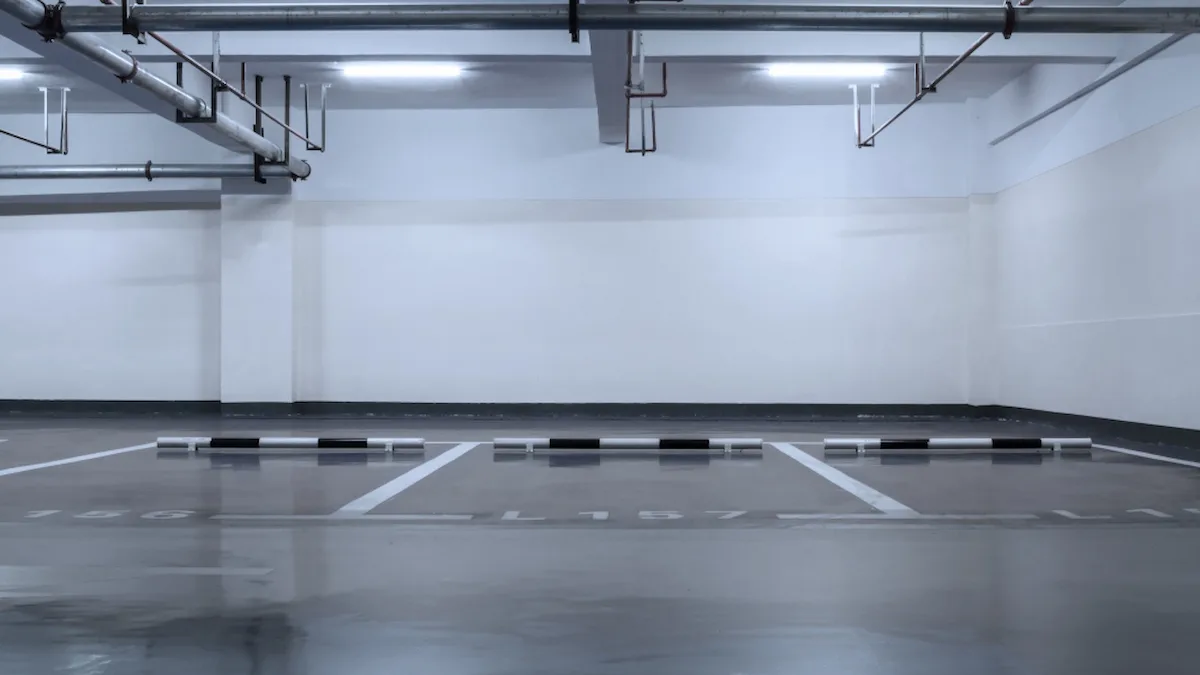
Buying a parking space to rent out has become one of the most common ways to enter the world of real estate investment. You don’t need a large amount of capital, managing a parking space is much simpler than managing an apartment, and in the right areas, the return on investment can far exceed that of other financial products considered safe.
But, as with any investment, not everything goes. Success depends on the location, the purchase price, the associated expenses, and the tax implications surrounding this type of asset. In this guide, we’ll cover everything you need to know before taking the plunge: how much you can earn, what taxes you’ll pay, how to calculate the actual return, and what mistakes to avoid if you want your money to work for you without any surprises.

Investing in a parking space involves purchasing this real estate asset not for personal use, but to generate income by renting it out or to benefit from its appreciation over time. It’s, in essence, the same principle you’d apply to buying an apartment to rent out, but with a much lower initial outlay and considerably less management involved.
Unlike residential properties—where the average price in major Spanish cities can be around 200,000 euros—a parking space typically costs between 10,000 and 25,000 euros, depending on the city and neighborhood. This makes it an affordable option for anyone looking to start building real estate wealth without having to take out a large mortgage.
The process is simple: you purchase the parking space (usually within a parking garage or in the basement of a condominium complex), rent it out to individuals who need a place to park their vehicle, and receive monthly rent in return. In some cases, the parking space may be part of a separate registered property, which makes it easier to buy or sell without having to include an associated residential unit.
There are two main ways to generate income from a parking space: traditional rental to a neighbor or worker in the area, and rental through digital platforms specializing in parking, which are increasingly used in cities with high turnover of visitors or workers who commute by car daily.
Renting is the most common source of income, but it’s not the only way to make a profit. Just as with a home, a well-located parking space tends to appreciate in value over the years, especially in downtown areas where it’s nearly impossible to build new parking facilities. This structural shortage works in the owner’s favor, as they can sell the space in the future for more than they paid for it.
Furthermore, owning a parking space can increase the value of a home if sold together with it. Having a parking space can increase the price of an apartment by up to 7.5%, which demonstrates the significance of this asset within the real estate market as a whole.
Each type of real estate asset has a different risk, return, and management profile:
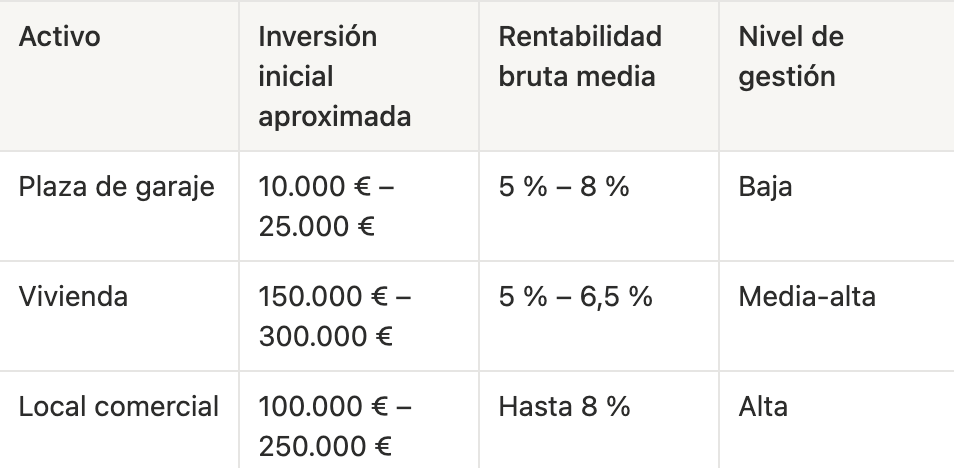
Residential properties require a much larger investment and typically involve renovations, maintenance, and more complex tenant management. Commercial properties, while they may offer similar or higher returns, carry a higher risk of vacancy in medium-sized cities, as they depend heavily on the economic activity of the area. Parking spaces, on the other hand, stand out for their simplicity: less paperwork, fewer unforeseen issues, and a demand that rarely disappears entirely—especially in urban areas with limited parking space.

The short answer is yes, though with some caveats. The average gross return on this type of investment has ranged in recent years between 6.5% and 7.5%, depending on the year and the source consulted. This figure continues to outperform products considered safe, such as bank deposits or Treasury bills, which yield around 2.5% and 3%, respectively.
However, this return does not always remain stable from one year to the next and varies greatly depending on the autonomous community, the city, and even the specific neighborhood. Therefore, before buying, it’s important to understand how it’s calculated and what factors influence it.
Advertisements and comparisons often refer to gross return—that is, the percentage obtained by dividing the annual rent by the purchase price, without deducting any expenses. However, the figure that really matters when making a decision is the net return, which does take into account the costs associated with the property.
These expenses include property tax (IBI), homeowners’ association fees, parking space insurance, maintenance, and, if applicable, loan interest if the purchase is financed. Once these expenses are deducted, the net yield is usually one to two percentage points lower than the gross yield. Thus, a parking space offering a 7% gross yield might yield around 5% or 5.5% net after all expenses are subtracted.
The calculation is simple, and you can do it yourself before finalizing any transaction:
Gross return = (Monthly rent × 12) / Purchase price × 100
For example, if you buy a parking space for 18,000 euros and manage to rent it out for 100 euros a month, the calculation would be as follows:
To calculate the net return, subtract fixed expenses (condominium fees, property tax, insurance, maintenance) from the annual rent before dividing by the purchase price. This small adjustment makes the difference between a deal that looks attractive on paper and one that actually is in practice.
The amount you can earn depends directly on the area and the price paid for the parking space. As a reference, the average monthly rent for a parking space in Spain is around 75–100 euros nationwide, although in central neighborhoods of Madrid or Barcelona it can exceed 120 or 150 euros per month.
If we take as an example a parking space worth 15,000 euros rented for 90 euros per month, the owner would earn 1,080 euros gross per year, which equates to a gross return of approximately 7.2%. Once standard expenses are deducted, that return would be reduced, but it would still be competitive compared to other traditional savings alternatives.
There is no universal figure, but as a general rule, it’s best to rule out investments offering a gross return of less than 5%, unless this is offset by strong expectations of future appreciation. Many experienced investors set a minimum threshold of 6% gross, which, after deducting expenses, typically translates to a net return of 4.5%–5%—a figure that still outperforms conservative savings products without taking on excessive risk.
Before setting your own threshold, consider the average price in the area, the rent you can actually charge (not what other owners advertise, but what is actually paid), and the room for negotiation with the seller.
Beyond the annual return, many investors use other indicators to assess whether a parking space is worthwhile in the long term. One of these is the MOIC (Multiple on Invested Capital), which measures how many times you recoup your initial investment over time, taking into account both rental income and any potential capital gain from the sale.
For example, if you invest 15,000 euros and, over the course of ten years, receive 900 euros annually in rent (9,000 euros in total) and then sell the parking space for 18,000 euros, your recovered capital totals 27,000 euros. The MOIC would be 1.8—in other words, you would have multiplied your initial investment by 1.8 during that period.
The true potential of this type of investment becomes apparent when the rental income is not spent but rather reinvested. A common strategy among parking space investors is to accumulate monthly rent payments over several years until they have enough capital to purchase a second space, and then repeat the process successively.
In this way, each new acquisition increases the monthly income stream, which in turn accelerates the pace at which the next one can be purchased. It’s the basic mechanism of compound interest applied to real estate: it’s not just that the money generates a return, but that this return, in turn, generates more returns.
For this strategy to truly work, several conditions must be met: maintaining a high occupancy rate (avoiding prolonged vacancy periods), controlling management expenses, and reinvesting disciplined rather than diverting the income to other purposes. It’s also important to choose properties in areas with stable demand, since the compounding effect is diluted if any of the investments stop generating income for months.
Ultimately, compound interest isn’t automatic: it depends on the investor’s consistency and the quality of the decisions they make with each new purchase.
Parking spaces have been gaining prominence for several years among those taking their first steps into the world of real estate investment. And it’s no coincidence: they offer a number of features that make them particularly accessible compared to other assets.
While buying an apartment in a major city may require an outlay of hundreds of thousands of euros (or at least a 20–30% down payment if taking out a mortgage), a parking space can be purchased for a much lower amount, in many cases for less than 20,000 euros. This allows investors with modest capital to enter the real estate market without needing a large mortgage loan—and even to pay for the purchase in cash.
A parking space does not require kitchen or bathroom renovations, nor does it suffer the wear and tear that a home can accumulate after years of use. Maintenance costs are usually limited to periodic cleaning and, occasionally, repainting the boundary lines or making minor repairs to the shared electrical system. Furthermore, the rental process is much more streamlined: it does not require an energy efficiency certificate, rarely leads to disputes with tenants, and finding a new tenant usually takes only a few days in high-demand areas.
In the most densely populated neighborhoods of major cities, finding street parking can become a complicated daily task. This structural shortage, combined with the constant growth of the vehicle fleet, keeps demand for garage spaces at high levels. In cities like Barcelona, a very significant proportion of homebuyers require a garage space as a condition for closing the deal, which gives an idea of the pressure on this type of asset.
The proliferation of Low-Emissions Zones (LEZs) in an increasing number of Spanish cities is having a direct effect on the demand for parking spaces. By restricting the circulation of certain vehicles in the city center, many drivers choose to park their cars in a garage near these regulated zones rather than risk fines. This phenomenon is boosting the appeal of parking spaces located in districts affected by these regulations, where demand—and, consequently, potential profitability—tends to remain stable or even increase.
Before signing any deal, it’s wise to carefully analyze a series of variables that will determine whether the investment will be profitable in the medium and long term.
This is, without a doubt, the most decisive factor. A parking space located in a central neighborhood, near hospitals, office districts, or public transportation stations, will always be in higher demand than one located on the outskirts or in residential developments with an oversupply. It’s important to examine the ratio of available parking spaces to vehicles in the area: the lower the ratio, the greater the demand, and therefore the easier it will be to keep the space rented out.
It’s not enough to just look at the price: you need to check whether there is a real need for parking in that specific area. Neighborhoods with regulated parking (ORA zones or resident-only zones), a shortage of on-street spaces, or older buildings without their own garages tend to have a more solid and stable demand than newly developed areas, where each home already includes its own parking space.
The purchase price should always be analyzed in relation to the rent you can command, not in isolation. Paying a low price for a spot in an area with low demand can end up being more expensive in the long run than paying a bit more for a spot in a neighborhood where rental income is guaranteed. Before making a decision, it’s advisable to compare several listings in the area and consult with property managers or local real estate agencies to determine the actual market price, both for purchase and for rent.
Not all parking spaces are the same, and these differences directly affect their ability to generate income. Factors to consider include:
Before buying, it’s essential to review the overall condition of the building and the homeowners’ association. It’s a good idea to request the minutes from the most recent meetings to check for any outstanding or planned special assessments—for example, to repair access ramps, upgrade the electrical system, or improve security systems. An unexpected special assessment can significantly reduce the profitability of the investment during the first few years, so this step should never be skipped.
The profitability of a parking space varies greatly depending on the city and even the neighborhood, so it’s a good idea to analyze the market in detail before deciding where to invest.
Some Spanish cities consistently stand out for offering above-average returns. This is the case in Madrid, Murcia, Valencia, and certain towns in the Valencian Community and Castilla-La Mancha, where the combination of population growth, land scarcity, and high urban density keeps demand for parking at high levels. Emerging cities, with prices that are still affordable but demand on the rise, are also establishing themselves as attractive options for those looking to enter the market before prices spike sharply.
Within each city, neighborhoods with a high concentration of offices, hospitals, universities, or train and bus stations tend to offer the highest returns, as they combine a high turnover of people traveling by car with limited parking availability. Neighborhoods with older buildings, where many homes do not have their own parking spaces, also tend to have particularly strong demand.
Not all areas are equally recommended. It’s best to avoid new developments where every home already includes its own garage space, as this creates an oversupply that drives down both rental prices and returns. The same applies to towns with little economic activity or a small transient population.
To stay ahead of other investors, it’s helpful to look for early indicators: the approval of new Low-Emission Zones, the arrival of new public transit lines that bring activity to the area, the opening of hospitals or universities, or urban development projects that reduce the number of on-street parking spaces. These changes typically precede increases in demand—and prices—for nearby garage spaces, so keeping an eye on municipal urban planning can make the difference between buying before or after the market reacts.
One of the aspects that most surprises first-time investors is the taxation associated with garage spaces, which in some respects differs significantly from that of a primary residence.
When purchasing a parking space, you should take the following taxes into account:
Once the purchase is complete, the owner must cover a series of recurring expenses:
This is where this asset differs most from residential property: renting a parking space is subject to 21% VAT, unless it is rented together with the residence to which it belongs, in which case it may qualify for the exemption applicable to leases of primary residences. This is a key difference that many first-time owners are unaware of and that should be kept firmly in mind when calculating the actual net return.
In addition, rental income is taxed under the Individual Income Tax (IRPF) as real estate capital gains and is added to the general income base. Unlike the rental of a primary residence, the tax reductions provided for the latter do not apply; therefore, the net return is calculated by directly subtracting deductible expenses from gross income. Deductible expenses include interest on the loan used for the purchase, homeowners’ association fees, property tax (IBI), insurance, repair and maintenance costs, and the amortization of the purchase price.
On the other hand, it is important to remember that the rental of parking spaces is not governed by the Urban Lease Law (LAU), but rather by the Civil Code, which gives the owner greater flexibility when setting the term of the lease and resolving situations of non-payment.
To obtain a realistic figure, start with the gross annual rent and subtract, in this order: output VAT (if applicable and not offset by input VAT on expenses), property tax (IBI), homeowners’ association fees, insurance, maintenance, and, if applicable, mortgage interest. The result is divided by the total investment cost (including purchase taxes and notary fees) to obtain the actual net return percentage. Although this calculation requires a bit more work than simply calculating the gross return, it is the one that truly allows you to compare different investment opportunities objectively.
Once you’ve purchased the unit, the next step is to rent it out as efficiently as possible.
The price should be set based on the local average, without making the mistake of overpricing the space in an attempt to maximize short-term profit. A price slightly below market rate can help reduce vacancy time and ensure more stable occupancy, which often makes up for the small difference in monthly rent.
Although renting a parking space does not require as much formality as renting a home, it is always advisable to draw up a written contract that includes, at a minimum: the details of both parties, an exact description of the parking space (including its location within the building), the rent amount, the payment method and date, the term of the contract, and the conditions for early termination.
It is common to require a security deposit of one to two months’ rent, which in theory should be deposited with the relevant regional authority, although in practice this requirement is enforced less strictly than in residential leases. Unlike under the LAU, there is no mandatory five-year extension, which allows the parties to freely agree on the lease term. It is also advisable to include a clause for annual rent adjustments, typically linked to the CPI, so that the rent does not lose value over time.
Delinquency rates for garage space rentals are typically considerably lower than for residential rentals, in part because, since these leases are not protected by the LAU, it is much easier to terminate the contract in the event of nonpayment. Even so, it’s a good idea to take some basic precautions: request references from the tenant, require payment of the security deposit before handing over the keys or garage remote, and set up direct debit for monthly payments, which makes it easier to track payments and reduces the risk of delays.
As mentioned earlier, the upfront cost of purchasing a garage space is much lower than that of any other real estate asset, making it an accessible entry point for investors with limited capital.
There’s no need to deal with energy efficiency certificates, renovations, broken appliances, or the tenant disputes common in residential rentals. Management is essentially limited to collecting rent and maintaining contact with the tenant.
In cities with the greatest parking pressure, garage spaces tend to sell relatively quickly, providing investors with liquidity that other real estate assets—such as commercial properties—do not always offer.
Once rented out, the parking space generates recurring income with virtually no involvement from the owner, making it an attractive option for those seeking passive income without having to devote too much time to management.
The most common risk is paying a price above the actual market value. If this happens and the rent does not rise at the same rate, the profitability of the investment is compromised from day one, and recouping the investment may take much longer than expected.
Investing in developments with an oversupply of garages or in areas with low activity can result in long periods of vacancy, which drastically reduces the actual return compared to the theoretical one.
Before buying, it is essential to verify that the parking space is free of encumbrances (mortgages, liens) and that there are no outstanding assessments that could reduce profitability in the early years. It’s also a good idea to review the community bylaws, as some prohibit or restrict renting to people outside the building, which would reduce the potential tenant pool.
The transition to electric mobility and new urban policies may alter future demand for parking spaces. On the one hand, the installation of charging stations may increase the value of certain parking spaces; on the other hand, regulatory changes that promote public transportation or restrict the use of private vehicles in certain areas could reduce the long-term need for parking in some urban settings.
Diversifying your investment across different neighborhoods or even different cities reduces the risk associated with short-term changes in demand in a specific area, while also allowing you to compare returns and optimize your portfolio over time.
Some spacious parking spots can be divided or adapted to rent space to motorcycles, which in certain cases allows you to generate income from more than one vehicle in the same spot, especially in areas where demand for motorcycle parking is also high.
Installing an electric vehicle charging station or upgrading the garage’s security systems can justify a monthly rent higher than the local average, while also broadening the pool of potential tenants interested in the space.
Many buildings offer the option to purchase a garage space along with an attached storage unit. This combination allows you to diversify your income stream within a single transaction, as both spaces can be rented out independently or together, increasing the overall return on investment.
Investing in a parking space makes sense when several conditions are met: the area has real and sustained demand for parking; the purchase price is in line with the market average; there are no hidden fees or special assessments; and the investor is looking for a low-risk, easy-to-manage asset, albeit with a moderate return.
Conversely, it is not advisable to invest in parking spaces located in developments with an oversupply, in areas where most homes already include their own parking, or in communities with legal problems or large outstanding special assessments. Nor is it the best option for those seeking very high short-term returns, as this asset is intended more for stability and diversification than for quick speculation.
The average price of a parking space in Spain currently ranges from 10,000 to 25,000 euros, depending on the city and neighborhood. In major cities like Madrid or Barcelona, prices in central areas can exceed 20,000 euros, while in medium-sized cities or outlying neighborhoods, it’s possible to find spaces for less than 10,000 euros. Purchase taxes, notary fees, and registration costs must be added to this amount.
If the purchase is made from a private individual, you pay the Property Transfer Tax (ITP), the rate of which varies by autonomous community and typically ranges from 6% to 10%. If the parking space is purchased from a developer or company (new construction), 21% VAT applies instead of the ITP. In both cases, notary and property registration fees must be added.
Yes. Unlike the rental of a primary residence, which is exempt from VAT, the rental of a parking space is subject to 21% VAT when rented separately. It is only exempt if it is rented together with the residence to which it belongs, as part of the same lease agreement.
The best opportunities are usually found in downtown neighborhoods with a shortage of street parking, near hospitals, office districts, or transit stations, and in cities with active Low-Emissions Zones or those in the process of implementing them. It’s also worth looking at towns with sustained population growth and neighborhoods with older buildings that lack their own garages.
The main risks include buying above market price, investing in areas with oversupply or low demand, purchasing a space with outstanding fees or assessments, and being affected by regulatory changes related to urban mobility. There is also the risk of prolonged vacancy if the location does not have sufficient demand.
Just as investing in a parking space can be an accessible way to enter the real estate market, Domoblock opens the door to new alternatives for investing in properties with small amounts of capital.
Enter the world of real estate without complications or large capital outlays. With us, you can invest starting at €200, without banks or complicated paperwork. We digitize real properties in strategic areas so you can participate in their appreciation through tokens.
The entire process is 100% online and backed by blockchain. Our team of specialists analyzes each investment to ensure its profit potential before offering it to you.
Investing in a parking space remains, in 2026, one of the most accessible and stable ways to take your first step into the real estate market. With an initial investment much lower than that of a home, simple management, and returns that—in the right areas—easily outperform other traditional savings products, this asset has earned its place among individual investors.
Of course, the success of the transaction depends largely on doing your due diligence: choosing a location with real demand, verifying that the parking space is free of encumbrances, calculating the net return while taking taxes and expenses into account, and not letting enthusiasm get the better of you when setting the purchase price. On that basis, a parking space can become a reliable source of passive income and an asset that, with patience and careful selection, will continue to appreciate in value over the years.


.png)

41 Av. del Oeste
Funded
100%
763.249,36 €
Target
€763,249.36


.png)
.png)
.png)
.png)




.avif)
.avif)


