

Spain has one of the largest stocks of empty homes in Europe, with over 3.4 million unused properties, according to data from the National Institute of Statistics.
For owners, keeping a home empty not only implies an opportunity cost but can also lead to potential tax penalties.
In this article, we will thoroughly analyze the issue of empty homes in Spain, starting with what constitutes an empty home, what are the legal and tax implications of owning a vacant property, what are the best strategies to make it profitable, and how to avoid penalties and maximize the benefits that can be obtained from an empty home.

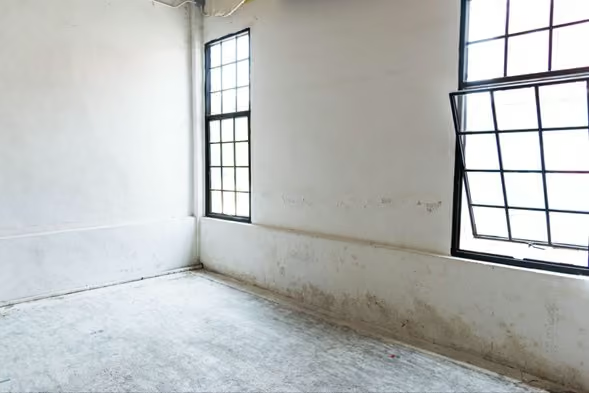
According to Spain's Housing Law, a property is considered empty when it is not the owner's habitual residence and is not rented out (neither as a traditional long-term rental nor as tourist accommodation).
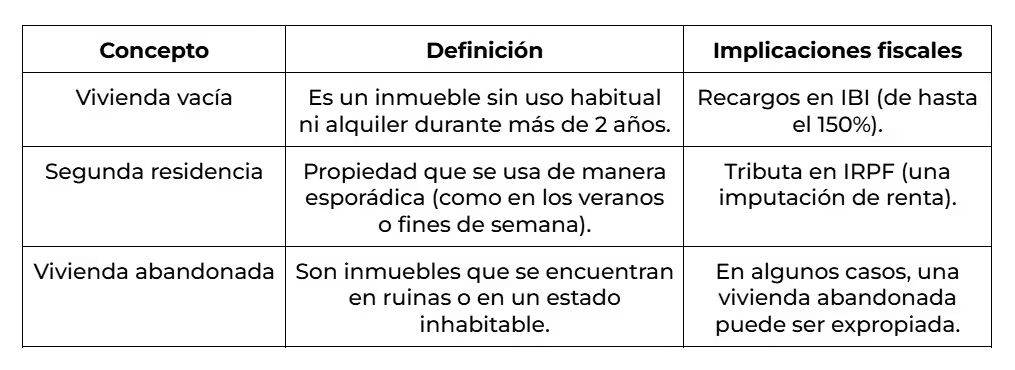
Generally, a home that has been continuously unused for more than two years will be considered empty. However, it should be noted that this period may vary depending on the autonomous community.
In some locations, such as rural areas, towns, or small cities, rental prices are too low and therefore do not cover maintenance costs. For this reason, owners prefer to leave homes empty.
Some owners choose to keep certain homes empty while waiting for the property's value to increase so they can later sell them at a higher price.
Many empty homes often belong to families where multiple heirs have property rights to the asset but cannot agree on what to do with the property.
Lack of renovations
Often, properties are in poor condition and require a significant investment to be habitable, which owners cannot afford to finance at the moment.
Currently, data reports that there are 3.4 million empty homes in Spain, which constitutes 13.7% of the total housing stock.
Areas with the most vacant homes are concentrated in small municipalities, or in provinces like Lugo, Ourense, and Teruel.
In contrast, areas with fewer vacant homes are densely populated cities such as Madrid, Barcelona, and Malaga.
The current housing law in Spain imposes various taxes or surcharges, with special charges for homes that are vacant. We will explain these below.
A vacant home is subject to an imputed real estate income tax (IRPF). If you own a vacant home, the tax authorities will apply a "tax penalty" of 2% of the cadastral value (if it hasn't been revised in the last 10 years) or 1.1% of the cadastral value if it has been revised recently.
Some municipalities may apply progressive surcharges, such as over 50% if it has been vacant for more than 2 years, over 100% if it exceeds 3 years vacant, or even over 150% if you own 4 or more vacant homes in the same municipality.
A minor fine for not declaring a vacant home can be up to 1,500 euros if the taxable base does not exceed 3,000 euros. A serious fine can range from 50% to 100% of the evaded amount if concealment is proven. There is also a risk of incurring a very serious fine, which implies 100% to 150% of the evaded amount, if fraudulent means are proven to have been used.
Renting out a vacant home can offer advantages such as monthly passive income, tax deductions (up to 1,000 euros in IRPF if the home has been vacant for more than a year), and avoiding IBI surcharges.
However, risks such as issues with defaulting tenants (though insurance covering non-payment is available) and potential maintenance costs must also be considered.
You might also be interested in: deductible rental expenses.
Selling a vacant property offers advantages such as immediate liquidity and avoiding taxes and maintenance. However, risks such as difficulty selling in slow markets or a loss of property value if one waits too long must be considered.
Other options include a gratuitous loan to family or friends without a formal contract, or a sale with a lifetime annuity, where a monthly pension is received.

For areas like Madrid or Barcelona, a traditional rental might be the best option, as it offers an average annual return of 4% to 6%.
In places like the Costa del Sol, implementing short-term tourist rentals can be the most profitable, potentially yielding an annual return of approximately 8% to 12%.
In rural areas, sales can be a good option, albeit at a lower price, and profitability will depend on the demand in that specific geographical location.
First, you'll need to renovate and prepare the property, then set a competitive price. After finding a tenant, you'll need to sign a legal contract with them, ensuring specific clauses are included for non-payment. It's also advisable to get rental insurance.
You should have the property appraised with the help of a valuer or an agency. Then you'll need to clean and prepare the home to enhance its appeal, and choose a sales channel. Finally, you'll have to manage all the documentation, such as notary services, property tax (IBI), or the mortgage.
You might be interested in: how to sell your house fast.
Keep in mind that a well-maintained house sells or rents faster, so making necessary renovations is actually an investment.
For example, you could offer one month of free rent to secure a tenant faster.
This can help improve the property's perception in online listings and attract interested individuals more easily.
It's a good idea to have a professional manager to optimize taxes and handle documentation properly.
Yes, if you haven't declared it in your income tax (IRPF) or if the local council applies surcharges to the property tax (IBI).
This will depend on your specific situation. For example, if you need immediate liquidity, selling is the best option. But if you want to generate recurring income, renting out the property is a better idea.
The most important documents are the property deed, the energy performance certificate, the receipt for the Property Tax (IBI), a certificate from the homeowners' association (if applicable), a property registry extract, the occupancy certificate, if applicable, and your identification document.
Generally, the selling process is expected to take between 6 and 9 months. However, in areas with high housing demand, a sale can be finalized within an average of 3 months.
Yes, but you'll need to settle the debt with the sale proceeds or negotiate an agreement with the bank.
Domoblock transforms the real estate investment and how people invest in properties. Through real estate tokenization, you can participate in real estate projects with an initial capital of just €200, without the need for lengthy or cumbersome banking processes.
Access properties with high profitability potential and leverage transparent, secure, and modern technology. All projects are evaluated by experts, ensuring confidence in every investment.
Earn returns exceeding 10% within 8 to 12 months, with options to diversify your portfolio from home. At Domoblock, we invest in your peace of mind. Our mission is for you to earn more with fewer complications, supported by blockchain and professional advice.
Take a look at our projects for: real estate investment in Madrid, real estate investment Alicante, real estate investment Zaragoza and real estate investment Valencia.
Owning a vacant property in Spain is actually an opportunity to generate tax breaks and earn profits. Renting or selling is usually more profitable than leaving it unused, so don't hesitate to start taking advantage of it. If you need help, consult a tax advisor or a real estate agency, but make the smart decision and don't let the property lose value.


.png)

41 Av. del Oeste
Funded
100%
763.249,36 €
Target
€763,249.36


.png)
.png)
.png)
.png)





.avif)
.avif)


