
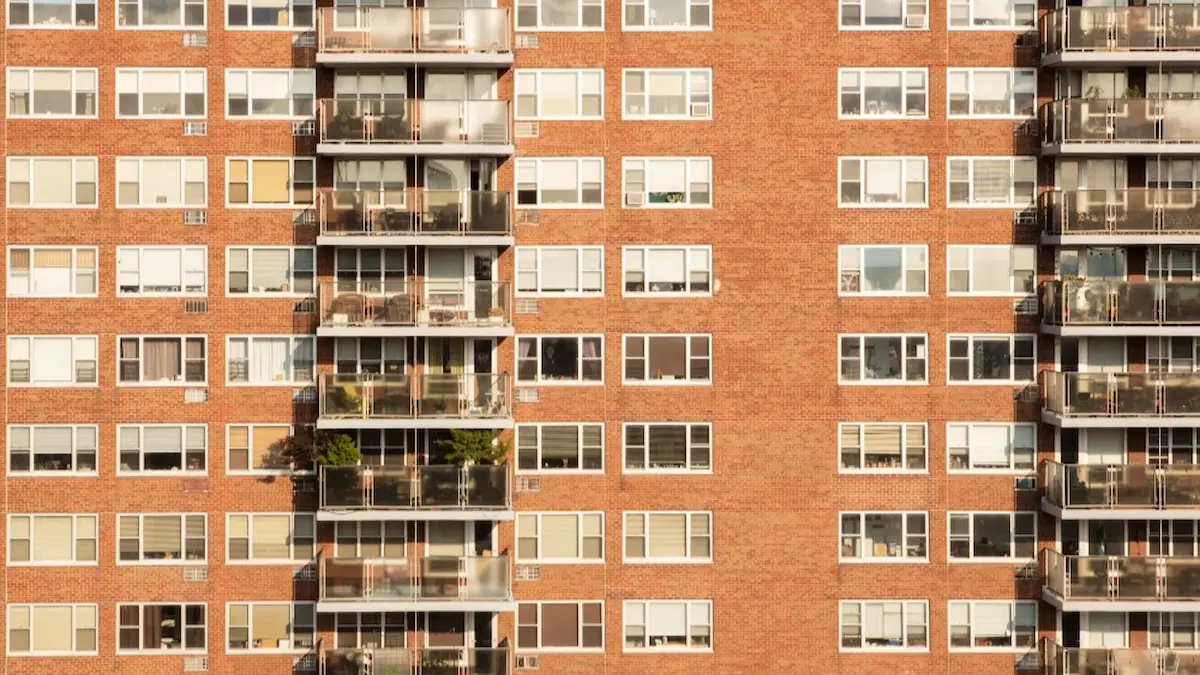
When we talk about multi-unit housing, many people immediately think of an apartment building. That’s correct, but it’s not the only meaning of the term: in official statistics, it means something very different, and confusing the two uses leads to errors when interpreting market data or analyzing a real estate investment.
In this guide, we explain the two definitions, the types of multi-unit housing that exist, what shared expenses are involved in living in or investing in such properties, and what we at Domoblock review before evaluating a property of this type for a project.

In architecture and urban planning, collective housing refers to a building that groups together several independent dwellings that share a common structure, entrances, and facilities. It is the typical multi-family housing model in Spanish cities: an apartment building with a common entrance, stairwell, elevator, and roof, managed by a homeowners’ association.
In statistics, however, the National Institute of Statistics (INE) uses the term “collective housing” to refer to establishments where people who do not form a family household live together and are subject to a common authority or regime, such as residences, convents, barracks, or hospitals.
Therefore, for the INE, an apartment within a building is a family dwelling located in a collective building, and not “collective housing” per se. Understanding this distinction helps avoid drawing incorrect conclusions when consulting data from the Population and Housing Census.
In a multi-family building, each apartment is an independent unit with its own kitchen, bathroom, and entrance, and can be sold or rented separately. In a collective facility, such as a residence, the rooms do not typically function as complete dwellings and rely on the building’s shared services.
Both models share common elements, but to a very different degree. In an apartment building, the entrance, stairwells, elevator, and roof are shared; in a residence, the kitchen, dining room, laundry room, and a significant portion of daily services are also shared.
A family home is occupied by people who choose to live together—whether or not they are related—and who organize their lives freely. Collective housing, in the statistical sense, is governed by the internal rules of an institution or a management company, which sets schedules, services, and conditions of use.
This distinction matters when interpreting census data. If you want to know how many dwellings there are in an area or how many are vacant, family housing statistics are the relevant ones for an investor; collective housing units are counted separately and follow a different market logic.
Multiple housing units are stacked vertically or grouped together on a single lot, allowing for more efficient use of the land. This concentration significantly reduces the land cost per housing unit compared to single-family homes and explains why it is the dominant housing type in urban centers.
Each owner has a private unit—their apartment—and a share in the building’s common areas. This division between private and common spaces is governed by Law 49/1960 on Horizontal Property (LPH), which establishes rights, obligations, and the majorities required for decision-making.
Building more housing on less land means higher density, better use of public transportation networks and municipal services, and reduced land consumption. It is one of the main arguments in contemporary urban planning for favoring compact cities over sprawling ones.
Expenses for the building entrance, elevator, cleaning, insurance, and the building facade are divided according to each unit’s share of ownership, as established in Article 9.1.e of the LPH. The homeowners’ association must also set aside a reserve fund of at least 10% of its most recent regular budget (Art. 9.1.f LPH).
A single building can combine studio apartments, two-bedroom apartments, and family penthouses, which broadens the range of potential buyers and tenants. This variety also provides stability to the homeowners’ association, as it brings together residents with different needs and schedules.
This is the most widespread type in Spain and accounts for the majority of sales and rentals. It can take the form of a linear block, a closed block with an interior courtyard, or a tower, and its quality depends largely on the era of construction and the maintenance it has received.
These are homes with open floor plans or spread over two stories, integrated into a multi-family building. Many lofts result from the conversion of former commercial spaces or industrial buildings, so it’s important to verify that the first-occupancy permit and property registration accurately reflect residential use.
These are housing developments with a maximum sale or rental price and eligibility requirements for buyers or tenants. Law 12/2023, on the right to housing, establishes the national framework, and each autonomous community regulates its own protection schemes and their duration.
In a traditional cooperative, the members jointly develop the building, and each member then receives their own home as freehold property. In a right-of-use arrangement, the cooperative retains ownership, and members enjoy an indefinite right of use in exchange for an initial contribution and a monthly fee. Law 27/1999 on Cooperatives and regional laws regulate both models.
These are private homes, typically smaller than usual, complemented by spacious common areas managed by the residents themselves. They are usually legally structured as a cooperative and require a high degree of member involvement in decision-making and maintenance.
It combines private bedrooms or studios with shared kitchens, living rooms, and workspaces, all managed by a professional operator. There is no specific national regulation for this model, so it is necessary to verify in each municipality its compliance with zoning regulations, the business license, and habitability conditions.
The INE includes in this category establishments where people reside under a common living arrangement. These are the main examples included in official statistics:
These include college dormitories and university housing, both public and private. Demand for them depends on the university offerings in each city and the influx of students from other provinces or abroad, and in recent years they have become a distinct investment segment.
These are facilities providing care and health services, subject to authorization and inspection by the corresponding autonomous community. Their number and occupancy rates are a key indicator of population aging and the need for new beds.
These include religious communities with permanent residents and military facilities that house their personnel. Although they account for a small share of the total, the INE classifies them as collective establishments because their residents live together under a common authority.
These include hospitals, correctional facilities, and shelters, provided that people reside there on a regular basis. Short-stay patients are not counted; only those who reside there during the Census reference period are included.
They are considered collective housing when they provide stable accommodation to people as their usual residence, rather than to passing tourists. This is common in long-stay guesthouses and in some aparthotels that, in practice, function as permanent housing for their occupants.
These are common elements by nature and the most visible to any buyer or tenant. Their state of repair and the age of the elevator directly influence the value of each apartment, and their renovation is one of the most common causes of special assessments in older buildings.
These may be common elements of the building or separate properties with their own ownership share and registration number. Always check the property abstract to determine which applies, as this affects both separate sales and the allocation of expenses.
Some terraces or patios are common areas but are for the exclusive use of a single unit, typically the penthouse or the ground-floor unit. This distinction determines who pays for repairs: waterproofing is usually the responsibility of the homeowners’ association, while routine maintenance falls to the user.
These are common in coliving and cohousing models, where they form an essential part of the value proposition. In conventional apartment buildings, they are rare, and when they do exist, they tend to increase community fees due to the costs of cleaning, utilities, and equipment.
These are typical in residences, coliving, and cohousing, and require very clear protocols for use, scheduling, and cleaning to avoid conflicts among residents. In a conventional apartment building, however, each unit has its own separate kitchen.
Galleries, open hallways, or spacious landings foster relationships among neighbors without invading the privacy of each unit. Contemporary residential architecture increasingly uses these features to improve community life and cross-ventilation among the apartments.
An apartment building consumes less energy per square meter than an equivalent single-family home because each unit has less exterior facade area exposed to the outside. It also allows for more efficient centralized systems, such as community-based geothermal heating or solar energy self-consumption shared among residents.
Energy retrofitting of multi-unit buildings is also one of the priorities of European regulations. Directive (EU) 2024/1275 requires new buildings to be net-zero emissions starting in 2030 and sets targets for the gradual reduction of average energy consumption in the residential building stock.
In our projects, we take a very practical approach to this, because energy efficiency improvements are part of the renovation plan from the very beginning. As Sergio Navarro, CEO of Domoblock, explains, an energy-efficient renovation “reduces emissions by 30–40% per project.”

These are groups of people who design their building from scratch, with common spaces tailored to their lifestyle and shared values. The process is usually lengthy, as it requires agreeing on the project, securing land and financing, and maintaining the commitment of all members over the course of several years.
This model addresses job mobility and high rental costs in major cities by offering flexible stays with services included. For investors, the main risks lie in tenant turnover, dependence on the operator, and the lack of uniform regulation across the country.
It combines housing for older adults and young people in the same building, often as part of public housing developments with support services. It aims to reduce loneliness among older adults and facilitate access to housing for young people, with common spaces that encourage mutual support.
These are serviced apartments for independent seniors, offering amenities such as a front desk, activities, an optional dining room, or on-demand assistance. They fall halfway between conventional housing and a nursing home, and demand for them will grow as the population ages.
They are regaining prominence as an alternative to traditional housing developments, particularly in the “transfer of use” model promoted by some city governments. They allow access to housing with a lower initial contribution, although construction timelines and management risks fall on the members themselves.
This involves converting offices, hotels, or commercial spaces into housing or coliving spaces. Before proceeding, it is essential to verify that zoning regulations permit residential use and that the building can be adapted to comply with the Technical Building Code regarding habitability, safety, and energy efficiency.
A good multi-unit residential building requires effective sound insulation between units and common areas that invite use without forcing it. When this balance is lost, neighborhood conflicts arise that erode the quality of coexistence and significantly reduce the building’s appeal.
Through-units or units with dual orientations ventilate better, receive more natural light, and consume less energy for heating and cooling. This is one of the features most valued by buyers and tenants—and one of the most difficult to correct once the building is constructed.
The SUA Basic Document of the Technical Building Code establishes accessibility requirements for new construction. In existing buildings, the homeowners’ association is required to carry out certain accessibility modifications when requested by owners with disabilities or those over 70 years of age, according to Article 10.1.b of the LPH.
Evacuation routes, emergency lighting, and fire compartmentalization must comply with the Basic Document SI of the Technical Building Code. Well-designed circulation routes also improve day-to-day life, as they facilitate access with strollers, wheelchairs, or during moves.
Lightweight partition walls and adaptable layouts allow for changes in the use of rooms over time, for example, as a family grows or when working from home becomes a reality. This flexibility extends the home’s useful life and broadens the pool of potential buyers.
Active ground floors—with shops or amenities—along with access to public transportation and proximity to schools and health centers improve residents’ quality of life. They also sustain the property’s value in the long term, as demand is concentrated in well-served neighborhoods.
Here is the checklist we use when evaluating an apartment in a multi-unit building, before determining whether it fits into a project:
A building with 20 units has an annual operating budget of €24,000, which covers cleaning, the elevator, insurance, electricity for common areas, and administration. For an apartment with a 4.5% ownership share, the figures would be as follows:
A special assessment of that size can eat up several months’ worth of net rent and completely change the estimated profitability of a transaction. That’s why we always review the minutes of the homeowners’ association meetings before committing to a purchase—not just the interior condition of the property.
Compared to other property types, apartments in multi-unit buildings are the most liquid assets in the Spanish residential market, as they account for the majority of both purchase and rental demand. Even so, relative liquidity does not guarantee a quick sale: sale timelines depend on the price, the neighborhood, and market conditions.
To estimate its profitability, we start with the gross rent and subtract common area fees, property tax (IBI), insurance, maintenance, and a period of vacancy. With a rent of €900/month (€10,800 per year) and annual expenses of €2,200, the estimated net income would be €8,600. Based on a total price of €200,000, including taxes and closing costs, the estimated net return would be around 4.3%, not including income tax or potential special assessments.
It is also important to take into account the frequently changing regulatory framework for rentals. Royal Decree-Law 26/2026, published in the Official State Gazette (BOE) on September 30, 2026, limits rent increases and extends extraordinary lease extensions; it is subject to ratification by Congress. Furthermore, as of April 3, 2025, opening a vacation rental in a condominium building requires a favorable vote from three-fifths of the homeowners’ association (Art. 17.12 LPH, amended by Organic Law 1/2025).
At Domoblock, our proprietary tool monitors real estate portals 24/7, and we analyze more than 100 properties per week. Most are units in multi-unit buildings, and what rules out the most opportunities isn’t the price of the unit, but rather the condition of the building and the community’s pending repairs.
The lack of available land in large cities will continue to drive the shift toward multi-family buildings and the densification of already urbanized areas. This includes adding additional floors to existing buildings or converting obsolete industrial land into residential neighborhoods.
The rise in single-person households and small families favors smaller homes with more shared amenities. Developers are already adapting their projects to include studio apartments, one-bedroom apartments, and larger common areas than in the past.
Senior living, assisted living, and intergenerational housing models will gain prominence due to Spain’s demographic trends. Demand for accessible housing—located near healthcare services and offering basic care—will grow steadily over the coming decades.
Renovating and repurposing existing buildings will become increasingly important compared to new construction, due both to a lack of land and to decarbonization goals. Reusing a building’s structure avoids a significant portion of the emissions associated with building from scratch.
Smart meters, shared self-consumption, and digital community management platforms will facilitate a more efficient use of shared resources. They will also make financial information more transparent for owners, tenants, and investors.
In architecture, yes: it is a multi-family building with common areas. According to the INE, however, each apartment in the building is considered a single-family dwelling, and the term “collective housing” is reserved for residences, convents, barracks, or hospitals where people live together under a common regime. It’s important to know in which sense the term is used when reading statistics.
It is the percentage of the total building that corresponds to each unit, as established in the deed of incorporation. It determines how much each owner pays in common expenses and special assessments, as well as the weight of their vote in certain majority decisions. It appears in the property abstract from the Registry and in the deed of horizontal division.
Yes. As of April 3, 2025, to begin operating a tourist rental unit in a building under horizontal property ownership, the express approval of three-fifths of the owners and their ownership shares is required, according to Article 17.12 of the LPH, as amended by Organic Law 1/2025. The bylaws may also prohibit this activity.
The LPH requires accessibility modifications when requested by owners with disabilities or those over 70 years of age who live or work in the building. This obligation applies in full if the annual cost passed on to owners does not exceed twelve ordinary monthly payments of common expenses, after deducting any available public subsidies.
Yes, unless the bylaws restrict it or the municipality regulates this activity. Renting out rooms is generally not covered by the Urban Lease Law and is governed by the Civil Code and the terms of the agreement. Check local regulations and insurance coverage, as high tenant turnover increases wear and tear and may lead to neighborhood disputes.
It is possible if the municipal zoning plan permits residential use on that floor and the commercial space meets the conditions for habitability, ventilation, and accessibility. You’ll need a change-of-use permit, renovation work, and then an amendment to the property description in the Land Registry. Some building bylaws also require authorization from the homeowners’ association.
Multi-unit housing can address various urban needs, ranging from conventional apartments to models with shared services, but each type has its own costs, regulations, and operational risks. When reviewing Domoblock’s tokenized projects starting at €200, examine the intended use, demand, and property management; investing 100% online via blockchain does not replace technical, legal, and financial due diligence.
Multi-unit housing is the dominant model in our cities, but its value depends as much on the apartment itself as on the building and the community that manages it. Before buying or investing, request the minutes from the last three meetings and the debt certificate: these documents typically list the special assessments that aren’t mentioned in the listing. Remember that all real estate investments involve risks of illiquidity, delays, and capital loss, and that they are not covered by the Deposit Insurance Fund.



Rúa Progreso, 27
Funded
Target
1.575.297,50 €