

Implied renewal is one of the most significant mechanisms in the field of lease agreements, frequently causing confusion among both landlords and tenants. It is a legal concept that operates automatically, extending the validity of a rental contract after its initial term has ended, without the need for a new express agreement between the parties.
Its application can significantly affect the rights and obligations of both parties, influencing aspects such as the contract duration, the rental price, and even the landlord's possibilities of recovering the property.
In this updated guide, we will analyze in detail what the law states, what requirements must be met, how long this regime can be extended, and what consequences it has for landlords and tenants. Additionally, we will provide practical tips to avoid implied renewal when it is not desired.


Implied renewal is a legal concept that allows for the automatic extension of a rental contract once its initial term has ended, provided that neither party expresses their intention to terminate it.
Unlike a voluntary extension, where both parties agree to renew the contract, implied renewal operates without the need for a new express agreement. It is sufficient for the tenant to continue occupying the property and paying rent, and for the landlord to accept it, for the contract to be renewed under the same conditions or with the variations established by law.
You might be interested in: rental contract extension.
In Spain, implied renewal is regulated by Article 1566 of the Civil Code, which states: "once the lease has ended, if the tenant continues to enjoy the leased property for more than fifteen days with the landlord's acquiescence, the contract shall be understood as renewed for the period specified in the preceding articles, and so on."
Furthermore, the Urban Leases Act (LAU) also addresses this concept in its Article 9, applicable to residential leases. According to it, if the tenant remains in the property after the term's end and the landlord does not object, the contract is renewed for annual periods (in residential leases) or as initially agreed (in leases for non-residential use).
The lease agreement must have reached its original expiration date without an express renewal having occurred through a new agreement between the parties. This applies to both fixed-term contracts (e.g., one year) and those without a fixed term where the landlord decides to terminate the agreement.
The tenant must continue occupying the dwelling or premises after the contract termination date, thereby demonstrating their intention to remain. This continued use is primarily evidenced by the payment and acceptance of rent in the months following expiration, the maintenance of utilities (electricity, water, etc.) in the tenant's name, and the absence of any intention by the tenant to vacate the property.
The owner must not actively oppose the continuation of the lease. This tacit consent is presumed when they collect rent for the period after the contract's expiration, when they do not initiate legal action to recover the property (such as an eviction lawsuit), and when they do not communicate in writing their decision not to extend the contract before its termination.
Some contracts include clauses that explicitly exclude tacit renewal, thus establishing that the lease will definitively end on a specific date without the possibility of automatic extension. In these cases, the tenant's continued occupancy of the property could be considered unlawful occupation rather than tacit renewal.
In residential lease agreements, it applies when the tenant continues to live on the property after the initial term expires, or if the landlord does not notify their intention not to extend the contract with the legally required notice period (usually 30 days for residential leases).
In leases for non-residential use (commercial premises, offices, etc.), it applies if the tenant continues their activity on the premises and the landlord does not demand their eviction, and when there is no automatic termination clause at the end of the term.
In verbal contracts or those without a defined term, if the tenant has been occupying the dwelling for some time without a written contract and the landlord accepts payments, it can be understood that there is a tacit lease renewable annually.
It does not apply when the landlord reliably notifies their intention not to renew (via burofax, email with acknowledgment of receipt, etc.), if there is an express clause for no automatic extension in the contract, or in situations of eviction due to the owner's need (such as recovering the dwelling for personal use).
You might be interested in: rent without a contract.
The duration of tacit renewal varies depending on the type of contract. In residential lease agreements, according to Article 9 of the LAU, renewal occurs for successive annual terms as long as neither party expresses their intention to terminate it, meaning that, in theory, the contract could continue indefinitely if the landlord does not take steps to end it.
In contracts for non-residential use (premises, warehouses, etc.), it is governed by what was agreed in the original contract, and if there is no express agreement, the Civil Code (Art. 1566) establishes that renewal will be for years or months, depending on the frequency of rent payment (for example, if paid monthly, renewal will be month-to-month).
There is no maximum limit of years, but the landlord can always terminate the contract with the corresponding legal notice. In practice, many tacitly renewed contracts last between 1 and 5 years before either party decides to end them.
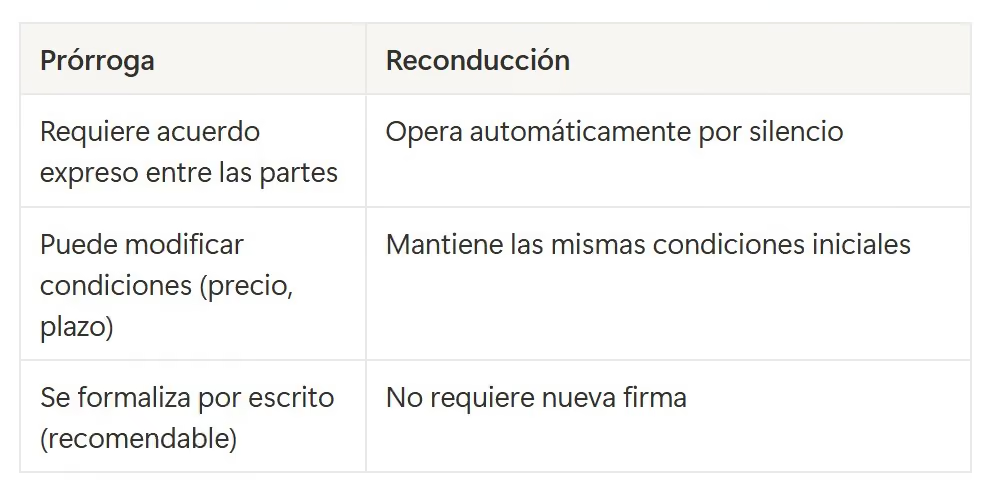
For the Tenant, tacit renewal implies the right to continue in the dwelling without the need for a new contract, the maintenance of the original conditions, except for rent updates according to the CPI or agreement, and protection against abrupt evictions, as the landlord must respect the notice periods.
For the Landlord, there is greater difficulty in recovering the property if they do not act with due notice, they have the possibility of updating the rent according to what was agreed in the initial contract (although in some cases the LAU limits increases), and there is a risk that the tenant acquires long-term rights, especially in habitual dwellings.
The tax and registration implications are that the tacitly renewed contract does not require registration in the Property Registry, but it remains valid, and the rents received must be declared in the landlord's personal income tax (IRPF).
If the landlord does not wish the contract to be tacitly renewed, they must give advance notice of non-renewal by sending verifiable notice (burofax, email with read receipt) at least 30 days before expiration (for residential properties). For commercial premises, the period may be longer (consult the original contract).
The landlord should not accept payments after the expiration date. If the tenant attempts to pay after the termination date, the landlord must refuse payment or accept it "with reservations," indicating that it does not imply an extension.
You can initiate eviction proceedings if necessary. If the tenant does not vacate the property, the landlord can file an eviction lawsuit for termination of contract.
The original contract can stipulate that there will be no tacit renewal, obliging the tenant to vacate upon expiration.
In the Civil Code (Art. 1566) and the Urban Leases Act (Art. 9).
No, as it operates automatically through silence and continued use.
Yes, the price can be updated according to the CPI or what was initially agreed upon.
The landlord must give legal notice (generally 30 days for residential properties).
Yes, in contracts with non-renewal clauses or in eviction cases due to the owner's need.
Domoblock is the new way to access the real estate investment: more accessible, simpler, and fully digital. From just €200, you can participate in real estate investments of flipping house and flipping building and generate income without acquiring an entire property.
Ideal for beginners and experts alike, Domoblock allows you to diversify effortlessly, thanks to its blockchain-based technology and real estate tokenization which offers maximum traceability and trust.
Every opportunity published on the platform is verified by experts. You decide where to invest; Domoblock does it for you. Smart, secure, and profitable. Leverage blockchain technology with Domoblock and grow your money safely!
Domoblock also features various real estate investment projects in Madrid, real estate investment in Alicante, real estate investment in Zaragoza and real estate investment in Valencia. Check them out!
Tacit renewal is a legal mechanism that protects both tenants and landlords, allowing the continuation of a lease without additional formalities. However, it is crucial to understand its requirements and consequences to avoid conflicts.
If you are a landlord and do not wish to renew, provide timely notice, and if you are a tenant, ensure your continued occupancy does not lead to disagreements. In case of doubt, consult with a specialized lawyer.


.png)

41 Av. del Oeste
Funded
-
-
Target
€763,249.36


.png)
.png)
.png)
.png)




.avif)
.avif)
.avif)


