
.avif)
In today's article, you'll discover everything related to lease subrogation. If you want to know what it entails, in which cases you can request it, its requirements, and more, be sure to read on!


Lease subrogation allows a person to assume the rights and obligations of an existing contract, without having to sign a new one.
It can apply in cases such as the tenant's death, divorce, or voluntary assignment. It's not like a rental without a contract, since another person will continue the rental under the same conditions that were agreed upon initially.
However, you must have the landlord's consent or proof of kinship for the subrogation to be valid.
You might also be interested in: tacit renewal notice and how it differs from a subrogation.
The rental agreement subrogation and contract assignment are two completely different concepts. Although related, they differ in the context of rental agreements.
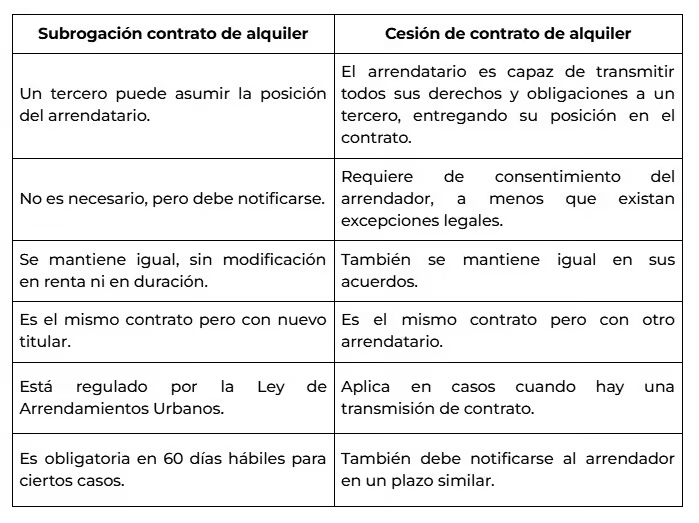
The rental agreement subrogation can be beneficial for the landlord, as it prevents them from having to look for a new tenant and allows the existing contract to continue. Below, we explain in which cases you can request it:
When the tenant dies, the law allows family members to continue living in the home by taking over the rental agreement. This applies to the spouse, common-law partner, or children.
The purpose of this law is to protect those who lived with the tenant and prevent them from becoming homeless suddenly. To do this, they must notify the landlord within the specified timeframe and provide the necessary documentation.
In the event of a breakup with a partner, subrogation also applies. This is important if the property is the family home and it is desired to prevent someone from becoming homeless.
The spouse who remains in the home must inform the landlord of their intention to subrogate and comply with the same terms of the contract.
As a tenant, you can assign your contract to another person, provided you have the written approval of the property owner.
This scenario is very useful if you have to be temporarily absent or change your residence. The person receiving the assignment will assume all rights and obligations of the contract and maintain the same conditions.
Have you ever wondered what happens to the rental agreement if the property is sold? When this occurs, the new owner will be subrogated for the duration of the contract.
The Urban Leases Act considers specific situations, such as subrogation in favor of people with disabilities who lived with the deceased tenant.
You might be interested in: selling an inherited apartment.
The rental contract subrogation is an important process to ensure the continuity of the lease when the titleholder changes. For it to be valid, you must meet the following requirements and provide the necessary documentation:
Finally, there is the adherence to original terms. The new tenant must accept and maintain all conditions agreed upon in the initial contract, without modifications.
The process is very simple; just follow these steps and comply with the legal requirements:
To finalize, add an addendum to the original contract, signed by all parties, establishing the subrogation and the new tenant's details. These steps will ensure a secure and legal process.

To submit the application, you must follow a transparent process. You need to notify the landlord in writing of your intention to subrogate, stating the reason, your relationship with the original tenant, and attaching the necessary documentation.
Legal deadlines may vary depending on the reason. For example, if it is due to the tenant's death, family members have one month to inform the landlord and provide the necessary documentation.
The letter template must include the applicant's and landlord's details, the property's address, and the reason for subrogation.
It is essential that you state your relationship with the tenant, attach the necessary documentation, and express your commitment to assume the contract's obligations. You must sign and submit the letter within the legal timeframe.
The lease subrogation can be a simple process if you follow these legal tips:
Before you start any process, you must review the current rental agreement. This way, you'll know if it allows for subrogation and its conditions.
Notifying the homeowner is a key step. The law requires you to communicate your intention to subrogate within a specific period. This notification must be made in writing.
In cases where subrogation is not automatic by law, the owner's consent will be necessary.
Similarly, you must provide credit documentation and maintain the original conditions of the contract. If you follow these tips, you can achieve a successful subrogation without surprises.
The lease subrogation allows you to assume the rights and obligations of the original tenant, but it is not without risks and limitations. Here are the main ones:
It is essential to have the owner's written approval. Without this consent, the subrogation may be rejected and the contract terminated.
This only applies in specific cases, such as death, divorce, or voluntary transfer.
There are specific deadlines for notifying subrogation, especially in the event of death; if these are not met, the owner can reclaim the property.
Yes, except for specific legal cases such as the tenant's death.
Yes, but you only need to inform the employee in writing. You do not need to go through a new formal subrogation process.
If there are multiple heirs, they must agree on who will take over the contract. If there is no agreement, it may be resolved judicially.
No, subrogation maintains the original contract. You only need to notify the change of ownership in writing.
Not being officially registered as a resident can make subrogation difficult, as proof of habitual residence in the property is usually required.
Would you like to generate passive income with real estate backing and no complications? With Domoblock, you can get started in the real estate investment sector. from just 200 €.
Thanks to its blockchain-based technology, Domoblock tokenizes physical properties, allowing you to buy digital fractions of real properties, track them in real-time, and receive returns upon project completion.
We have a team specialized in investment, property tokenization, real estate crowdfunding and renovations that advises you from the start. Our business model is based on buy, renovate, and sell projects (“Flipping Houses”), with annual returns exceeding 10%.
Invest securely, simply, and with complete transparency. With Domoblock, accessing the real estate market is no longer a privilege, but an opportunity available to everyone.
Discover all our projects for real estate investment in Madrid, real estate investment in Alicante, real estate investment in Zaragoza and real estate investment in Valencia.


.png)

41 Av. del Oeste
Funded
-
-
Target
€763,249.36


.png)
.png)
.png)
.png)



.avif)
.avif)
.avif)


