
When a property is surrounded by other properties with no access to a public road, a right of way comes into play. At Domoblock, we encounter this more often than you might think: in homes with interior courtyards, in commercial spaces accessible only via a private passageway, and in rural properties marketed as “bargains.” In this guide, we explain how it works under the Civil Code, how compensation is calculated using an example, and what to check before buying a property subject to a right of way.

An easement is an encumbrance on a property for the benefit of another property belonging to a different owner, according to Article 530 of the Civil Code. In the case of a right-of-way easement, the owner of one property must allow the owner of another to cross their land. The property that benefits is called the dominant tenement. The one that bears the right of way is the servient tenement. It is a real right; it is attached to the properties, not to the people. If either property is sold, the easement remains with the new owner.
Easements are regulated in Articles 530 through 604 of the Civil Code, within the book dedicated to the methods of acquiring and modifying property. These articles set forth the rules on how easements are acquired, exercised, and terminated.
Article 564 recognizes the right of an enclosed property to demand a right of way through neighboring properties, subject to compensation. The following articles regulate the route (565), the width (566), cases where no compensation is required (567), termination when the right is no longer necessary (568), and right of way for construction work (569).
In Catalonia, Book Five of the Civil Code (Articles 566-1 et seq.) applies, with its own specific rules. Navarre, Aragon, and Galicia also have specific civil regulations in certain areas. In addition, there are administrative easements (livestock trails, coastlines, power lines) governed by a regime distinct from civil law.
These are freely agreed upon by the owners of both properties. They may establish the route, width, hours of use, price, and maintenance as they see fit. This is the most flexible option and the one that generates the fewest conflicts if drafted properly.
This is the type that can be enforced even if the owner of the servient estate objects, provided the requirements of Article 564 are met. If no agreement is reached, a judge determines the terms.
It is apparent when it is visible through external signs, such as a marked path, a gate, or a well-trodden trail. It is non-apparent when there are no visible signs of its existence.
A continuous easement is exercised without human intervention, such as a right of light. A right of way is discontinuous: it is exercised only when someone passes through. This classification has practical implications for how an easement is acquired, as you will see below.
A permanent easement implies a permanent path. A temporary easement meets specific needs, such as harvesting a crop or accessing a construction site. This difference affects the calculation of compensation.
Article 564 requires three conditions:
It is not sufficient that the right of way through the neighboring property is more convenient or shorter. If there is an access point, even if it is inferior, a compulsory easement is generally not recognized.
There is one exception where no compensation is required. According to Article 567, if a property becomes landlocked as a result of a sale, exchange, or partition, the seller or co-owner must grant right of way without charging a fee. This is often seen in inheritance cases where a property is divided without providing for access routes.
Article 565 requires that the right of way be routed through the point that causes the least harm to the servient estate. This is the primary criterion.
Only to the extent that it is compatible with causing the least harm is the shortest distance to the public road also considered. If the shorter route splits an orchard in two and the longer route follows the property line, the route along the property line usually takes precedence.
Article 566 states that the width shall be sufficient to meet the needs of the dominant property. There is no fixed measurement.
A residence may require access for a car; a farm, for a tractor. The actual use of the dominant property determines the width, and if that use changes, an expansion may be requested by demonstrating the new need.
A private contract signed by both owners is sufficient. It is valid between them, but does not protect against a future buyer who is unaware of it.
Formalizing it in a deed and registering it with the property registry makes it enforceable against third parties. It will appear on the property abstracts for both properties. This is the approach we most strongly recommend; it is inexpensive compared to a future lawsuit. (Read more about an example of a property abstract.)
If the neighbor refuses, the owner of the enclaved property may sue for compulsory establishment. The judge determines the boundary line, width, and compensation, usually with the assistance of an expert.
Article 541 of the Civil Code considers the existence of an apparent boundary between two properties that once had the same owner to constitute title. If, upon separating the properties, no objection is raised and the visible sign is not removed, the easement continues. This is known as the “family head’s intention,” which is common when a family property is divided.
According to Article 539 of the Civil Code, discontinuous easements are acquired only by title. Since a right of way is discontinuous, using a path for 30 years does not, in and of itself, grant the right to continue doing so. This is one of the most common misconceptions: many property owners believe they have a right that is, in reality, merely a tolerance granted by their neighbor.

Owner of the dominant estate (the one with right of way)
Owner of the servient estate (the party whose property is crossed)
Article 564 distinguishes between two cases:
Illustrative example of an isolated rural property that requires a permanent road 150 meters long and 4 meters wide for vehicle access:
These figures are hypothetical. The key point is this: resolving access by mutual agreement costs a few thousand euros, whereas a property without legal access can lose a significant portion of its market value and be difficult to finance. For this reason, when we analyze a landlocked property, we calculate the compensation as an additional cost of the purchase.
The two owners can modify or cancel it at any time. If it was registered, it’s advisable to cancel it in the property registry as well.
According to Article 568, if the owner of the dominant property establishes their own access to a public road, the owner of the servient property may request the termination of the easement. In exchange, they must return the compensation received.
If the same person purchases both properties, the easement is extinguished by merger (Article 546.1).
The easement is extinguished if it has not been used for 20 years (Article 546.2). For intermittent easements, such as a right of way, the period begins on the last day it was used.
The owner of the servient estate may request a new route that is equally convenient if the current one causes harm, provided they pay for the change. This is useful, for example, to free up a lot for construction.
The abstract from the Property Registry indicates whether there are any registered easements, whether in your favor or against you. Also review the seller’s deed of sale.
Compare the plans with the Cadastral maps and with what you see on the ground. A path that crosses the lot but does not appear in any document is a red flag.
Walk around the perimeter and ask the neighbors. On rural properties, this is usually the quickest way to discover de facto uses.
An easement may be valid even if it is not registered, for example, based on apparent signs under Article 541. A clean property abstract does not guarantee that one does not exist.
If you have any doubts, request a report from a lawyer and a surveyor before signing the deposit agreement. Making the deposit contingent on that report is a practice we often use.

On the servient estate, the right of way limits what can be built or enclosed within that strip and reduces privacy.
On the dominant property, the registered easement is what gives the property its value: without legal access, it is often impossible to secure financing or obtain a building permit.
Appraisers reflect easements in their reports and may adjust the value accordingly. A bank may refuse to finance a property without verified access.
If the seller conceals a hidden, unregistered easement, the buyer may request rescission of the contract or compensation, within the time limits set forth in Article 1483 of the Civil Code.
Regularizing the easement after purchase usually costs more than negotiating it beforehand. Factor this into your offer price.
Gather deeds, abstracts, old photographs, maps, and testimonies regarding the use of the right-of-way.
As of April 2025, Organic Law 1/2025 requires attempting an appropriate means of dispute resolution before filing a lawsuit in most civil matters. A documented negotiation or mediation fulfills this requirement.
A surveying expert or agricultural engineer can verify the necessity of the right-of-way and propose the least disruptive route.
A declaratory action defends an existing easement; a negatory action asserts the property’s freedom from a right of way that does not exist. A petition for compulsory establishment or termination may also be filed.
If someone blocks a right of way that had been in use, an oral summary proceeding for the protection of possession may be filed (Article 250.1.4 of the Civil Procedure Act). It must be filed within one year of the blockage.
Yes, provided it does not prevent or hinder passage. The standard practice is to install the gate and provide a key or remote control to the owner of the dominant estate. If the gate restricts access hours or prevents vehicles that previously passed through, this may be considered a disturbance of the easement.
If the title deed only mentions pedestrian access, then in principle, no. To extend it to vehicles, you must reach an agreement with the neighbor or prove in court that the property requires it, paying compensation for the resulting additional inconvenience. The width is adjusted to actual needs.
The easement follows the properties. If you sell, it passes to the buyer. If you subdivide the dominant tenement, each part retains the right of way, but without increasing the burden on the servient tenement. If you subdivide the servient tenement, the right of way must be respected on the portion through which it runs.
Yes. Article 569 of the Civil Code requires a neighbor to allow the passage of materials or the erection of scaffolding if it is essential for constructing or repairing a building. In exchange, the neighbor receives compensation for the inconvenience. In the case of facade renovations in city centers, this is more common than it might seem.
The owner of the servient estate may use their land, but may not build or plant in a way that impedes or restricts passage. If they need that strip of land, the solution is to request a change in the road’s alignment, offering an alternative route that is equally convenient and covering the cost.
Domoblock allows you to invest as little as €200 in real estate projects managed 100% online using tokens and blockchain technology. Digital traceability does not replace legal, registry, and technical due diligence, nor does it eliminate the risks of non-performance or capital loss. Review the documentation for each project and seek independent advice when necessary before investing.
Domoblock, a real estate investment platform, offers house-flipping projects in Spain, with extensive experience in real estate tokenization and real estate crowdfunding. Thanks to these real estate investments, you can grow your savings and secure your financial future.
A right of way is a long-standing legal concept with very real, current effects on a property’s value. Our practical advice: before buying, don’t settle for just the property abstract. Walk the property’s perimeter, ask the neighbors, and compare what you see with the Cadastre records. If there’s a path that no one can explain, clarify its status in writing before signing the preliminary agreement. Resolving it beforehand costs little; resolving it afterward often leads to a lawsuit.


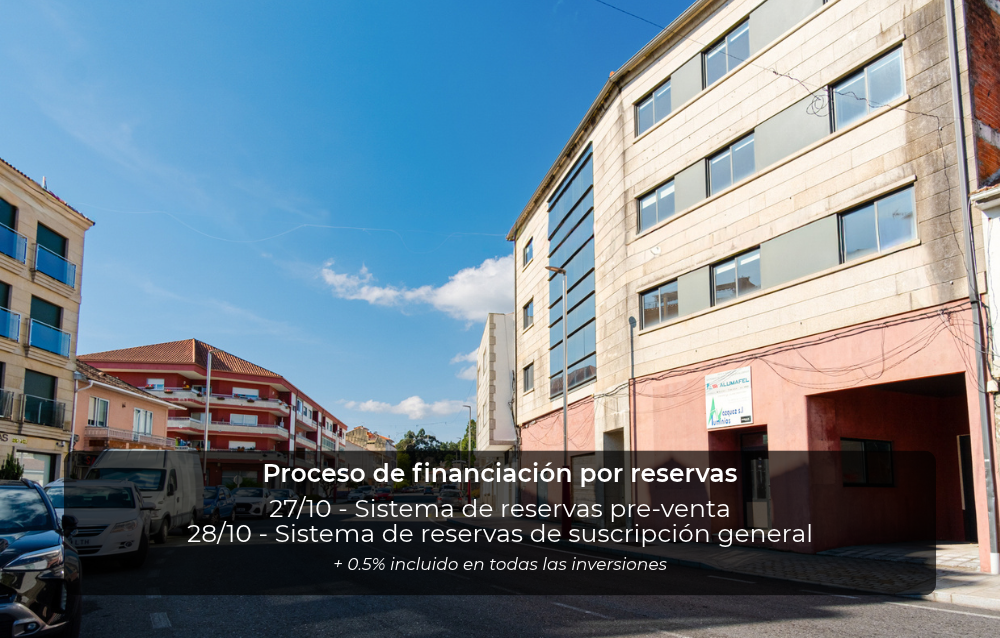

Rúa Progreso, 27
Funded
Target
1.575.297,50 €