

If you’re thinking about renting a home—whether as a landlord or a tenant—there are three acronyms you should fully understand before signing anything: SERPAVI, IRAV, and “high-demand area.” In just a few months, the SERPAVI index has become the official barometer of rental prices in Spain, and knowing how to interpret it correctly can mean the difference between signing a contract with peace of mind and facing a hefty fine.
In this guide, we’ll explain—clearly and without unnecessary jargon—exactly what SERPAVI is, where it gets its data, when it’s mandatory to use it, how to look it up step by step, and how it relates to the new IRAV index, which has replaced the CPI. We’ll also look at real-life examples, the penalties you could face for exceeding the limits, and the most frequently asked questions. The goal is that, by the end, you’ll know exactly how it affects you and what wiggle room you have.

SERPAVI is the State Reference System for Residential Rent Prices, a public tool from the Ministry of Housing and Urban Agenda that provides a guideline range of rental prices based on the property’s location and characteristics. Simply put: you enter the details of an apartment, and the system returns a range in euros per square meter that reflects what, according to official statistics, is being paid for similar properties in that same area.
The key difference between SERPAVI and typical real estate websites is the data source. While a real estate website displays asking prices—what landlords are asking for—SERPAVI uses actual data from contracts that have already been signed and reported to the tax authorities. This source gives it a legal weight that no private comparison site possesses.
For years, Spain lacked reliable official statistics on rental prices. Every website, every consulting firm, and every report used different figures, and there was no common benchmark to rely on during negotiations or in court. SERPAVI fills that gap.
Its impact goes beyond mere information. In areas of the country where the market has been declared tight, this index is no longer just a reference but functions as a mandatory price cap in certain leases. In other words, it’s no longer just a matter of getting a general idea; in certain cases, the maximum rent you can charge is directly set by the system. That’s why landlords, tenants, agencies, and government agencies are consulting it more and more frequently: it has become a central component of the new rental framework.
SERPAVI traces its origins to Royal Decree-Law 7/2019 on urgent measures regarding housing and rent, which already provided for the creation of a national system of reference indices. However, the final impetus came with Law 12/2023, of May 24, on the Right to Housing, which mandated its development and assigned it specific functions within the mechanism for high-demand areas.
To develop it, a technical working group was formed under the coordination of the Ministry of Housing, with participation from the Tax Agency, the General Directorate of Cadastre, the National Institute of Statistics, the Bank of Spain, and other agencies. This inter-agency origin explains both its statistical robustness and the fact that it combines information from multiple government agencies simultaneously.
The system’s reliability depends directly on its sources. SERPAVI does not make estimates; rather, it cross-references data that already exists in public records. The main sources of information are:
This combination of sources is also its main weakness, something worth noting: tax data has a certain time lag, so the index reflects the market one or two years behind. It is not a real-time market price, but rather a recent—though not instantaneous—snapshot.

Beyond the technical definition, the important question is what you can do with SERPAVI. And the answer depends on whether you’re looking at it from the perspective of the renter, the landlord, or the regulator.
For anyone looking for an apartment, SERPAVI is a top-notch negotiation tool. Before agreeing to a rent, any tenant can check the reference rent for the area and see if what they’re being asked to pay is in line with the market or sky-high. That information shifts the balance of power in negotiations with the landlord or real estate agency.
In high-demand areas, its value is even greater, because there the index does more than just provide guidance: in certain leases, it sets the legal maximum rent. A tenant who discovers that the rent exceeds that cap has solid grounds to demand a reduction and even to pursue administrative remedies. Transparency ceases to be an ideal and becomes a concrete lever.
For public administrations, SERPAVI serves a dual purpose. On the one hand, it is the tool used to determine whether an area meets the requirements to be designated as a high-demand area, as it provides the statistical basis for that decision. On the other hand, it allows for continuous monitoring of price trends and evaluation of whether price-control measures are effective.
It also serves as a benchmark for broader housing policies, such as rental assistance or state programs, which in many cases tie their eligibility thresholds to the index’s values. In practice, it has become the dashboard for the residential rental market.
This is one of the key points that causes the most confusion. The rental reference system can be consulted throughout Spain, but it is only legally binding in areas designated as “high-demand.” Outside these areas, it serves as an informational reference; within them, it can be a mandatory limit. Understanding how one of these areas is designated is essential.
A residential market under pressure is a geographical area where access to housing has become particularly difficult due to price pressures. The designation is not automatic, nor is it decided by the central government: the authority lies with the autonomous communities, typically upon a proposal from local governments, following a report from the Ministry of Housing. Each designation is valid for three years and is renewable.
This division of authority explains the highly uneven landscape. Regions that would technically meet the criteria have decided not to apply the mechanism for political reasons, while others have implemented it swiftly. It is a legally established issue—the Constitutional Court upheld the law in early 2026—but one that is highly controversial politically.
For a region to declare an area as a housing-stressed zone, it is sufficient to meet one of these two objective criteria, set forth in Article 18 of Law 12/2023:
It is not necessary to meet both criteria at the same time. In practice, however, the large metropolitan areas that were first designated met both criteria simultaneously, which made the designation particularly robust.
The map changes frequently, but as of mid-2026, the situation was highly concentrated in just a few autonomous communities. Around 300 municipalities have been designated as high-demand areas, distributed as follows:
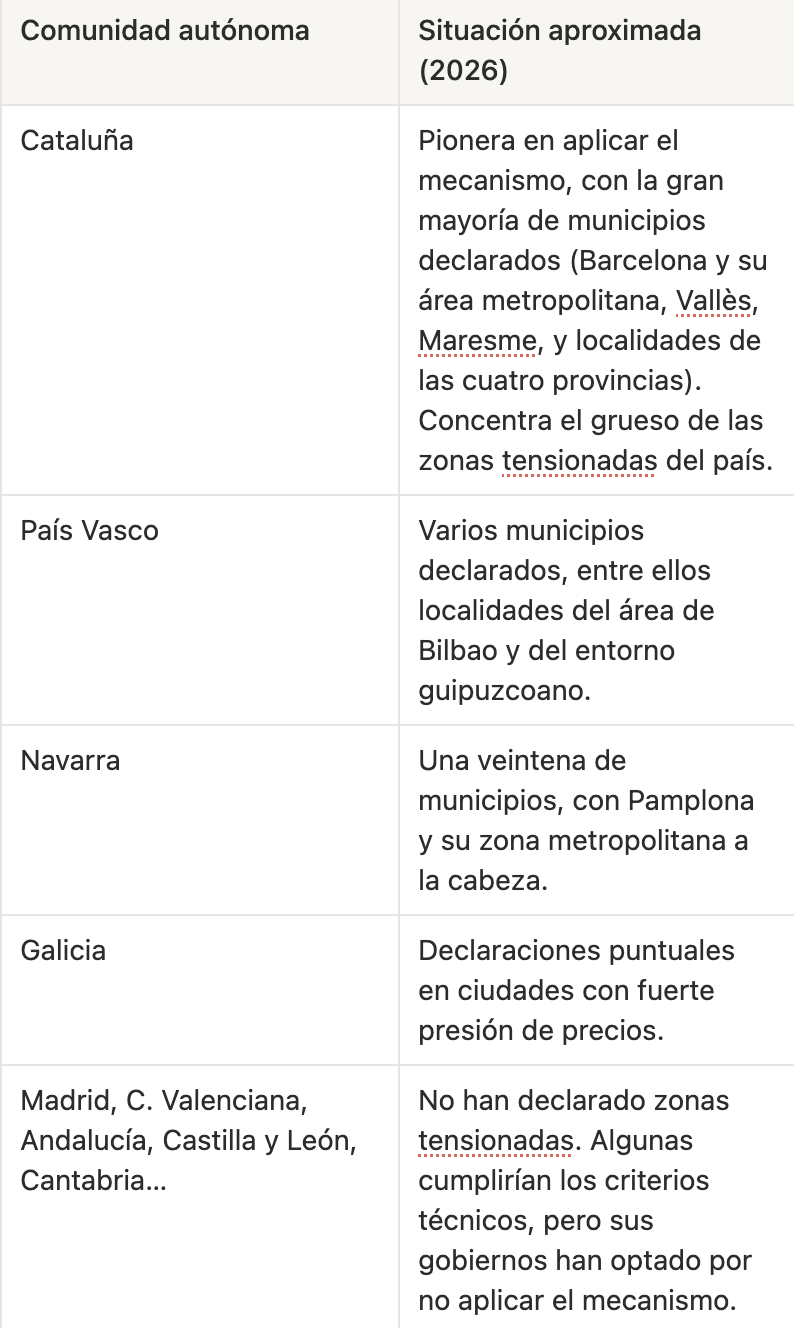
The message is clear: whether or not your home is subject to SERPAVI limits depends, to a large extent, on the autonomous community in which it is located. Before setting a rent, it’s always a good idea to check the Ministry’s updated official registry, as the list is periodically expanded and updated.
Within a high-demand area, the level of obligation varies depending on who the owner is. The law clearly distinguishes between two categories, and the differences between them are significant.
A large property owner is defined as a natural or legal person who owns more than ten urban residential properties or a total built area of more than 1,500 m² for residential use, excluding garages and storage units. Furthermore, in high-demand areas, autonomous communities may lower this threshold to five or more residential properties within the area itself.
For this category, the regulations are the strictest. In a new lease within a high-demand area, the rent cannot exceed the limit set by SERPAVI when there is no prior lease to serve as a reference. This is the scenario in which the index exerts its full binding force: the large property owner is required to comply with the cap determined by the system.
Individual landlords who do not meet the threshold for large-scale landlords are subject to a somewhat more flexible regime, although they are not entirely exempt from regulation. In a high-demand area, the general rule for a new lease is that the rent cannot exceed that of the last valid lease in the previous five years, once the corresponding adjustment has been applied.
However, if the property has not been rented during that period and there is no reference lease, the small-scale landlord may also be required to apply the SERPAVI cap, as established by regional regulations. For this reason, even as a private landlord, it’s advisable to check the index before setting the rent: the line between what’s permitted and what’s punishable may be narrower than it seems.
Just as important as knowing when SERPAVI applies is knowing when it does not. There are several cases in which its limits do not apply:
In summary, outside of high-demand areas and for primary residences, SERPAVI retains its advisory role but is no longer mandatory.
Checking the index is free and can be done through the Ministry’s official web application, accessible at serpavi.mivau.gob.es. The process is simple and offers two ways to enter information.
The most accurate way to check is by using the cadastral reference, a 20-character alphanumeric code that uniquely identifies each property. You can find it on your property tax (IBI) bill, in the property deed, or by searching for it on the Cadastral Registry’s online portal using the address.
When you enter the cadastral reference, the system automatically retrieves the property’s physical data—area, year of construction, location—and combines it with market information for the area. This is the recommended option because it minimizes the margin of error: the initial data is provided directly by the Cadastre.
If you don’t have the cadastral reference, you can also consult the index by entering the property’s full address: street, number, city, and, when applicable, floor and unit number. The system locates the property and, from there, requests or fills in the characteristics needed for the calculation.
This method is convenient and fast, but you must carefully verify that the retrieved data matches the actual details of the apartment. An error in the square footage or year of construction can significantly shift the price range.
SERPAVI does not return a single figure, but rather a range with a lower and upper limit, typically expressed in euros per square meter per month. This range reflects the natural variability of the market for properties with similar characteristics in the same area.
Interpreting it correctly is key. In an area without high demand, the reference rent range is simply a guide: it tells you whether the price you’re considering is within the norm or falls above or below it. In a high-demand area, however, the upper end of that range can serve as the legal cap that you must not exceed in leases subject to rent caps. Before finalizing a lease, it’s a good idea to save the query—including the date, data entered, and result—as documentary evidence in case you need to justify the agreed-upon price later on.
The result returned by the system doesn’t come out of thin air: it depends on a set of variables that add or subtract value. Knowing them helps you understand why two seemingly similar apartments yield different ranges, and to verify whether the calculation was based on correct data.
These are the three most significant factors. Floor area has a direct influence, though not always proportional: the price per square meter tends to be slightly higher for smaller homes and somewhat lower for larger ones. Location is a determining factor, since the index is calibrated at a very fine level—down to the census tract—so that two nearby streets may have different reference points. And the year of construction serves as an indirect indicator of the building’s condition and features: generally, newer buildings fall at the higher end of the range.
Energy efficiency is becoming increasingly important. A home with a good energy efficiency rating is more attractive and economical to live in, and that translates to the price range. The condition of the property follows the same logic: a renovated property, with up-to-date systems and no structural issues, ranks higher than one that has damage or requires repairs. This is where the owner has real room for improvement, since investing in the property can legitimately raise its price range.
Certain features act as value-added elements that drive the price up. Among the most notable are:
None of these extras alone significantly increases the price, but their combination can place the property at the high end of the range. When consulting SERPAVI, it is important to accurately specify these features, because omitting them artificially lowers the result, and overstating them also distorts the calculation.

SERPAVI doesn’t work in isolation. To understand the new rental framework, you must add the IRAV to the equation—the index that has changed how rents are adjusted each year. They are distinct but complementary concepts, and confusing them is one of the most common mistakes.
The IRAV is the Housing Rent Reference Index, an indicator published monthly by the INE that, as of January 1, 2025, has replaced the CPI as the benchmark for the annual adjustment of rents in primary residence leases signed on or after May 25, 2023.
The reason for the change was to curb the disproportionate rent increases caused by the CPI during periods of high inflation. The IRAV is defined as the lowest value among three measures: the annual change in the general CPI, the annual change in the core CPI, and an adjusted average rate calculated using technical coefficients. Since it always takes the lowest of the three, it tends to be more stable and moderate than the CPI. To get an idea of the order of magnitude, throughout 2025 and 2026 the index has hovered around 2 percent, standing at around 2.5 percent in mid-2026, for example—well below what applying the CPI would have entailed during those same months.
It is worth noting which contracts each index applies to: those signed before May 25, 2023, continue to be adjusted using the CPI—or the agreed-upon index—while those signed after that date are governed by the IRAV.
The key lies in distinguishing between two distinct stages of the lease. SERPAVI comes into play when setting the initial rent for certain new leases in high-demand areas. The IRAV, on the other hand, comes into play later, when it is time to adjust that rent each year.
An example clarifies this: a large-scale landlord who rents an apartment in a high-demand area sets the initial rent in accordance with the SERPAVI cap; from there, on each anniversary of the lease, they may raise the rent by no more than the amount set by the IRAV for that month, provided the lease includes an adjustment clause and the tenant is given at least thirty days’ notice. One sets the starting point; the other, the rate at which it can increase. Together, they form a system that limits both the initial price and its evolution over time.
Breaking these rules is no longer without consequences. The development of the penalty system—particularly active in Catalonia through Decree-Law 1/2025—has given teeth to regulations that were previously difficult to enforce. The amounts vary depending on the severity of the violation and the autonomous community.
At the lowest level are minor violations, penalized with fines ranging, as a general guideline, from 3,000 to 9,000 euros. This category includes formal non-compliance, such as failing to correctly include mandatory information in the contract for high-demand areas.
From there, the scale rises rapidly. Serious violations can reach 90,000 euros, and very serious violations—for example, setting a rent that exceeds the maximum allowed amount by more than 30%, or disguising a long-term lease as a temporary one—can reach up to 900,000 euros. In other words, the fine “of up to 9,000 €” is only the first step in a system that can become very costly for repeat offenders or those who flagrantly violate the rules.
Beyond the financial penalty, there is one consequence that is often overlooked: the mandatory reduction of rent. When it is proven that a lease exceeds the maximum legal rent in a high-demand area, the government can require the rent to be adjusted to the permitted limit. The tenant also has the right to claim a refund of any excess amounts charged.
This means that the landlord not only risks a penalty but also permanently forfeits the excess amount they sought to collect and must refund what has already been received. The combination of these two measures makes noncompliance a very unprofitable proposition.
Let’s first imagine an individual landlord with a single apartment in a city that is not in a high-demand area. For her, the SERPAVI serves as a guideline: she can consult it to set a reasonable market price, but she is not required to adhere to any cap. She has considerable leeway.
The situation is very different for a large landlord with twenty properties in a high-demand area who wants to rent out a vacant apartment that has not been rented under a prior lease in the last five years. Here, SERPAVI acts as a cap: the rent cannot exceed the value set by the index, and doing so would expose the landlord to the penalties described.
The following table summarizes four common scenarios:
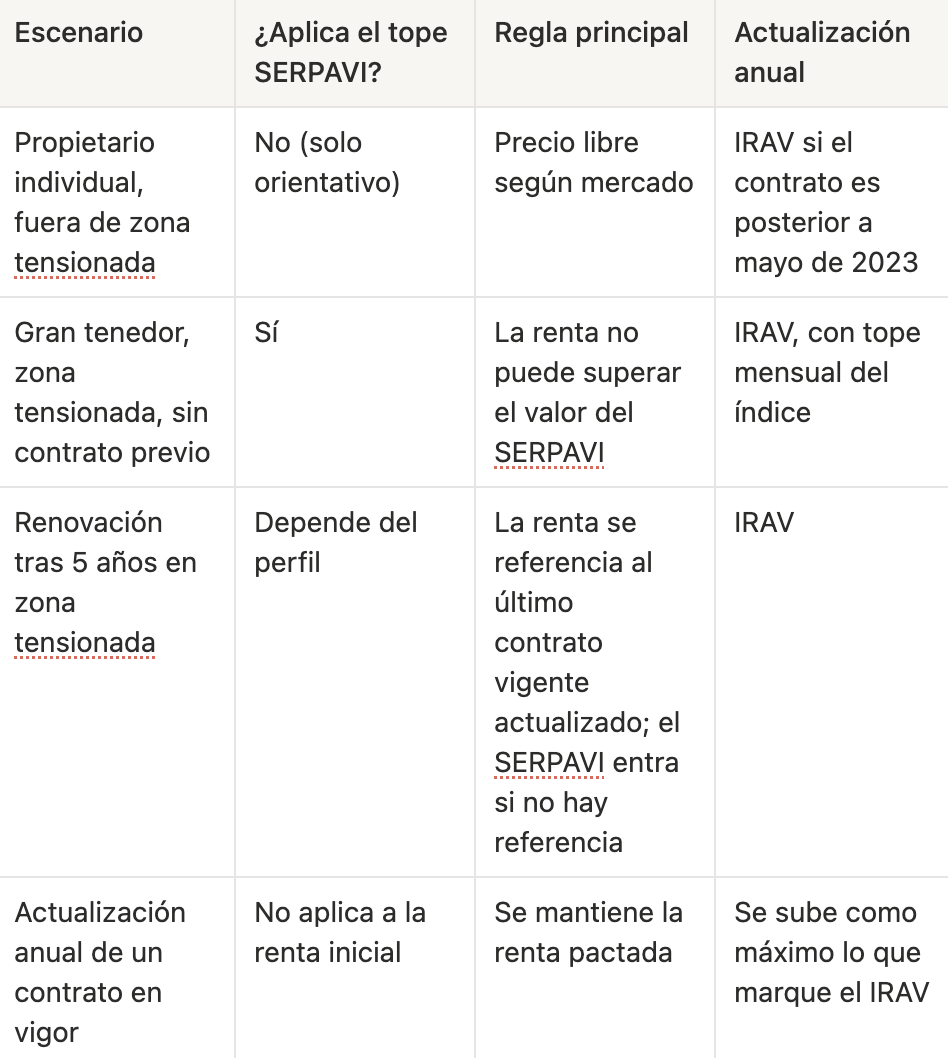
As you can see, there is no single answer. The combination of three variables—location, the landlord’s profile, and whether or not there was a prior lease—determines whether the index is merely a guideline or a legal requirement.
It is managed by the Spanish Government’s Ministry of Housing and Urban Agenda, which maintains the official web application and updates the data. The Tax Agency, the Cadastre, and the National Institute of Statistics (INE) also participate in its development, providing the statistical sources.
No. It is available throughout Spain as an informational reference, but it is mandatory only in areas designated as high-demand and, within those areas, for certain leases—especially those involving large-scale landlords or those without a prior reference lease. Outside of these cases, it serves as a guideline.
In a high-demand area, exceeding the legal limit can result in penalties ranging from a few thousand euros in minor cases to hundreds of thousands in very serious cases. Additionally, the government may require the rent to be lowered to the maximum allowed amount, and the tenant may claim a refund for the overcharge.
SERPAVI sets the reference price range and, in high-demand areas, the cap on the initial rent. IRAV is the index that limits how much that rent can increase during the annual adjustment. One sets the starting point; the other, the rate of increase.
Yes, within certain limits. Making improvements can justify an additional increase above the applicable cap—around 10% in many cases—provided that the requirements and deadlines set by the regulations are met. Improving the property’s condition or energy efficiency also legitimately raises the range reflected by the index.
No. SERPAVI is designed for primary residences. Tourist rentals are governed by their own regional and municipal regulations, and seasonal rentals have traditionally been exempt from the caps, although this last point is currently under review to prevent fraudulent use.
There is a way to continue generating real estate returns without relying on high-demand areas, rent caps, or administrative red tape. With Domoblock, you can invest starting at €200, without banks or complicated processes. We digitize real properties in strategic areas so you can participate in their appreciation through tokens, without having to buy an entire home or manage rental contracts.
The entire process is 100% online and backed by blockchain. Our team of specialists analyzes each investment, also evaluating its regulatory exposure (SERPAVI, ZMRT, IRAV), to ensure its profit potential before placing it in your hands. That’s how simple it is to invest in real estate today: with vision, technology, and professional support, leaving the red tape of traditional renting in the past.
SERPAVI has evolved from a legislative promise into a key component of Spain’s rental market. For the tenant, it’s a tool for transparency and negotiation; for the landlord, a benchmark that becomes a requirement in high-demand areas; and for the government, the dashboard it uses to monitor price trends.
The key takeaway is simple: the location of the property, the identity of the owner, and the existence of a prior lease determine whether the index serves as a guideline or a legal limit. Added to this is the IRAV, which sets the maximum annual rent increase, and an increasingly stringent penalty system that makes it unfeasible to ignore these rules.
Before signing any lease in a regulated area, the recommendation is always the same: check the official index, document the result, and, if you have even the slightest doubt about your specific situation, seek professional advice. Understanding the system thoroughly is the best way to navigate safely in a market whose rules have changed profoundly.


.png)

41 Av. del Oeste
Funded
100%
763.249,36 €
Target
€763,249.36


.png)
.png)
.png)
.png)





.avif)
.avif)


