

This word probably brings to mind ancient civilizations, when deities communicated with the earthly world through a message known as an oracle.
However, in the blockchain environment, this word takes on a slightly different, though closely related, meaning.
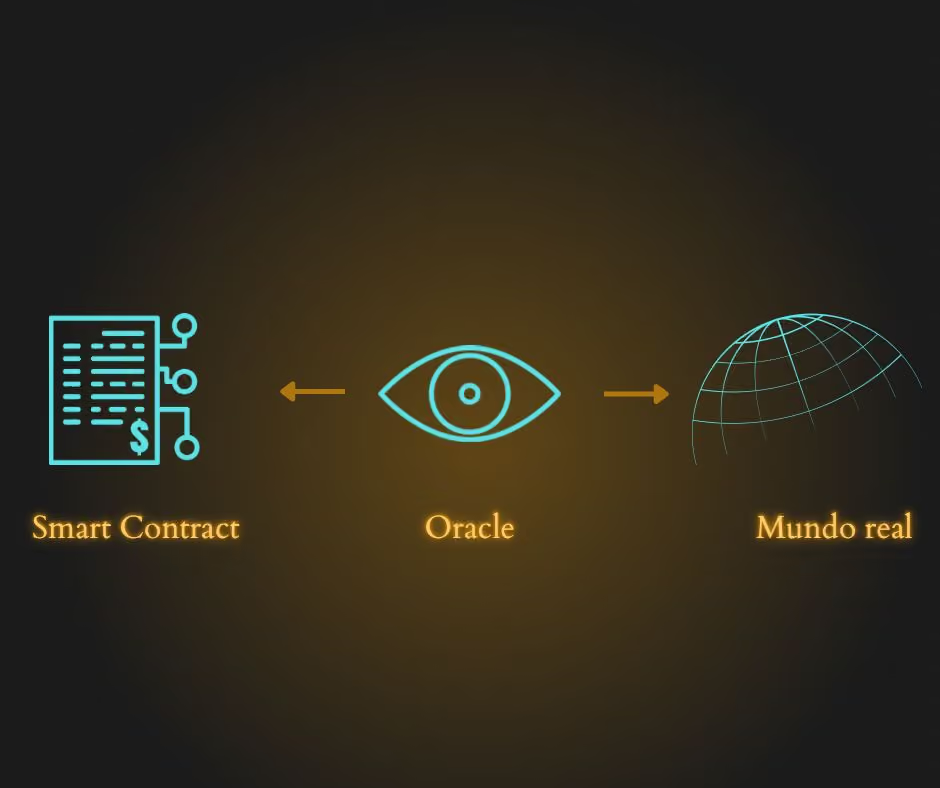
Just as oracles in ancient times allowed communication between two worlds, a blockchain oracle establishes communication between a blockchain network (and the smart contracts hosted on it) and the world outside this network.
To answer this question, it's necessary to understand, broadly speaking, how smart contracts on blockchain networks operate.
A blockchain network, simply put, is a database shared by a number of users who store the information contained within it on a hardware device.
The only way for this database to introduce new information is through majority consensus and a series of protocols that ensure it is not corrupted.
On the other hand, a smart contract is simply a set of computer instructions stored in this database. The smart contract is designed to generate an outcome (output) from information (input).
For example, we can program a smart contract on the Ethereum blockchain to purchase 5 ethers once block number X is mined.
However, smart contracts have a problem: on their own, they can only interact with information contained within the network they are programmed on (they only understand the digital world).
And this is where oracles become relevant.
An oracle is a piece of code that acts as a bridge between a blockchain network and the outside world. By the outside world, we mean any data source, i.e., any information that can be shared. These oracles connect the blockchain with platforms, databases, other blockchains with different languages, and any data source we can think of.
For example, thanks to an oracle, we can program a smart contract to purchase ether when its price reaches $1500. The oracle will be responsible for consulting a data source that tells it the price of ether and will inform the smart contract, which will then execute the programmed purchase.
Oracles are involved in most use cases of smart contracts developed today, so it can be said that they are an essential component for the development of this technology.
However, oracles are not without problems. If the information source they rely on is corrupted, or if the communication between the oracle itself and the blockchain network is manipulated, the smart contract will also be corrupted since the information it is acting upon is incorrect.
This means that the smart contract will generate a response based on this information, which probably won't correspond to what it should have generated with the real data.
Let's imagine we program a smart contract on the Ethereum network. In it, two participants, Alice and Bob, place a bet.
Both lock up a certain amount of money (represented by cryptocurrencies) and agree to send it all to whoever correctly predicts the price of Bitcoin on January 1, 2023. If it exceeds $50,000 per bitcoin, it will be sent to Alice. Otherwise, it will be sent to Bob.
Thanks to the oracle, our smart contract can access a database that will tell it the price of Bitcoin when the time comes (for example, let's say our oracle connects us to the Coinmarketcap platform, a recognized website for cryptocurrency prices).
Or, rather, the oracle will access this database and inform our smart contract with the results it obtains.
In this case, if the Coinmarketcap platform were to suffer a hack that modified the price it indicates for Bitcoin, the oracle would give our SMART contract incorrect information, which could lead to the loser of the bet illicitly obtaining the funds.
Additionally, oracles are also susceptible to what are known as main-in-the-middleattacks, in which data is modified in the flow between oracles and smart contracts.
One solution to this problem is the decentralization of oracles.
This doesn't eliminate the trust problem, but it does diversify the risk.
A widely used decentralized oracle today is Chainlink, a service that runs on the blockchain of Ethereum and other EVM-compatible networks.

Chainlink allows users who request its services to use its oracles, which it incentivizes to behave honestly. To do this, once Chainlink receives a request, it assigns the task of verifying the required information to one or more of its oracles based on certain characteristics that go beyond the scope of this article. But, in short, the more reputation an oracle wants to gain within Chainlink, the more different sources it must consult when reporting a certain data point.
Another example is the platform Augur, which serves as a prediction market for placing bets. In it, its own participants are incentivized to share information about real-world events with the goal of acting as a decentralized oracle.
Finally, it's worth noting that oracles can not only connect to cloud-shared data sources (software oracles), but also with physical devices that have built-in technology capable of sending information via an API.
For example, in a food supply chain, the food can be monitored by a sensor that constantly indicates the temperature and communicates it to a smart contract via this oracle, allowing it to act accordingly.

Oracles also embody the philosophy and values of blockchain technology, empowering individuals and giving them the opportunity to provide information about a specific event with the goal of being rewarded or to offer a greater degree of decentralization and security to the entire data network (oracle network).
Anyone can be an oracle and earn rewards for it. Decisions will no longer necessarily rest with centralized organizations holding significant decision-making power.
In this regard, as you can imagine, if we want to unlock the full potential of blockchain technology in any industry or sector, we will need reliable sources of information that allow us to bridge the gap between the analog and digital worlds. Otherwise, we would face extremely limited processes and applications based on blockchain technology, since a vast majority of events or activities occur in the physical world.
Ultimately, oracles are essential tools without which Blockchain networks and smart contracts would have severely limited functionalities due to their inability to interact with the outside of the network, making them one of the key components for the optimal functioning of applications developed on decentralized networks.


.png)

León XIII, 27
Funded
-
-
Target
507.697,35 €


.png)
.png)
.png)
.png)


.avif)
.avif)
.avif)


