
What is the Nasdaq? It is an electronic stock exchange in the United States, founded in 1971, where major technology companies such as Apple, Microsoft, and Nvidia are listed. Its most widely followed index, the Nasdaq-100, comprises the 100 largest non-financial companies on the market. From Spain, you can invest in it through a broker using stocks, ETFs, or index funds, assuming market risk and dollar risk.
The Nasdaq is one of the world’s most important stock markets, known as a leader in technology and financial innovation. If you have no idea what it is or what it’s all about, but you’ve heard that it offers good investment opportunities, keep reading. In this article, we’ll explain what the Nasdaq is, how it works, and what sets it apart from other markets. We’ll also give you some tips on how to start investing and everything else you need to know.


Nasdaq stands for National Association of Securities Dealers Automated Quotation, one of the world’s most important stock exchanges. Founded in 1971, Nasdaq was the first exchange to operate electronically, revolutionizing the way financial transactions were conducted.
Unlike traditional stock exchanges, which used a trading floor-based system, Nasdaq implemented a computerized system that allowed traders to execute transactions efficiently and quickly.
Today, Nasdaq is known for its focus on technology and high-growth companies, and it operates as follows:
In the previous section, we mentioned that Nasdaq has certain indices that help understand the state of the market. These indices, calculated based on the market capitalization of the shares of companies listed on the exchange, serve as guides; therefore, we’ll tell you about the most important ones below:
The Nasdaq-100 is Nasdaq’s best-known index and one of the most important in the world. Composed of the 100 largest non-financial companies listed on the exchange, this index represents the crème de la crème of the technology sector. From giants like Apple, Microsoft, and Amazon to innovative companies in biotechnology, software, and telecommunications.
This is a broader index that includes all stocks listed on the Nasdaq—more than 3,000 in total. Unlike the Nasdaq-100, this index is not limited to non-financial companies but also encompasses sectors such as real estate, finance, various types of investments, healthcare, and others. One could say that this index provides a “snapshot” of the market as a whole at the time of analysis.
The Nasdaq Biotechnology Index focuses on companies in the pharmaceutical and biotechnology sectors. To be included in this index, companies must meet certain requirements, such as being listed exclusively on the Nasdaq and having a trading volume of more than 100,000 shares.

Nasdaq is home to a large number of companies across various sectors, but it is particularly well-known for being home to tech giants such as Apple, Microsoft, Amazon, Alphabet (Google), Tesla, Meta (Facebook), Nvidia, Adobe, and AMD.
If you’re interested in one of them in particular, we’ll tell you what to look for before investing in Amazon.
However, the reality is that, in total, there are thousands of companies from around the world listed on this exchange, including:
Investing in the Nasdaq is a way to participate in the growth and innovation of some of the world’s most prominent technology companies. But how do you do it? Here’s how:
In case you didn’t know, a broker is a financial institution that allows you to buy and sell stocks. Research and compare different brokers to find one that fits your needs and budget. Before opening an account, check the CNMV’s official records to ensure the firm is authorized to operate in Spain.
Once you’ve chosen a broker, open a brokerage account. This process is very simple; it usually just involves providing personal and financial information and depositing funds into your account.
Once your account has been created and you’ve deposited funds, you should begin analyzing and researching companies. Before investing in any company, analyze its financial statements, performance history, future prospects, and market conditions. You can use online resources, financial analysis websites, and financial advisors to help with your research.
Once you’ve researched and selected the companies you want to invest in, you can start buying stocks. Here, you can choose from:
Use your broker’s trading platform to place your buy order, specifying the number of shares you want to buy, the order type (market, limit, etc.), and the price, if applicable.
It’s important to track the performance of your investments and make any adjustments you deem necessary to your portfolio. Most brokers offer tools for this, but you should also follow the news and conduct financial analysis to stay informed about the companies you’ve invested in and the market in general.
Two people can buy the same Nasdaq stocks and end up with different results due to taxes, currency, and the investment product they choose. This is what’s most often overlooked:
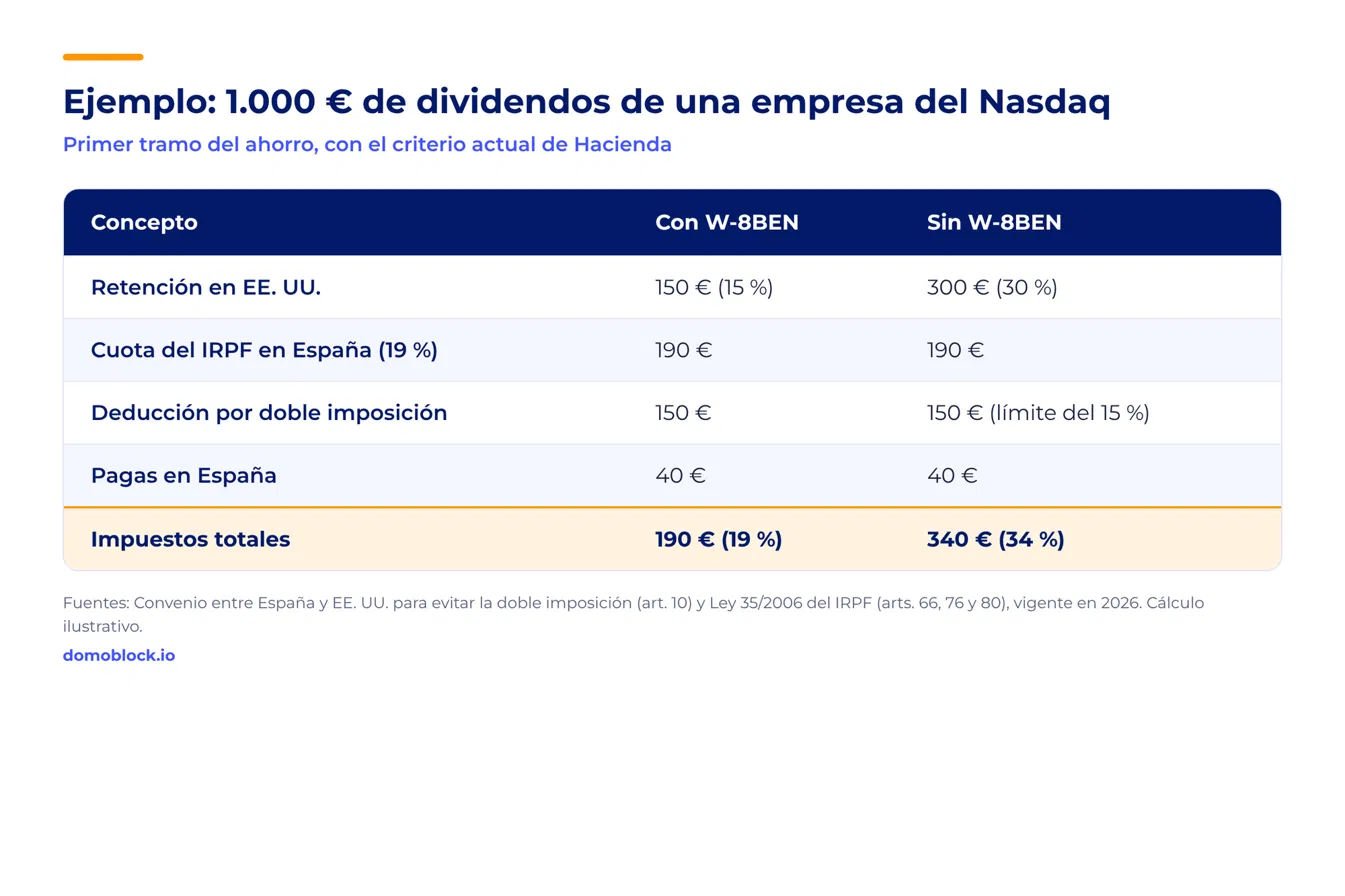
Without the form, you’ll pay an extra €150. You can try to recover the overpayment in the U.S., but it’s a lengthy process.
The same applies to real estate: the return that matters is what remains after taxes and costs. As Sergio summarizes, “the difference between the costs of purchase, construction, and sale results in a capital gain”; in the stock market, that difference is determined by commissions, currency exchange rates, and withholding taxes.
Investing in the Nasdaq, as in any stock market, involves risks. Past performance is no guarantee of future results, and the value of your investments can fluctuate—in other words, you can always lose money.
However, the fact that it has performed well in certain periods does not make it a safe market. Because it is focused on technology, it tends to rise and fall more sharply than other stock indices.
According to Nasdaq’s historical data, the Nasdaq Composite closed at 5,048.62 points on March 10, 2000, and at 1,114.11 points on October 9, 2002—a 78% drop. It did not close above that high again until April 2015—15 years later.
Anyone who bought at the peak needed more than a decade to recoup their investment. That’s why, rather than wondering if the Nasdaq is safe, it’s better to ask yourself how long you could wait if it drops by 50% or more.
We started working with blockchain around 2018, and if we’ve learned anything, it’s to separate technology from price: just because a company uses disruptive technology doesn’t mean its stock is cheap.
The Nasdaq has become an attractive destination for investors seeking to diversify their portfolios and take advantage of the opportunities offered by the dynamic and nearly limitless tech sector. In addition, investing in this market offers advantages such as:
As we’ve already made clear in this post, while the Nasdaq is known for its strong presence in the tech sector, it also hosts a wide range of companies from various sectors, including healthcare, consumer goods, financial services, industrials, and many more. This sectoral diversification allows investors to spread their capital across different areas of the economy, mitigating the risk associated with reliance on a single sector.
This market is one of the most liquid in the world, meaning there are a large number of active buyers and sellers at all times. This high liquidity facilitates the quick and efficient buying and selling of stocks, allowing orders to be executed at the desired price without significant delays. This is the key difference from real estate: a stock can be sold in seconds, while a property can take months. In our projects, for example, capital remains tied up until the property is sold.
Nasdaq is synonymous with innovation, so investing in it offers you the opportunity to participate in the growth of companies that are developing disruptive technologies in areas such as artificial intelligence, biotechnology, fintech, and renewable energy.
The Nasdaq is home to a high concentration of fast-growing companies, particularly in the technology sector, some of which have grown significantly over the past few decades, while others disappeared following the dot-com crisis. This potential for continued growth can translate into substantial opportunities for gains—as well as losses—for those willing to take on higher levels of risk.

If you want to succeed in any type of investment, you must first have a well-defined strategy and a highly disciplined approach. If you’re specifically considering investing in the Nasdaq, always keep the following tips in mind:
The first thing you should do is understand how the market works, its unique characteristics, and the associated risks. Research the different indices, the market’s structure, and the factors that influence stock prices so that you can then clearly define your investment goals.
Don’t invest blindly. Take the time to thoroughly research the companies you’re interested in, their business models, their competitive advantages, and potential risks. To do this, you can use online resources, financial analysis websites, and financial advisors to help with your research.
If you want to reduce the likelihood of losses—or the losses themselves—you should diversify. By diversifying your investments, if one performs poorly, it won’t jeopardize your entire financial well-being because another investment might be performing well.
Limit orders allow you to set a maximum price at which you’re willing to buy a stock, helping you control your budget and avoid paying an excessive price.
If you’re not sure how to get started or need help creating a personalized investment plan, consult a financial advisor. A financial advisor can guide you through the investment process, help you make informed decisions, and mitigate risks. Even if you think you know quite a bit and already have experience, a financial advisor can always offer you a new, broader, and more professional perspective.
If you’re considering where to invest beyond the stock market, at Domoblock we invest in real estate through three types of projects: house flipping (we buy homes below market value, renovate them with energy-efficiency in mind, and sell them), building flipping (conversion to residential use), and new construction, with typical timelines of 6 to 12 months.
Through real estate tokenization, you can invest starting at €200. It’s free for investors: you pay nothing directly, and Domoblock charges a 5% management fee, which is included in the project costs. The historical IRR of our projects is +15% annually; this is historical data and does not guarantee future returns.
The difference from the Nasdaq isn’t just the asset itself. Your investment is structured as a participatory loan, and its returns are taxed as capital gains, with a 19% withholding tax. And, unlike a stock, you cannot sell it whenever you want.
Before investing, please consider the risks: the return on each project is an estimate; there is no secondary market, so your capital remains tied up until the project’s completion; there may be delays in construction or sale, and you may lose some or all of your capital, which is not covered by the Deposit Guarantee Fund. Domoblock does not offer financial instruments regulated by the CNMV.
You can learn how real estate investing with Domoblock works and view the current projects on our website.
Yes. You can buy shares of companies listed on the Nasdaq through a broker authorized to operate in Spain, or invest in an index fund or a UCITS ETF that tracks the Nasdaq-100. Before doing so, check the CNMV’s records to ensure the firm is authorized and carefully review its fees.
The Nasdaq-100 comprises the 100 largest non-financial companies listed on the Nasdaq. The Composite includes virtually all stocks on the market, including financials. That’s why the Nasdaq-100 is more heavily weighted toward large tech companies, while the Composite offers a broader view of the entire market.
Capital gains and dividends are taxed under the savings bracket of the personal income tax (IRPF), ranging from 19% to 30% in 2026 depending on the amount. For dividends from U.S. companies, a 15% withholding tax is also applied if you have filed Form W-8BEN, which you can then claim as a deduction on your tax return.
It’s the form you use to certify to the U.S. that you reside in Spain. Thanks to this form, the withholding tax on your dividends drops from 30% to 15%, as stipulated by the double taxation treaty. You typically fill it out online when opening an account with a brokerage firm, and it must be renewed every few years.
There’s no official minimum: it depends on the broker and the product. Some brokers allow you to buy fractional shares, and some index funds accept small contributions. More important than the amount is that it’s money you won’t need for years and that fees don’t eat into your returns.
In summary, with its high liquidity, sector diversification, and potential for significant gains, the Nasdaq can be a way to participate in technological advancements and market trends. However, as with any investment, it’s important to conduct thorough research and have a clear strategy, always considering the potential risks. Investing in the stock market involves risks, including the possible loss of principal, and past performance is no guarantee of future results.
Sources
This article is for informational purposes only and does not constitute tax, legal, or financial advice, nor is it an investment recommendation. Past performance is no guarantee of future results. All investments involve risks, including the partial or total loss of principal: consult a professional regarding your specific situation.




27 Lope Gisbert St.
Funded
Target
€1,922,534.26