
Before buying a used car, almost everyone asks to see the maintenance log to find out what inspections have been performed. Something similar applies to a building, but few buyers ask for it: the Building Log details how it was built, who was involved, what maintenance it needs, and what renovations have been carried out over its lifetime. In this guide, we explain what the Building Logbook is, what it contains, who is required to have it, how to obtain it if it’s missing, and why we at Domoblock always review it when we assess a property for a project.


The Building Log is the set of documents that describes a building exactly as it was constructed, along with instructions for its proper use and maintenance. It is regulated by Article 7 of Law 38/1999 on Building Regulations (LOE), which requires that documentation of the completed construction work be provided to end users.
The deed certifies ownership, the abstract of title reflects the registration status, and the ITE or IEE assess the condition of the building at a specific point in time. The Building Log is more comprehensive because it brings together the project, the parties involved, the warranties, and the maintenance plan into a single file.
It serves as a technical record because it includes plans, materials, and installations; a legal record because it identifies those responsible for the construction and their warranties; and an administrative record because it contains the permits and authorizations obtained. This threefold function makes it an essential reference for any decision regarding the building.
It allows you to understand how the building is constructed, what materials were used, and where its systems are located. This information is very useful for identifying the source of a malfunction or for assessing whether a problem is isolated or affects the entire property.
It includes instructions for use and a maintenance schedule with specified intervals, such as inspections of roofs, elevators, or fire protection systems. Following this schedule prevents emergency repairs and extends the useful life of the building’s components.
A technician familiar with the building’s structure and systems can plan a renovation with fewer test pits, fewer unforeseen issues, and a more accurate budget. In a comprehensive renovation, having this information can save weeks of preliminary studies.
A record of work performed demonstrates that the homeowners’ association is fulfilling its duty to maintain the building. This documentation can be important when dealing with the city government, an insurance company, or in the event of a potential dispute with a neighbor or a third party.
The Building Log provides valuable information to the buyer about the property’s actual condition and future expenses. In renovation projects, it may also be a requirement for accessing certain public grants and specific financing options.
It includes the plans used to obtain the building permit and any changes made during construction. It is important that it reflects what was actually built—not just what was planned—because these differences may be significant in the event of future renovations.
This is a key document because its date marks the start of the liability periods under Article 17 of the LOE: 10 years for structural damage, 3 years for defects affecting habitability, and 1 year for finishing defects. Without this date, it is difficult to determine whether a claim is still within the time limit.
This includes the developer, the designer, the contractor, the construction supervisor, the project manager, and the relevant laboratories and suppliers. Knowing who was involved is essential for properly handling any claim for construction defects.
This includes the building permit, the first-occupancy permit or equivalent declaration of compliance, and authorizations for the building systems. These documents certify that the building was constructed and put into use in accordance with current regulations.
These contain instructions for the proper use of the building and its systems, as well as a schedule for periodic inspections. Many malfunctions result from improper use or failure to perform scheduled maintenance—something these manuals help prevent.
These include the final construction plans, diagrams of the electrical, plumbing, HVAC, and telecommunications systems, and a description of the materials used. This information is essential for any technician who needs to work on the building.
This section includes the ten-year insurance policy—mandatory for residential buildings under Article 19 of the LOE—equipment warranties, and the energy efficiency certificate for the completed building. It is advisable to verify the insurance company and the start date of coverage.
This includes repairs, renovations, technical inspections, and incidents that occur throughout the building’s lifespan. This is the section that the homeowners’ association must keep updated, and it provides the most information about the building’s actual condition and recurring problems.
The New Construction Building Log is prepared by the developer using the construction documentation and is delivered upon completion. It is the document required by the LOE for all buildings for which a permit was applied for after the law took effect in May 2000.
The Existing Building Logbook (LEE) is a separate document, designed for buildings constructed before the LOE took effect or that do not have one. It was established by Royal Decree 853/2021, which regulates residential rehabilitation assistance programs financed with European funds, and includes the following content:
In practice, it serves as a roadmap for renovating the building in stages, based on the homeowners’ association’s available budget. This concept aligns with the “renovation passport” introduced by Directive (EU) 2024/1275 on the energy efficiency of buildings.
The LOE requires that documentation of the work performed on buildings for which a permit was applied for after the law took effect in May 2000 be prepared and submitted. Article 16 further requires owners to retain this documentation and to transfer it when they sell the property.
Article 8 of Part I of the Technical Building Code specifies the content of this documentation and includes the building’s maintenance plan. Thus, the Building Log is not merely a collection of papers, but a practical guide for the building’s upkeep.
Several autonomous communities have their own regulations governing the Building Log, both for new construction and for existing buildings. In Catalonia, for example, Decree 67/2015 regulates the Building Log for existing residential buildings; therefore, it is always advisable to consult the regulations of each autonomous community and the municipal ordinances on technical inspections.
The Existing Building Logbook is generally not mandatory at the national level, but it may be a requirement for obtaining renovation grants. In such cases, preparing it becomes the first step in any building improvement project.
The developer must compile all documentation related to the construction project and provide it to the homebuyers, in accordance with Article 9 of the LOE. The developer is responsible for ensuring that the Building Record exists and is complete at the time of the building’s handover.
The construction management and project management teams provide the final technical documentation, updated plans, and the maintenance plan. Their involvement ensures that the book accurately reflects the building as it was constructed, including any modifications.
The builder provides documentation on materials, installed equipment, and supplier warranties. The project management team verifies that this documentation is complete and consistent with the work performed.
Once the building logbook has been delivered, the homeowners’ association or the sole owner must keep it and record any subsequent work performed. If it is not updated, the logbook loses much of its value as a record of the building’s history over the years.
In a building under the horizontal property regime, the Building Logbook is kept by the homeowners’ association, typically through the president or the property manager. Each owner should also receive the documentation pertaining to their own unit.
In a single-family home, the owner is responsible for keeping it and must hand it over to the buyer upon sale, according to Article 16.1 of the LOE. Keeping it up to date means adding any inspections, repairs, renovations, and changes to the building’s systems that are carried out, because without these updates, the book loses much of its usefulness.
If the building is new, the developer should retain a copy of the documentation provided. This is the first step in reconstructing the logbook when the homeowners’ association cannot locate it or when it is incomplete.
This is the most common way to access the Building Log for a condominium. Any owner can request access to the homeowners’ association’s records, and the property manager is usually the one who keeps them on file.
City councils retain the permit file, which includes the project proposal and submitted plans, though not the complete book. Consulting this file can be helpful in reconstructing some of the missing technical documentation.
Professional associations of architects and construction engineers may retain the approved project plans, if any, and provide copies to anyone who can demonstrate a legitimate interest. You can also contact the professionals who supervised the construction, if you have their contact information.
It is recommended to reconstruct as much as possible based on the municipal file and the approved project, and to consider commissioning an Existing Building Report from a qualified professional. This will provide the homeowners’ association with an up-to-date assessment and an action plan for the future.
The ITE (Technical Building Inspection) is a municipal-level inspection that assesses the building’s condition. The IEE (Building Evaluation Report) adds an assessment of accessibility and energy efficiency, in accordance with Article 29 of the Consolidated Text of the Land and Urban Renewal Act. The Building Record, for its part, contains the complete history of the building.
It may be necessary when the Building Log is out of date, when there are visible defects such as cracks or moisture, or before undertaking a major renovation. In these cases, the Building Log guides the inspection but does not replace it.
The ITE or IEE identifies the building’s deficiencies, and the Building Log records how and when they were corrected. Together, they provide a snapshot of the current condition and a timeline of the building’s evolution over time.
Having the Building Logbook does not exempt you from undergoing the ITE or IEE when required by the municipality. In the Community of Madrid, for example, the IEE is required for multi-unit residential buildings over 50 years old and is valid for 10 years.
Here is the checklist we use when reviewing a property’s Building Logbook before appraising it for a project:
A phased renovation plan, with estimated costs for each phase, allows you to anticipate the assessments the homeowners’ association will have to pay. This is the information that interests us most when analyzing a transaction, because it directly affects its profitability.
A recurring issue in the records—such as a roof leak or a recurring malfunction in the building systems—indicates an underlying problem, even if it has been repaired several times. This type of pattern is a red flag that should be investigated before purchasing.
The Building Log does not replace a technical inspection, a property abstract, or the homeowners’ association minutes. It may be incomplete or out of date, so it should always be cross-checked with other sources of information about the property.
A 16-unit building has an Existing Building Register with a three-phase plan: roof (€48,000), facade with insulation (€160,000), and renovation of the common electrical system (€32,000). The total estimated cost amounts to 240,000 €, which would be distributed as follows:
This information completely changes the analysis of a purchase: when factored into the price or cash flow, a transaction that initially appears profitable may no longer be so. At Domoblock, our proprietary tool monitors real estate portals 24/7, and we analyze more than 100 properties per week; building documentation is one of the filters that rules out the most opportunities.

The first step is to scan all documentation and name the files consistently—for example, using the date, the type of document, and the facility to which it refers. It’s also advisable to keep previous versions so you can see what the building looked like before each renovation.
Each work order must be recorded with its date, the company that performed it, the invoice, and, if applicable, the corresponding certificate. A well-organized record facilitates warranty claims and helps identify patterns of malfunctions.
Ideally, this should be a shared repository with read permissions for owners and edit permissions for the property manager. This way, any owner can view the building’s history without having to request copies each time.
Documents containing personal data must be handled in accordance with the General Data Protection Regulation. It is recommended to make regular backup copies and retain the signed original hard copy, which continues to have evidentiary value.
Article 16 of the LOE requires owners to retain and transfer documentation regarding the construction work performed. For a single-family home, the seller must hand it over to the buyer. For a condominium unit, the general building log is retained by the homeowners’ association, and the seller should hand over the documentation specific to the unit.
Yes. It identifies the developer, contractor, and technical professionals; establishes the date of the acceptance certificate, from which the 10-, 3-, and 1-year deadlines under Article 17 of the LOE begin; and includes details of the ten-year warranty. Without this information, a claim is slower to process and more difficult to prove.
It depends on the size of the building and the status of the existing documentation. Royal Decree 853/2021 provided grants to help prepare it, financed with European funds and administered by the autonomous communities. Many application periods have already closed, so it’s a good idea to check if any are still open in your region.
If it was built with a permit applied for after May 2000, it should have one, since the LOE applies to all types of buildings. The owner is responsible for keeping it, updating it with any renovations, and handing it over upon sale. For older homes, it can be reconstructed based on the municipal records.
It is a roadmap for renovating a building in phases until it achieves net-zero emissions, as provided for in Directive (EU) 2024/1275. Its approach is similar to the action plan in the Existing Building Logbook. Its implementation in Spain depends on the transposition of the directive.
The LOE requires occupants to use the building in accordance with its instructions for use, so the owner should provide the tenant with those instructions that pertain to the unit. Access to the complete community building logbook is reserved for owners; the tenant may request it through the landlord.
The Building Log helps identify maintenance work performed, pending tasks, and potential future costs associated with the property. Before investing as little as €200 in Domoblock’s tokenized real estate projects, review the available documentation and assess the asset’s risks: 100% online access and blockchain traceability do not replace technical, registry, and legal reviews.
The Building Log is the record that explains how a property was built and what it needs to be maintained. Before buying, ask the property manager for the log, the most recent ITE or IEE, and the renovation plan if available: these documents list the construction work and special assessments that aren’t apparent during a site visit. If the building does not have one, consider commissioning an Existing Building Logbook. Remember that all real estate investments involve risks of illiquidity, delays, and capital loss.


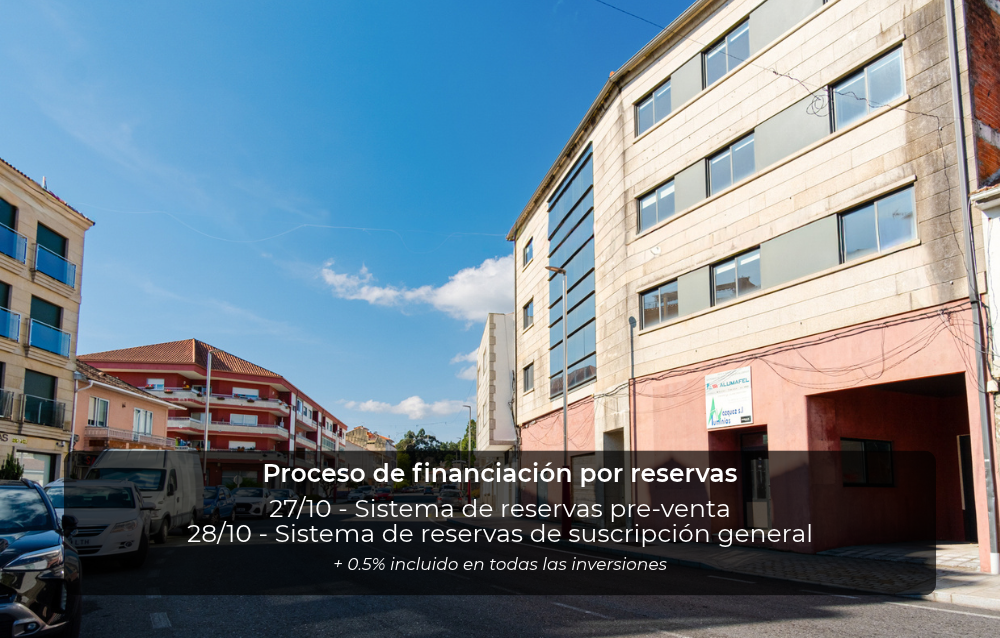

Rúa Progreso, 27
Funded
Target
1.575.297,50 €