

The real estate market has established itself and continues to be one of the most solid options for investors seeking good returns and stability. Within this sector, commercial premises stand out as an attractive alternative, combining the option of recurring income with long-term capital gains.
If you are considering investing in this type of asset, in this guide you will find everything you need to know, with the necessary information to make smart decisions.


Investing in a commercial property can be an excellent option to diversify your portfolio and generate passive income.
Commercial properties typically offer higher returns than residential properties, with an average yield ranging from 5% to 10% annually, depending on the location and the type of business occupying it. Compared to other assets, while bank deposits barely exceed 2-3% and the stock market can be volatile, well-located commercial properties provide stable cash flows.
In established urban areas, commercial property prices have increased by 3-7% annually over the last decade. Regarding CPI indexation, many rental contracts include annual adjustment clauses based on the Consumer Price Index, protecting the investor from inflation.
Unlike residential rentals, commercial leases typically have longer contracts (3 to 10 years), ensuring stable income for an extended period. There is lower tenant turnover, as established businesses (franchises, clinics, supermarkets) tend to remain in the same premises for years. There are also additional guarantees, as in many cases, commercial tenants provide bank guarantees or deposits, reducing the risk of default. Furthermore, exclusivity clauses can be included, as some contracts contain agreements that prevent direct competition in the same area, benefiting the tenant business.
A well-located commercial property can increase in value over time, especially if it is in developing areas or areas with high commercial demand. One can take advantage of a gentrification effect, where neighborhoods undergoing urban renewal see an increase in the value of their commercial properties; the demand from franchises, as expanding brands seek strategic locations and are willing to pay premiums for well-situated properties; or post-crisis opportunities, as after economic crises, commercial property prices can be depressed, offering advantageous buying opportunities.
By investing in a commercial property, you reduce dependence on other assets, such as the stock market or investment funds, protecting your capital during economic crises. This is because commercial properties typically have a low correlation with financial markets—while stocks can fall sharply, commercial rents usually remain stable—and they can serve as protection against inflation, as real estate often acts as a natural hedge against rising prices.
With property depreciation, you can deduct a portion of the property's value each year on your income tax, and with deductions for renovations, improvements that increase energy efficiency or accessibility can generate tax benefits.
You might be interested in: types of real estate investments.
You should consider whether you're looking for monthly income or long-term capital appreciation, and how much capital you can allocate to the investment.
Prioritize areas with high foot traffic, near shopping centers or main streets, developing areas with growth potential, and proximity to public transport and parking.
You can opt for businesses such as restaurants, fashion stores, franchises, offices, etc., ensuring that the premises comply with urban planning regulations.
You should compare bank loans for commercial investment, and it's a good idea to consult a tax advisor regarding taxes (IBI, IRPF, capital gains).
You should conduct a technical inspection of the premises, verify that it has no debts or encumbrances, and hire a specialized lawyer to review the contract.
The success of a commercial property depends 80% on its location. Key factors to consider include foot traffic and visibility – main streets, corners, and areas near public transport are ideal; competition and complementarity – a street with several restaurants can be positive (a "gastronomic zone" effect), but too much direct competition can saturate the market; and future urban planning – you should inquire about street expansion projects, new shopping centers, or zoning changes that could affect value.
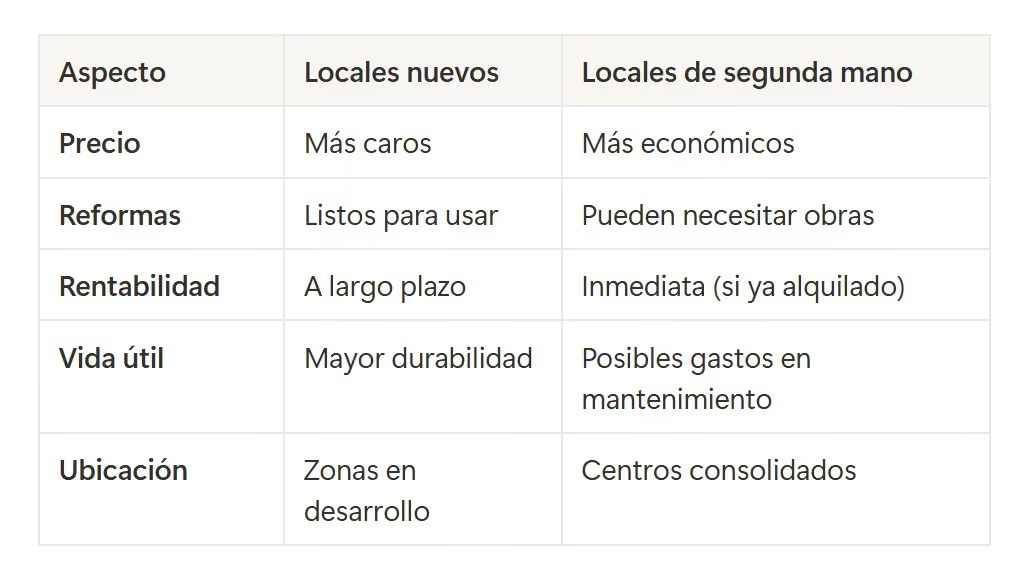
An older property may require investment in electrical installations, air conditioning, or accessibility. You must ensure it has an Energy Performance Certificate (EPC) and complies with fire regulations, and consider its use flexibility, as ****some properties have usage limitations (e.g., for offices only), which reduces the pool of potential tenants.
You should analyze which types of businesses thrive in the area (e.g., residential neighborhoods demand supermarkets; tourist areas, restaurants), review economic indicators such as employment data, per capita income, and population growth in the area, and consider post-pandemic trends, as the rise of online commerce has reduced demand for certain commercial spaces but increased the need for logistics spaces or "dark kitchens."
If it's already occupied, you should review the tenant's history, the update clauses (as some contracts link rent to the CPI and protect against inflation), and maintenance obligations (as some contracts state that the lessee must cover certain repairs).
The best cities for investment are Madrid and Barcelona, which have very high demand but elevated prices; Málaga, Valencia, and Seville, with significant tourism and commercial growth; Bilbao and Zaragoza, which are industrial cities with a strong business fabric; and coastal cities like Alicante and Murcia, which are ideal for tourism-related businesses.
An unoccupied premise can take months to rent, especially in areas with high supply, and during the vacancy period, you'll still have to pay property tax (IBI), community fees, and insurance without any income.
The growth of online sales has reduced the need for physical stores in some sectors (e.g., electronics, fashion). Remote work has led to lower demand for office spaces in certain areas, and changes in consumer habits have caused previously commercial neighborhoods to lose their appeal due to population migration.
Structural repairs, urban development contributions requiring payments for public works, and specific insurance policies can all entail unforeseen expenses.
Commercial premises are not as easy to sell as residential properties, especially during recessions. If you need to sell quickly, you're likely to receive offers well below market value.
Changes in regulations can limit uses (e.g., prohibition of terraces in certain areas), and some city councils have increased property tax (IBI) for commercial premises in recent years.
You might be interested in: what a hidden defect in a property is.
Specialized real estate agents, expert commercial contract lawyers, and wealth managers can lighten the administrative burden and help avoid potential problems or unpleasant surprises during the process.
There's less risk, as they are easier to rent than a large one in a peripheral area, and greater diversification provides more security.
Well-known franchises (like Starbucks) are often reliable tenants, and resilient sectors such as pharmacies, supermarkets, or medical clinics are less susceptible to economic crises.
To check foot traffic, and it's necessary to observe the commercial environment; if other businesses are closed or for sale, it could indicate a potential decline in the area.
Some companies offer guaranteed leases for 2 to 5 years in exchange for a slightly higher purchase price.
You must check for encumbrances, ensuring there are no liens, hidden mortgages, or lawsuits, and review the property's history.
Between 5% and 10% annually, depending on the location and type of business.
Property Tax (IBI), Personal Income Tax (IRPF) on rental income, and municipal capital gains tax in case of sale.
By renting them to stable businesses with long-term contracts.
Between 3 and 10 years, with renewal clauses.
It is declared on your income tax return as real estate capital gains.
It depends on the city, but in Spain, prices start from 100,000 euros in less central areas.
Domoblock breaks down the traditional barriers to real estate investment, allowing you to participate from just €200. You no longer need large sums to generate passive income: with this platform, specializing in blockchain and real estate tokenization you can access profitable properties and start seeing results quickly.
At Domoblock, we select real estate alternatives for flipping houses and flipping buildings that are real and make them accessible to you. With an estimated return between 8 and 12 months and returns exceeding 10%, it's a perfect option for diversification with low risk and high potential.
Every transaction is clear, secure, and traceable, providing complete confidence even for those taking their first steps in investing. Achieve your financial freedom and stability with Domoblock!
Take a look at our real estate investment projects in Madrid, real estate investment in Alicante, real estate investment Zaragoza and real estate investment Valencia.
Investing in commercial premises can be an excellent option to generate recurring income and diversify your portfolio. However, it requires a detailed analysis of location, demand, and legal conditions.


.png)

41 Av. del Oeste
Funded
100%
763.249,36 €
Target
€763,249.36


.png)
.png)
.png)
.png)




.avif)
.avif)
.avif)


