

Real estate law is the body of rules that governs how rights to real property are created, transferred, modified, and terminated. In practice, it determines who owns a home, what encumbrances it carries, and what you can do with it.
For investors, this isn’t just theory: the problems we encounter in a transaction almost never stem from the price, but rather from a lien, a debt, or unlicensed construction work that no one checked. At Domoblock, we buy, renovate, and sell homes, and the legal review is our first line of defense.

If you’re wondering what real estate law is, think of the rules governing land and everything attached to it: rights over the property (ownership, usufruct, mortgage) and contracts involving it (purchase, lease).
These are the real estate laws in Spain that have the greatest impact on an investment:
Note: Autonomous communities have their own regulations regarding urban planning, housing, and property transfer tax (ITP), so the same transaction is treated differently in Valencia than in Madrid.
A real right is a direct power over a thing, enforceable against anyone. The most comprehensive is full ownership; if the right of use is separated, bare ownership remains: you own the property but do not use it.
Rights in rem on real property that impose restrictions limit these powers and are attached to the property: if you purchase a property with a usufruct or an easement, you also acquire those rights. And that is reflected in the price.
To see what real estate law governs in practice, these are the areas that carry the most weight in an investment.

A sale is considered to exist once there is agreement on the property and price (Art. 1450 of the Civil Code), but ownership is transferred upon delivery, which in practice is the deed of conveyance (Art. 1462). The most common mistake involves preliminary deposits: if it is not expressly stated that they are penalty deposits (Art. 1454), the courts tend to treat them as confirmatory deposits, and no party may withdraw from the contract without forfeiting the deposit.

The key provision of the LAU for an investor is that the lease survives the sale: whoever purchases a rented property is subrogated into the lease for its first five years, or seven if the previous landlord was a legal entity (Art. 14). The tenant also has a right of first refusal, unless waived (Art. 25).

The Registry publishes who the owner of each property is and what encumbrances it carries. Its key effect is the public faith in the registry: anyone who purchases in good faith and for valuable consideration from the person listed as the owner, and registers the transfer, is protected even if the seller’s title is later annulled (Art. 34 of the Mortgage Law). The Cadastral Registry describes the property but does not prove ownership.

Two provisions of the Condominium Act directly affect an investment. Condominium association debts for the current year and the three preceding years remain with the unit even if it changes hands (Art. 9.1.e). And as of April 3, 2025, using a residence for tourism purposes requires the express approval of three-fifths of the owners’ association (Art. 17.12, amended by Organic Law 1/2025).

Purchasing a pre-owned home is subject to the Property Transfer Tax (ITP); purchasing a new construction from a developer is subject to VAT and Stamp Duty (AJD). Upon sale, the individual pays income tax (IRPF) on the profit and municipal capital gains tax. While owning the property, property tax (IBI) applies. A mistake here can alter the outcome of any transaction.
Real estate due diligence is the legal, urban planning, tax, and technical review of a property before purchasing it. At Domoblock, we perform this for every transaction and always request:

Example: What condominium association debt does the buyer inherit? You buy an apartment in October 2026, with a monthly fee of €80 that the seller has not paid since January 2022:
| Period | Unpaid Dues | Is the apartment liable? |
|---|---|---|
| 2022 | €960 | No |
| 2023 | €960 | Yes |
| 2024 | 960 € | Yes |
| 2025 | 960 € | Yes |
| 2026 (January–October) | €800 | Yes |
| Outstanding mortgage balance on the apartment | €3,680 | — |
Of the €4,640 in unpaid rent, €3,680 can be claimed against your apartment. The certificate is not a formality.
Schedule a technical inspection. Hidden defects can be claimed against the seller, but only within six months of closing (Art. 1490 of the Civil Code). Also verify that the property as built matches the registered description.
Verify the developer and the building permit. The Building Regulations Act (First Additional Provision) requires that payments made in advance be guaranteed by a surety or insurance: request the individual certificate before each payment.
If the property is rented, ask to see the lease agreement, rent receipts, and security deposit: you’ll inherit these. If it’s occupied without legal title, the price will be lower, but regaining possession involves an uncertain timeframe and cost that must be factored into your calculations.
Legal risks in real estate investment almost always leave a trace in some document:
And if the issue goes to court, as of April 3, 2025, most civil lawsuits require an attempt at negotiation or mediation first (Organic Law 1/2025).
Investing collectively or digitally does not remove the property from the scope of real estate law: deeds, the Land Registry, and taxes apply just the same. What changes is the relationship between the investor and the property, and therein lies the key to legal certainty in real estate investment.

Typically, a company purchases the property and is listed as the owner. The investor does not own the apartment: they hold a right against the company, either as a partner or a lender. It is essential to review what rights the investor receives and what guarantees are in place.
Platforms that connect developers and investors are governed by Regulation (EU) 2020/1503 and require authorization from the CNMV, along with detailed information and a knowledge test for inexperienced investors. Not all online models operate this way: check whether an entity is authorized and, if not, under what structure it operates.
A token is an entry on a blockchain that represents a right: a stake in a loan, a company, or a project. It changes how that right is registered and transferred, not the ownership of the property, which remains registered in the name of its owner. What matters is the contract behind it.
Urban planning law determines what can be built and what uses are permitted on each plot of land; real estate law governs the legal relationships between people regarding that property: who owns it, what encumbrances it has, and how it is sold or rented. In practice, the two constantly intersect: an illegal construction project affects any sale or purchase.
No. Civil law is much broader: it also governs family matters, inheritances, and obligations in general. Real estate law draws upon the Civil Code regarding ownership, property rights, and contracts, and adds to it the specific registration, tax, urban planning, and administrative regulations pertaining to real estate.
They review contracts and encumbrances, advise on sales and leases, conduct due diligence before a purchase, and represent clients in litigation—such as evictions, hidden defects, or disputes with the homeowners’ association or among heirs. Their greatest value lies in identifying problems before a contract is signed, when resolving them is still cost-effective.
Generally speaking, no: ownership is transferred through the contract and the handover, which is usually the deed of conveyance. However, registration is highly recommended, because only then does the Registry protect you against third parties—for example, in the event of a subsequent lien against the seller. A mortgage, on the other hand, only becomes effective upon registration.
Unless otherwise agreed, the seller pays for the original deed, and the buyer pays for the first copy and subsequent expenses, such as registration with the Registry (Art. 1455 of the Civil Code). In addition, the buyer is responsible for the Property Transfer Tax (ITP) or VAT, and the seller is responsible for the municipal capital gains tax. The allocation of expenses may be agreed upon differently in the contract.
We conduct this entire review before proposing a project. We analyze more than 100 properties per week using our proprietary tool, eliminate those that do not pass our review of encumbrances, zoning, and costs, and purchase, renovate, and sell the ones that do.
With our real estate co-investment opportunities, you can participate starting at €200, with the documentation, estimated return, and timeline for each project published. Your investment is structured as a participatory loan recorded on the blockchain. Domoblock does not offer financial instruments supervised by the CNMV nor does it provide participatory financing services.
Risks: Returns are estimated, not guaranteed; there is no secondary market, and capital remains tied up until closing; delays may occur, and you may lose some or all of your capital, which is not covered by the Deposit Guarantee Fund.
A good price does not make up for a bad title. Before committing money to a property—whether directly or through a platform—check who the owner is and what encumbrances exist, what debts are attached to the property, and what the zoning regulations allow. If you’re investing collectively, read exactly what rights you’re receiving. That half-hour of reading is the most profitable part of the transaction.


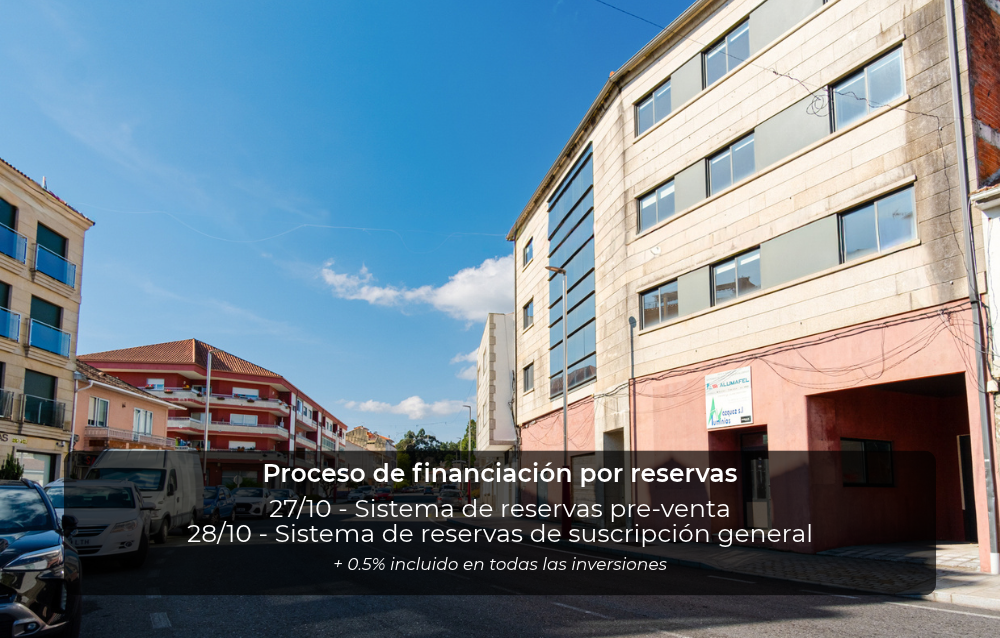

Rúa Progreso, 27
Funded
Target
1.575.297,50 €