

Real estate crowdlending has quickly become one of the most attractive investment alternatives in recent years, especially for investors looking to diversify their investment portfolio beyond traditional financial products, such as bank deposits or investment funds. In a context of low interest rates and high market volatility, this collective financing model offers attractive returns, access to the real estate sector without the need for large capital, and the opportunity to participate in projects with defined timelines.
Spain is positioned as one of the leaders in this industry, thanks to a clear regulatory framework and growing demand for alternative financing from real estate developers. But what makes real estate crowdlending so interesting? It allows small and medium investors to participate in loans backed by real assets, and reduces barriers to entry into the real estate market. However, like any investment, it is not without risks.
In this comprehensive guide, we will explore in depth what real estate crowdlending is and how it works, its main advantages over other forms of investment, and the best regulated platforms in Spain.


Real estate crowdlending is a collective financing model in which several investors contribute capital to finance loans for real estate projects, such as construction, renovation, or property acquisition. In return, investors receive periodic interest and the return of the invested capital once the loan term ends.
Unlike real estate crowdfunding, where investors participate in the ownership of the project, in crowdlending, they act as lenders and do not acquire rights over the property.
While bank deposits and government bonds offer returns of around 1 to 3% annually, real estate crowdlending can generate between 5 and 12% return, depending on the project's risk. This is because developers are willing to pay higher interest rates for access to fast and flexible financing.
One of the major advantages of real estate crowdlending is that it allows capital to be distributed across multiple loans, which reduces concentration risk. For example, you can invest in different cities, in various types of properties such as residential homes, commercial premises, and logistics warehouses, and with different terms, from 6 months to 5 years.
This prevents the failure of a single project from significantly impacting your portfolio.
Unlike other forms of crowdfunding, many real estate loans are backed by mortgages on the property, personal or corporate guarantees from the developer, or default insurance on some platforms. This reduces risk compared to unsecured loans.
With this model, you don't need to buy an entire property to benefit from the real estate market. With investments starting from 50 or 100 euros ****you can participate in loans to developers and receive periodic interest payments.
Unlike the stock market, where stock values can fluctuate daily, crowdlending loans have clear maturity dates and pre-established monthly or quarterly interest payments. This facilitates medium-term financial planning.
Some platforms (such as Housers or Mintos) allow you to sell your stake before maturity, which provides you with some liquidity should you need to recover your money early.
The goal is to finance the construction of new homes or the renovation of existing buildings, with medium to long terms (1 to 5 years). Returns are high, from 8 to 12%, but with higher risk due to potential construction delays.
These seek quick financing (3 to 18 months) to purchase an asset before securing a bank loan. They offer returns of 7 to 10%, with mortgage collateral.
The goal is to acquire properties for rent or resale, with returns of 6 to 9%, and carries lower risk as it involves already constructed properties.
Residential crowdlending offers unique advantages, such as generally higher demand for housing and lower volatility. However, returns are somewhat lower. On the other hand, commercial crowdlending offers higher returns and, in some cases, shorter terms, but is much more sensitive to an economic crisis.
First, the project is selected and published on platforms like Urbanitae or Housers, which analyze the developer's solvency and the project's viability. The investment opportunity is then published with details such as the requested amount, the type of collateral (mortgage, guarantee), the term, and the interest rate offered.
Investors then choose to participate; they can invest from €50 or €100 in one or more projects, and some platforms allow automatic investment based on your risk profile.
Once financing is complete, the contract is signed between the developer (who receives the money) and the investors (who act as lenders). In many cases, a mortgage is registered in favor of the investors.
Finally, interest is collected and capital is repaid. Payments can be monthly or quarterly (interest only), or at maturity (interest + capital). In case of default, the platform initiates legal action to recover the money.
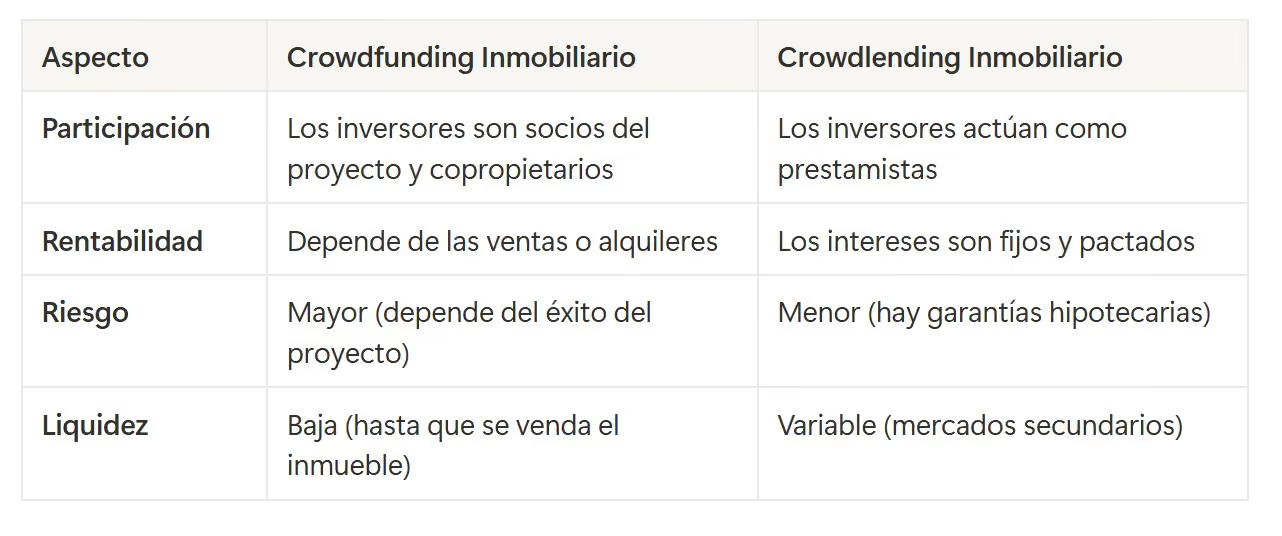
To get started in the real estate crowdlendingmodel, it's estimated that you need a minimum capital starting from 50 euros. Large sums aren't required, but diversification is recommended.
You need to register on a regulated platform, ensuring it's authorized by the CNMV in Spain or by the equivalent regulatory body in other countries.
You should have a basic understanding of the risks, recognizing that it's not a guaranteed product. You also need to know how to analyze projects and their factors, such as collateral or the developer's track record.
The ideal investor profile for this model is someone seeking profitability while accepting a certain level of risk. However, it is not recommended for ultraconservative investors.
You should check its history, years in the market, and user reviews. Some recommended platforms in Spain include Housers, Urbanitae, and ECrowd!
It's advisable not to allocate more than 10-15% of your capital to a single project, and it's better to combine short-term and long-term loans.
Prioritize loans with first-lien mortgages, and thoroughly review the developer's track record (experience, previous projects).
You should track and analyze project progress, and it's advisable to reinvest earnings to take advantage of compound interest.
You must consider the risk of default, because even with collateral, a developer can go bankrupt. Therefore, it's best to invest only in platforms with rigorous due diligence processes.
Also, consider the lack of liquidity, as most loans aren't liquid until maturity, and platform risks, as a platform's bankruptcy could complicate money recovery.
Furthermore, regulatory changes must be considered, as legislation on crowdfunding can evolve. Therefore, it's better to invest in jurisdictions with stable regulatory frameworks.
It specializes in mortgage-backed loans in Spain and Italy.
It focuses on real estate development projects with high returns.
It features investments in sustainable and socially impactful projects.
It is a Spanish platform offering asset-backed short-term loans.
It is regulated under Law 5/2015 on the Promotion of Business Financing.
For tax purposes, interest is declared as income from movable capital (between 19% and 26% in personal income tax), and some platforms register mortgages in favor of investors as collateral.
Yes, for those seeking profitability and diversification, but who are willing to accept some risk.
No investment is 100% safe, but choosing regulated platforms reduces risk.
Investors with a moderate risk profile who are looking for alternatives to stocks or deposits.
No, but it's always advisable to do your research and start with low-risk projects.
With Domoblock, access to the real estate world is no longer reserved for large capital. Thanks to real estate tokenization, you can invest in assets from as little as €200, earning returns of over 10% and recovering your investment in just 8 to 12 months.
This innovative real estate investment platform is the right choice if you're looking to grow your money without complications. Domoblock uses blockchain technology to ensure the security and transparency of every transaction, allowing users to invest with complete confidence and control.
Domoblock offers various real estate investment projects in Madrid, real estate investment projects in Alicante, real estate investment projects in Zaragoza and real estate investment projects in Valencia. Check them out!
Choose the house flipping project and flipping building that suits your financial goals, and let Domoblock do the rest!
Real estate crowdlending is an attractive option for generating appealing returns in the real estate sector without needing significant capital. However, like all investments, it carries risks that must be managed through diversification and prior analysis. With the rise of alternative finance, this model is solidifying its position as a key tool for investors seeking alternatives to traditional products.


.png)

41 Av. del Oeste
Funded
-
-
Target
€763,249.36


.png)
.png)
.png)
.png)




.avif)
.avif)


