

The housing access crisis in Spain has worsened in recent years, with rental prices even exceeding 40% of the average income of many families. In this context, social housing has become an indispensable mechanism to guarantee the constitutional right to decent housing, especially for those in vulnerable situations.
According to data from the Ministry of Transport, Mobility and Urban Agenda, it is estimated that over 200,000 households rely on some form of social housing program in Spain. However, demand far outstrips supply, making it essential to understand how the system works, who is eligible, and how to apply correctly.
This article explains in detail what social housing is. Additionally, you'll find a practical guide on how to apply for it, including updated requirements, realistic waiting times, and tips to increase your chances of success in being awarded a social housing program.

Social housing is a housing access scheme where public administrations, non-profit organizations, or private developers offer properties at prices significantly below market rates. Its main objective is to provide affordable housing for people in economically or socially vulnerable situations.
These homes typically belong to public assets (municipalities, autonomous communities, or the State), private entities participating in collaborative programs, or non-profit cooperatives and foundations.
Unlike the open market, social housing is regulated and subject to specific conditions regarding rent, tenant profile, and contract duration.
You might be interested in: subsidized housing.
While these terms can be confusing, each refers to a distinct model.
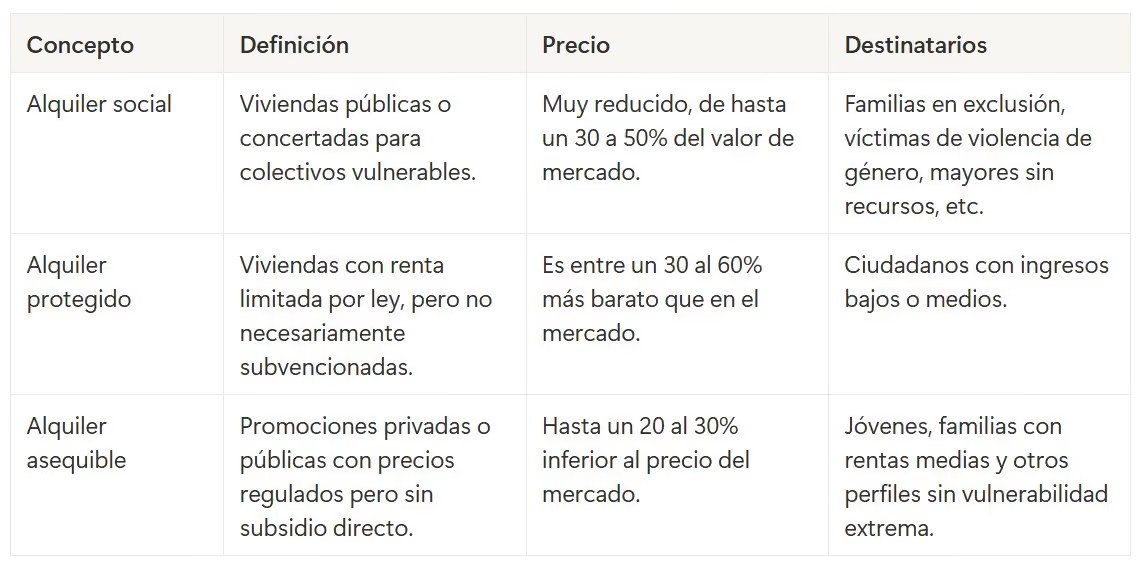
Other key differences worth mentioning include contract duration, as social housing is typically renewable, while protected housing may have time limits. Requirements also differ: social housing demands proof of a vulnerable situation, whereas protected housing depends on maximum income thresholds.
Social housing is aimed at groups with demonstrable economic or social difficulties, such as the following cases:
The required income threshold depends on each Autonomous Community, but generally, it should not exceed 2.5 times the IPREM (approximately 24,000 euros per year for a family of 4 members). In cities with more strained markets like Madrid or Barcelona, the limits can be even stricter. Priority situations include single-parent families and households where housing costs exceed 50% of their income.
For these types of cases, documentation such as a protection order or a social services report is required, although in some instances, a police report is sufficient. Cases involving victims of gender-based violence have the advantage of preferential allocation, potentially allowing them to bypass waiting lists, and rental contracts include clauses that permit early termination for safety reasons.
A disability certificate showing 33% or less disability is required, along with a report confirming the need for adapted housing, such as the installation of architectural barriers in their current home.
Specific programs exist for these cases, and some Autonomous Communities have agreements for reserved spots in accessible housing.
In this case, the typical profile is young people aged 18 to 35 who are in their first job, on temporary contracts or scholarships, and do not own property. Additionally, they may be eligible for supplementary aid. For example, in areas like the Basque Country, subsidies for deposits may be available.
The selection criteria here are pensioners with incomes equal to or less than 90% of the minimum wage (approximately 810 euros per month this year) and who are over 65 years old and at risk of exclusion.
For this case, options include public residences or assisted living apartments in some municipalities.
Requirements vary by administration, but commonly requested documents usually include the DNI or NIE for all adult members, the Family Book or a residency certificate, and an income tax return from the last fiscal year (or an income certificate if not required to file).
For proof of employment status, employed individuals must submit their last 3 pay stubs, self-employed individuals must submit their quarterly VAT declaration or income reports, and unemployed individuals must submit their unemployment certificate and proof of benefits.
Depending on the case, additional reports may be required. Social services may request a report confirming vulnerability, such as the risk of eviction. In cases of gender-based violence, a protection order or a social worker's report is required, and for disability cases, an IMSERSO or Autonomous Community certificate is needed.
Other requirements also include not owning another primary residence (with exceptions if in another province for work), and not having debts with the tax authorities or public administration.
You should consult the income thresholds and conditions of your Autonomous Community on its official website, and you can use income simulators to check if you qualify.
It is advisable to request social services reports or medical certificates in advance, as these can take time. Additionally, it's ideal to digitize documents by scanning them into PDF format, as some platforms do not accept photos.
Online, you must register on the Autonomous Region's electronic headquarters (which requires a digital certificate or Cl@ve), and upload the documents and sign them electronically.
In person, you must go to housing offices or city councils, which in most cases requires a mandatory prior appointment.
You will receive an application number to check the status of your application. If a document is missing, you will have 10 to 15 business days to complete it.
Allocations are communicated by certified mail or the OFFICIAL GAZETTE of the Autonomous Community. The typical waiting period is 6 months to 3 years, depending on availability in your area.
It can be submitted through regional channels. In Andalusia, it's AVRA (Housing and Rehabilitation Agency), in Catalonia, it's the Catalan Land Institute, and in Madrid, it's IVIMA.
Some municipalities manage their own social housing, so applications must be made at the city council or citizen service offices, where you can request an appointment for personalized advice.
Some collaborating entities where you can apply include the Red Cross, which helps groups in severe exclusion, Cáritas, which can manage housing in agreement with the Church, or the Tenants' Union, which advises on procedures and claims.
In some Autonomous Communities, the process can be initiated on digital portals such as Vivienda Social Madrid or Generalitat Valenciana.
Generally, between 3 and 5 years, renewable, provided the requirements are maintained. Some programs allow for exceptional extensions.
For social housing, the price ranges from 50 to 300 euros annually, depending on the location (it's cheaper in rural areas), the number of family members, and the income level, which may lead to a progressive scale.
You can appeal within 1 month by providing new documentation.
Not always, as allocations depend on availability.
Income is reviewed periodically. If you exceed the limit, you may lose your eligibility.
You should consult your Autonomous Community's public housing registries.
Yes, except with other direct rental subsidies.
Social housing is an essential tool for combating residential exclusion in Spain. Although the application process can be slow, it is a viable option for those facing financial difficulties. So, if you meet the requirements, don't hesitate to apply and contact social services for personalized advice.


.png)

41 Av. del Oeste
Funded
-
-
Target
€763,249.36


.png)
.png)
.png)
.png)





.avif)
.avif)


