

The first occupancy license (LPO) is one of the most important procedures in the process of buying, selling, renting, or legalizing a property in Spain. This document serves as an official certificate confirming that a property complies with all urban planning, safety, health, and accessibility regulations required for habitation.
Although many people are unaware of its relevance, the lack of this license can lead to serious legal and financial problems. In this article, we will explain exactly what a first occupancy license is, why it is so important, how to obtain it depending on the type of property, and the risks involved in not having one.
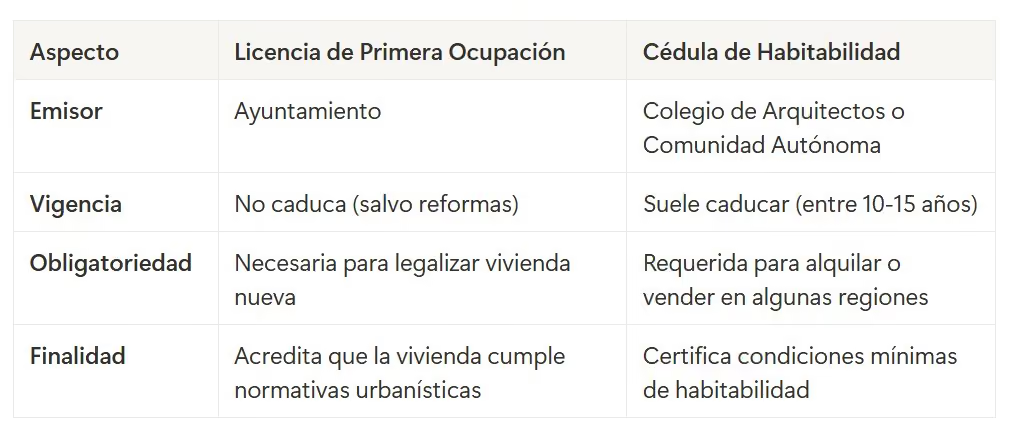
Furthermore, we will cover the necessary documentary requirements, the steps to apply for it, the associated costs, and the key differences from the certificate of habitability, another fundamental document in the real estate sector.


A first occupancy license is an administrative document issued by the relevant city council certifying that a dwelling or building complies with the urban planning, safety, health, and accessibility regulations established by law.
This procedure is mandatory to legalize a property and allows its use as a residence, as well as the execution of purchase and sale agreements, rental agreements or basic utility services, such as electricity, water, or gas.
The first occupancy license is not merely a bureaucratic procedure, but an essential requirement to ensure that a property is legal and safe. Its importance lies in several key aspects, such as legalizing the property with the city council, because without the LPO, a property is not officially recognized as habitable, which can lead to problems with municipal authorities. In many cases, city councils do not allow the activation of basic utility services (electricity, water, gas) without this document.
It is also necessary for notarizing and selling. Most notaries require the first occupancy license to formalize a sale, and if it is missing, the buyer could face difficulties registering the property in their name.
This license is mandatory for renting. A rental agreement can be declared void if the property does not have an LPO. Some autonomous communities even fine owners who rent without this document.
Furthermore, it facilitates banking and mortgage procedures, as banks usually request the LPO to grant a mortgage, as it guarantees that the property complies with legal requirements. Without it, the property's appraisal could be lower, affecting the loan amount. It also prevents sanctions and future problems, as urban planning inspections can impose fines on properties without a license, and in extreme cases, the city council could order eviction if the property does not comply with regulations.
Not all properties require the same process to obtain the LPO. Below, we detail the most common cases and how it is obtained in each.
In this case, the party responsible for carrying out the procedure is the developer or builder, who must manage it once the construction is completed.
This involves submitting the final construction certificate (a declaration that the construction matches the approved project) and a municipal inspection to verify compliance with regulations. The license is then issued if everything is in order.
For these types of properties, a new license is required if the property has undergone structural renovations such as changes in layout, extensions, or changes of use. The additional necessary documentation includes the technical project for the renovation, the building permit (if required), and the certificate of completion.
If the property already has an LPO, it is usually not necessary to renew it. However, in some municipalities that require an update when selling or renting, or if there were undeclared modifications, it may be necessary to regularize the situation.
Requirements vary by municipality, but generally include basic documentation such as a signed application form provided by the city council, the technical project endorsed by an architect, the certificate of completion (which declares that the construction matches the approved plans), and the building permit, if there was construction or renovation.
Additional certificates may be required, such as the energy performance certificate, which is mandatory for sale or rental, the electrical and gas installation certificates (required by some city councils), and the accessibility report, in some communities with specific regulations.
Municipal fees depend on the cadastral value and the city council, but typically range from 300 to 3,000 euros.
You might be interested in: where to apply for a certificate of occupancy.
Applications are submitted to the Urban Planning Department of the city council where the property is located. Some municipalities allow online processing, while others require in-person submission.
You must gather the necessary documentation, such as the technical project, certificates, etc., then submit the application to the city council (in person or electronically), pay the municipal fees, await the technical inspection (in some cases, a municipal technician visits the property), and receive the resolution. If favorable, the license is issued; however, if there are observations, they must be addressed before approval.
The usual timeframe is between 1 and 3 months, although it can take longer in large cities. Factors influencing this include the city council's workload, errors in documentation, and whether an on-site inspection is required.
The cost depends on the cadastral value of the property and the municipality, but typically ranges from 300 to 1,500 euros for single-family homes, and between 1,000 and 3,000 euros for multi-unit buildings.
Not having a first occupancy license can lead to serious legal and financial problems, such as administrative fines, where local councils can impose penalties of up to 6,000 euros for occupying a property without an LPO, and in severe cases, may even order eviction until the situation is regularized; issues with sales and rentals, as notaries and registrars may refuse to formalize deeds if the license is missing, and rental contracts could be annulled, leaving the owner without the right to collect rent; and difficulties with basic utilities, as electricity, water, and gas companies may refuse to activate services without an LPO.
Furthermore, there can be obstacles to mortgages and sales, as banks may deny loans if the property is not legalized, and buyers often demand discounts if they discover the license is missing.
Some long-term repercussions include that a property without an LPO loses market value and that, in a future sale, the new owner could sue the seller for concealing this defect.
It depends on the autonomous community, but generally, it has been mandatory since the 2008 Land Law.
You can find out by checking with the local council or by requesting a simple note from the Property Registry.
It depends on the notary, but many require it to avoid legal problems.
It is not legal, and the contract could be annulled.
You could have problems living in it, contracting services, or selling it in the future.
Do you want to invest in real estate, but don't have a large savings margin? Domoblock has designed a perfect solution for you. Starting from just €200, you can access real estate investment through real estate tokenization and real estate crowdfunding with blockchain-based technology to ensure secure and accessible transactions.
With a system where you'll have the possibility to recover your investment within 8 to 12 months, making your capital work for you. Whether you are a novice investor or someone with experience in the sector, Domoblock provides you with an intuitive platform and professional advice so you can make decisions aligned with your financial goals for house flipping and building flipping.
Domoblock offers various projects in real estate investment in Madrid, real estate investment in Alicante, real estate investment in Zaragoza and real estate investment Valencia.
Start investing today with Domoblock and take the first step towards a solid financial future!
The first occupancy license is an essential procedure to ensure the legality of a home. Without it, there are legal and financial risks that can affect both owners and tenants. If you are buying, selling, or renovating a property, you must ensure you have this document to avoid future problems.


.png)

41 Av. del Oeste
Funded
100%
763.249,36 €
Target
€763,249.36


.png)
.png)
.png)
.png)




.avif)
.avif)


